Fractions
Learning Objectives
- Understand what a fraction is — parts of a whole.
- Identify the numerator and denominator of a fraction.
- Recognise proper fractions and unit fractions.
- Find a fraction of a collection (e.g., 1/3 of 12).
- Compare like fractions (fractions with the same denominator).
- Understand the basic idea of equivalent fractions.
What Is a Fraction?
Imagine your mother makes a round roti and cuts it into 2 equal parts. She gives one part to you and one part to your sister. Each of you gets one out of two equal parts. We write this as ½ (one-half).
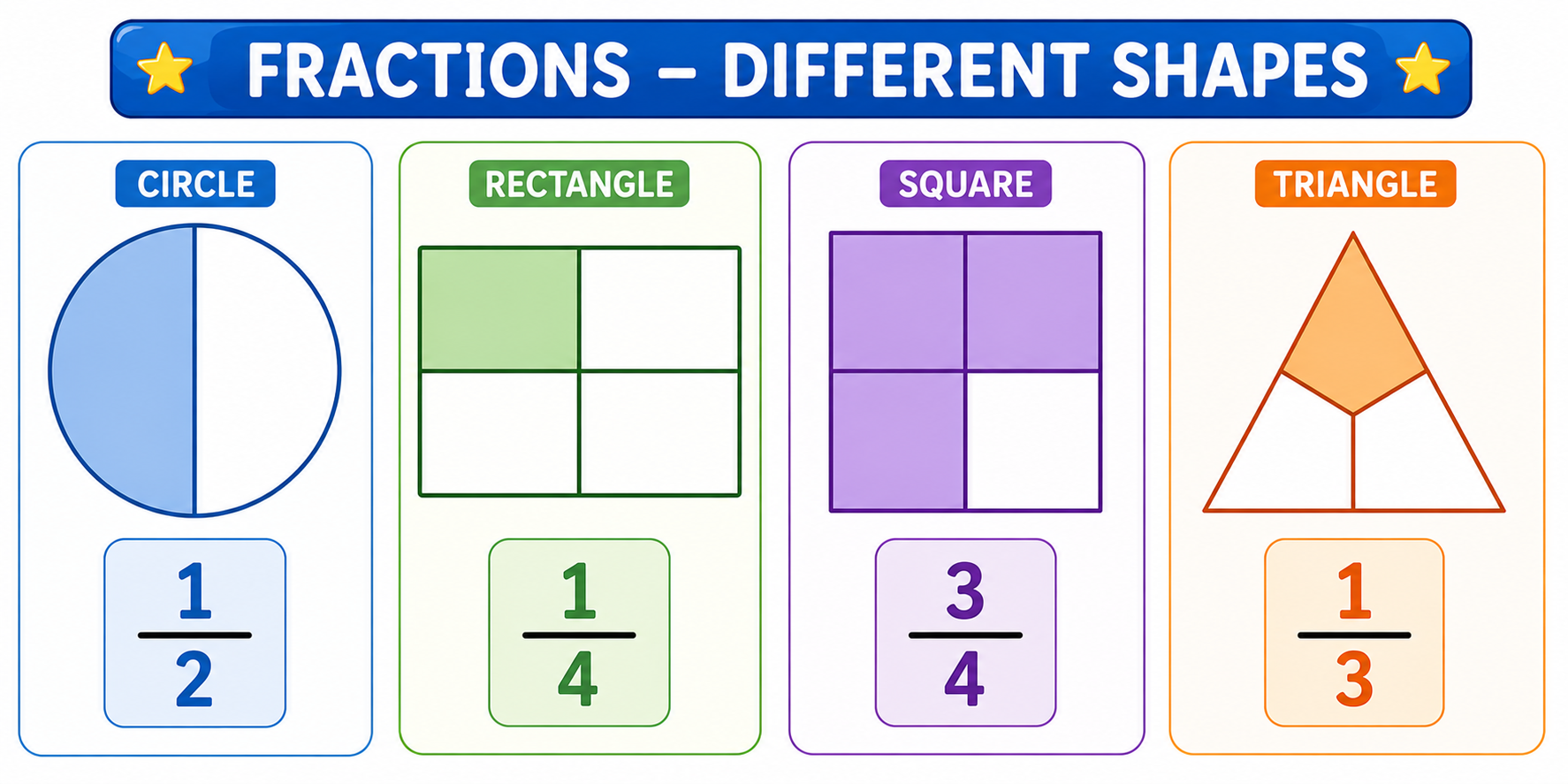
A fraction tells us how many equal parts of a whole we are talking about. When we divide something into equal parts and take some of those parts, we get a fraction.
For example, if a cake is cut into 4 equal pieces and you eat 1 piece, you have eaten ¼ (one-quarter) of the cake. The remaining cake is ¾ (three-quarters).
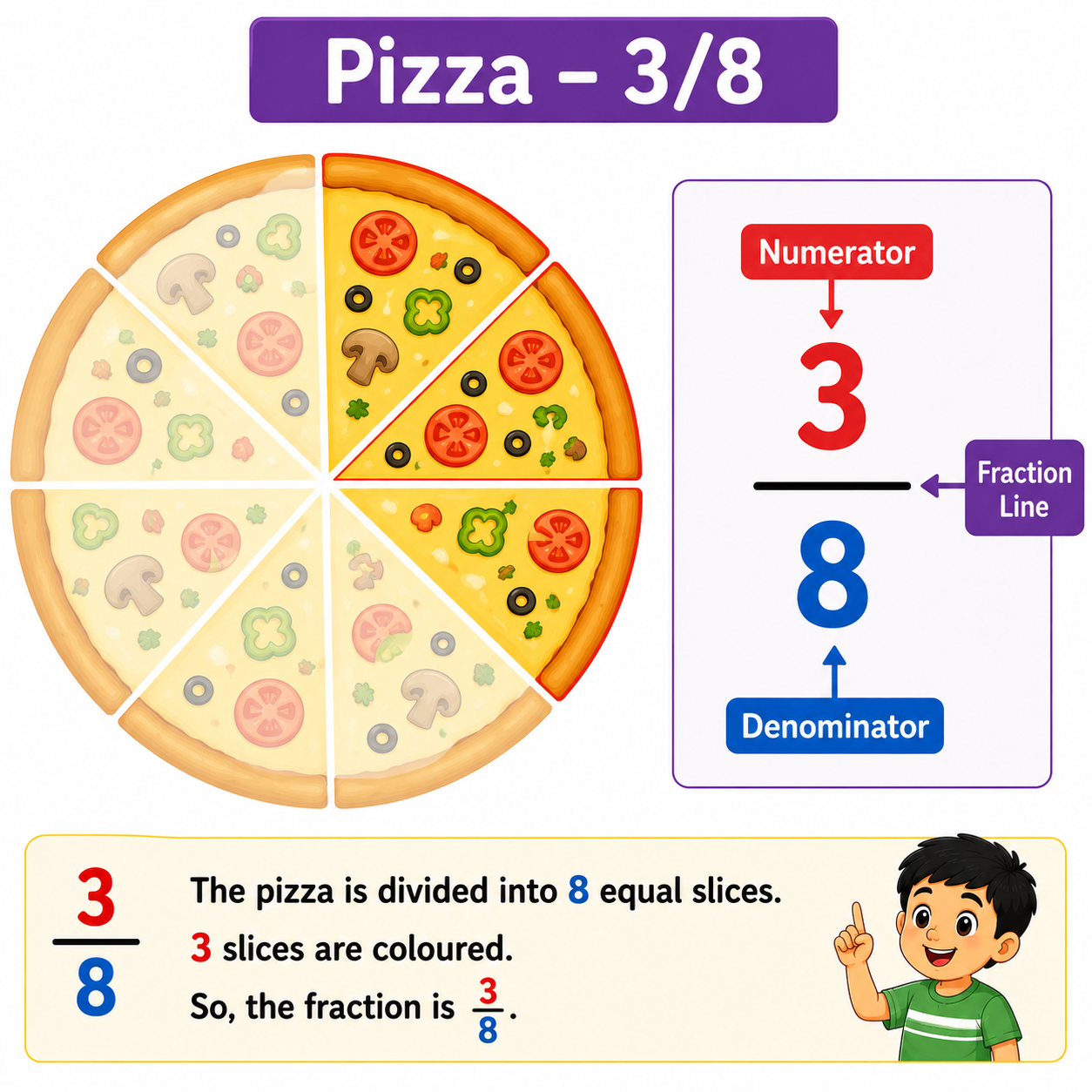
Numerator and Denominator
Every fraction has two numbers separated by a line:
| 3 | ← Numerator (top number) — tells how many parts we have taken |
| 4 | ← Denominator (bottom number) — tells how many equal parts the whole is divided into |
So in the fraction ¾:
- Numerator = 3 → We have taken 3 parts.
- Denominator = 4 → The whole was divided into 4 equal parts.
½ → Numerator = 1, Denominator = 2 (1 part out of 2 equal parts)
3/8 → Numerator = 3, Denominator = 8 (3 parts out of 8 equal parts)
5/6 → Numerator = 5, Denominator = 6 (5 parts out of 6 equal parts)
Types of Fractions
1. Unit Fractions
A fraction with 1 as the numerator is called a unit fraction. It means we have taken exactly one part out of the whole.
Examples: ½, ⅓, ¼, ⅕, ⅙, ⅛
2. Proper Fractions
A fraction where the numerator is less than the denominator is called a proper fraction. It is always less than 1 whole.
Examples: ½, ⅔, ¾, 3/5, 5/8, 7/10
In all these fractions, the top number is smaller than the bottom number.
4/7 → Yes (4 < 7) ✓
5/5 → No (5 = 5, this equals 1 whole)
2/9 → Yes (2 < 9) ✓
Fractions of a Collection
We can also find a fraction of a group of objects. To find a fraction of a collection, we divide the total number of objects by the denominator, then multiply by the numerator.
Step 1: Divide 12 by 3 (the denominator) → 12 ÷ 3 = 4
Step 2: Multiply by 1 (the numerator) → 4 × 1 = 4
Answer: ⅓ of 12 = 4 laddoos
Step 1: 20 ÷ 4 = 5
Step 2: 5 × 1 = 5
Answer: ¼ of 20 = 5 mangoes
Step 1: 15 ÷ 5 = 3
Step 2: 3 × 2 = 6
Answer: 2/5 of 15 = 6 pencils
Comparing Like Fractions
Like fractions are fractions that have the same denominator (same number of equal parts).
To compare like fractions, we simply compare their numerators. The fraction with the bigger numerator is the bigger fraction.
Both fractions have denominator 7 (like fractions).
Compare numerators: 3 and 5. Since 5 > 3, we get 5/7 > 3/7.
All have denominator 9. Compare numerators: 1, 2, 4, 7.
Ascending order: 1/9 < 2/9 < 4/9 < 7/9
Rule for like fractions:
- If numerator of first fraction > numerator of second fraction → first fraction is greater.
- If numerators are equal → the fractions are equal.
Equivalent Fractions
Equivalent fractions are fractions that look different but represent the same value.
If you cut a roti into 2 equal parts and take 1 part, you get ½. If you cut the same roti into 4 equal parts and take 2 parts, you get 2/4. Both are the same amount!
½ = 2/4 = 3/6 = 4/8 — all these are equivalent fractions.
Multiply (or divide) both the numerator and denominator by the same number.
½ → multiply both by 2 → 2/4
½ → multiply both by 3 → 3/6
⅔ → multiply both by 2 → 4/6
⅔ → multiply both by 3 → 6/9
Key Words
| Word | Meaning |
|---|---|
| Fraction | A part of a whole, written as one number over another (e.g., ¾) |
| Numerator | The top number — tells how many parts are taken |
| Denominator | The bottom number — tells how many equal parts the whole is divided into |
| Unit Fraction | A fraction with 1 as the numerator (e.g., ½, ⅓, ¼) |
| Proper Fraction | A fraction where the numerator is less than the denominator |
| Like Fractions | Fractions with the same denominator (e.g., 2/7 and 5/7) |
| Equivalent Fractions | Fractions that have the same value (e.g., ½ = 2/4) |
| Whole | The complete object or group before it is divided |
| Equal Parts | Parts that are exactly the same size |
| Collection | A group of objects (e.g., 12 laddoos, 20 mangoes) |
- A fraction represents equal parts of a whole or a collection.
- The numerator (top) tells how many parts are taken; the denominator (bottom) tells total equal parts.
- A unit fraction always has 1 as the numerator (½, ⅓, ¼, ⅕…).
- In a proper fraction, the numerator is always less than the denominator.
- To find a fraction of a collection: divide by the denominator, then multiply by the numerator.
- To compare like fractions (same denominator), compare the numerators — bigger numerator means bigger fraction.
- Equivalent fractions have the same value. Multiply or divide both numerator and denominator by the same number.
- The parts must be equal for a fraction to be valid.
Finished learning? Now test what you know!