Division
Learning Objectives
- Understand division as equal sharing and grouping.
- Learn division as repeated subtraction.
- Know division facts from multiplication tables (2 to 10).
- Perform long division of 2-digit numbers by 1-digit numbers.
- Understand division with remainder.
- Check division answers using the formula: Quotient × Divisor + Remainder = Dividend.
What is Division?
Aarav has 12 laddoos. He wants to share them equally among 4 friends. How many laddoos will each friend get? To find out, we divide: 12 ÷ 4 = 3. Each friend gets 3 laddoos.
Division means splitting a number into equal parts. It is the opposite of multiplication. If 4 × 3 = 12, then 12 ÷ 4 = 3.
We can think of division in two ways:
- Equal Sharing: Distributing items equally among a given number of groups. (How many in each group?)
- Grouping: Making groups of a given size from a collection. (How many groups can we make?)
Division as Equal Sharing
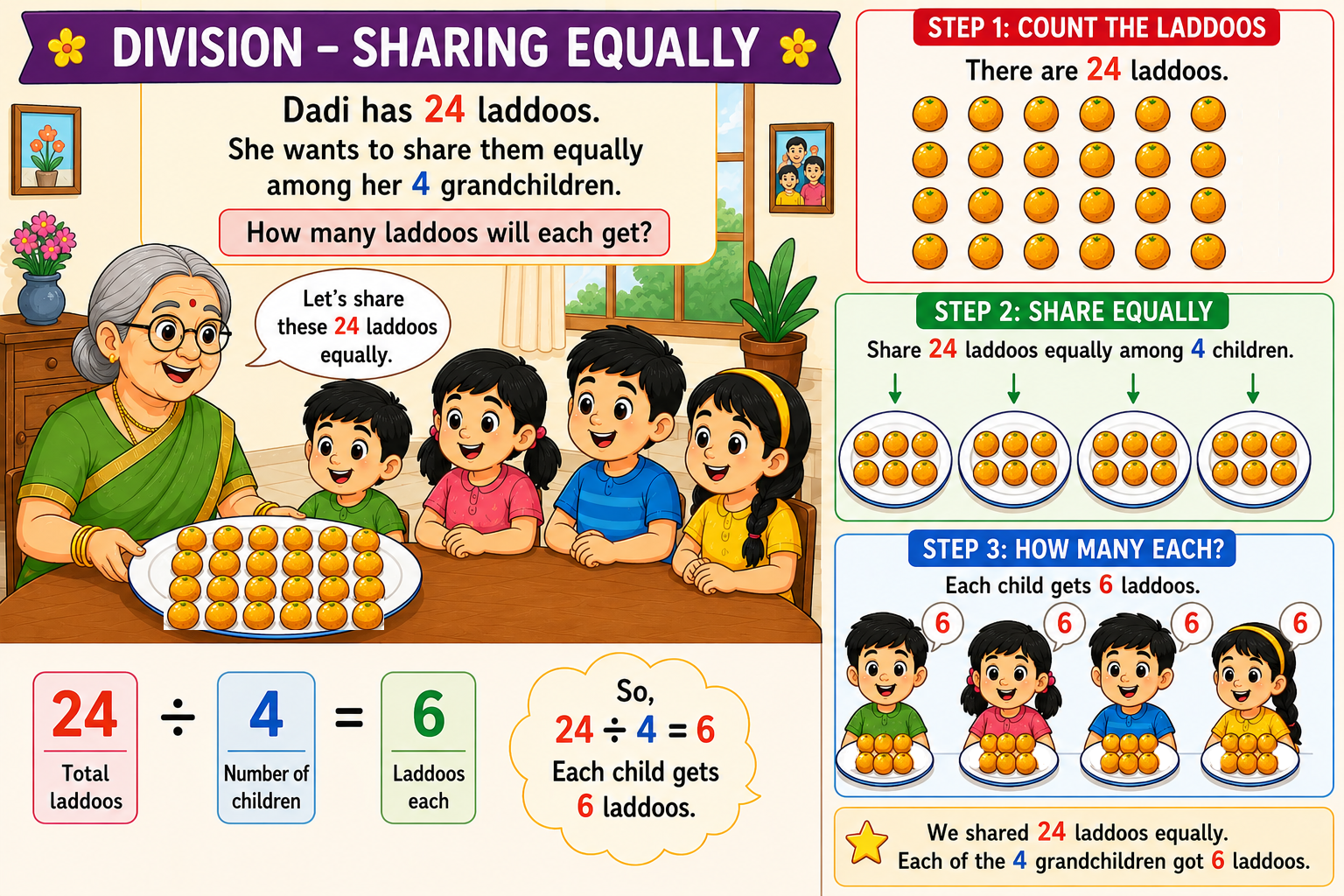
When we share things equally, we use division.
Priya made 20 laddoos for Diwali. She wants to pack them equally into 5 boxes. How many laddoos in each box?
Solution: 20 ÷ 5 = 4. Each box will have 4 laddoos.
A teacher has 24 notebooks to distribute equally among 6 students. How many notebooks does each student get?
Solution: 24 ÷ 6 = 4. Each student gets 4 notebooks.
Division as Grouping
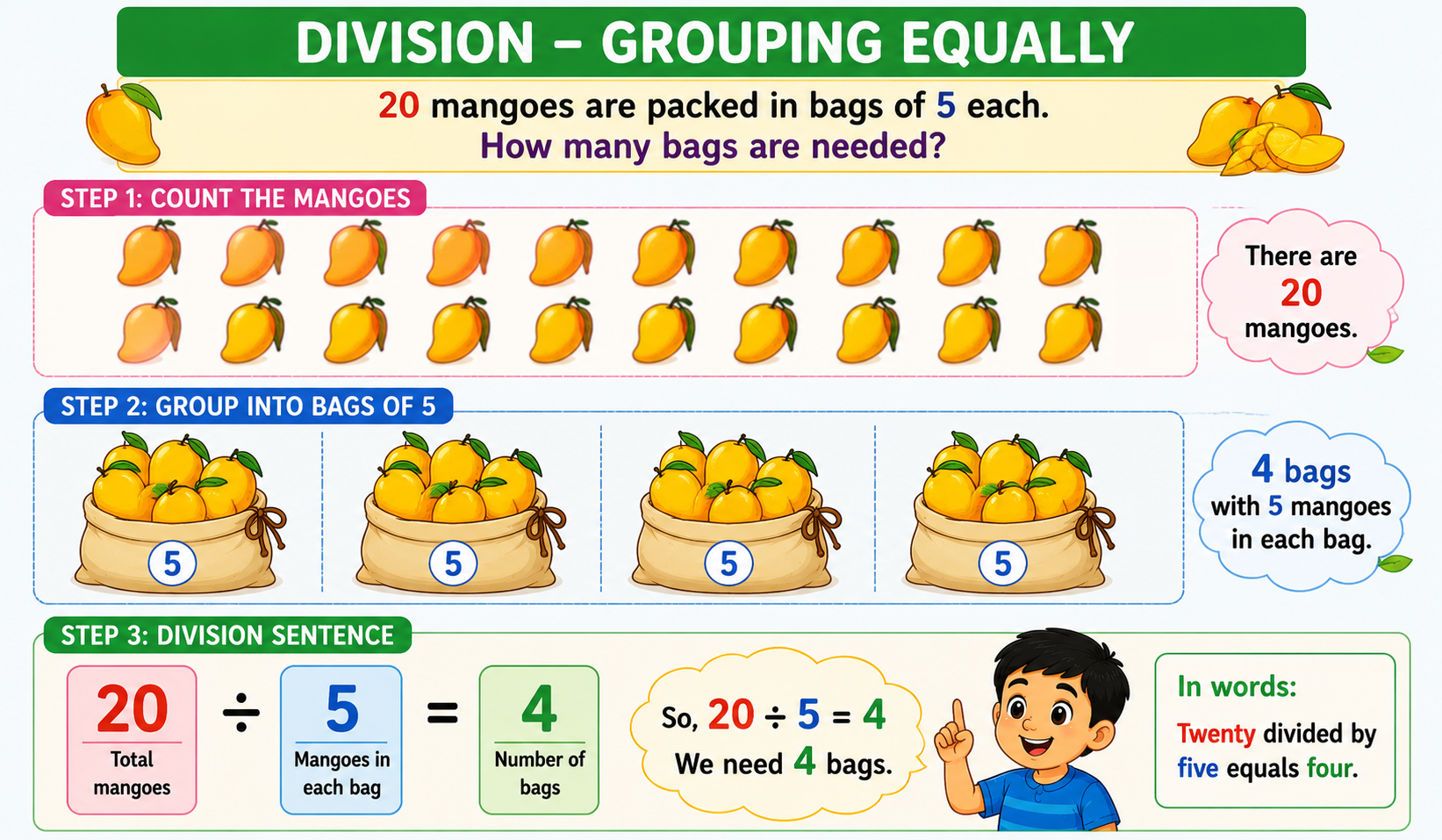
Sometimes we know the size of each group and want to find how many groups we can make.
There are 18 children in a class. The teacher wants to make teams of 3. How many teams can be formed?
Solution: 18 ÷ 3 = 6. The teacher can make 6 teams.
A fruit seller has 30 mangoes. He puts 5 mangoes in each bag. How many bags does he need?
Solution: 30 ÷ 5 = 6. He needs 6 bags.
Division as Repeated Subtraction
Division can also be understood as repeated subtraction. We keep subtracting the divisor from the dividend until we reach 0 (or a number smaller than the divisor). The number of times we subtract is the quotient.
15 − 3 = 12 (subtracted 1 time)
12 − 3 = 9 (subtracted 2 times)
9 − 3 = 6 (subtracted 3 times)
6 − 3 = 3 (subtracted 4 times)
3 − 3 = 0 (subtracted 5 times)
We subtracted 3 a total of 5 times. So, 15 ÷ 3 = 5.
20 − 4 = 16 → 16 − 4 = 12 → 12 − 4 = 8 → 8 − 4 = 4 → 4 − 4 = 0
We subtracted 4 a total of 5 times. So, 20 ÷ 4 = 5.
Division Facts from Multiplication Tables
Every multiplication fact gives us two division facts. If you know your tables, you can divide quickly!
| Multiplication Fact | Division Fact 1 | Division Fact 2 |
|---|---|---|
| 3 × 4 = 12 | 12 ÷ 3 = 4 | 12 ÷ 4 = 3 |
| 5 × 6 = 30 | 30 ÷ 5 = 6 | 30 ÷ 6 = 5 |
| 7 × 8 = 56 | 56 ÷ 7 = 8 | 56 ÷ 8 = 7 |
| 9 × 4 = 36 | 36 ÷ 9 = 4 | 36 ÷ 4 = 9 |
| 6 × 7 = 42 | 42 ÷ 6 = 7 | 42 ÷ 7 = 6 |
| 8 × 9 = 72 | 72 ÷ 8 = 9 | 72 ÷ 9 = 8 |
Special Division Rules:
- Any number ÷ 1 = the same number. (Example: 25 ÷ 1 = 25)
- Any number ÷ itself = 1. (Example: 7 ÷ 7 = 1)
- 0 ÷ any number = 0. (Example: 0 ÷ 5 = 0)
- We can never divide by 0. (Example: 8 ÷ 0 is not possible!)
Long Division (2-digit ÷ 1-digit)
For bigger numbers, we use long division. Let us learn the steps: Divide → Multiply → Subtract → Bring Down.
| Long Division | ||
|---|---|---|
|
2 1 4 ) 8 4 −8 ↓ 0 4 −4 0 |
Step 1: Divide the tens digit. 8 ÷ 4 = 2. Write 2 in the quotient (tens place).
Step 2: Multiply. 2 × 4 = 8. Write 8 below 8.
Step 3: Subtract. 8 − 8 = 0.
Step 4: Bring down the ones digit (4). Now divide 4 ÷ 4 = 1. Write 1 in the quotient.
Step 5: Multiply. 1 × 4 = 4. Subtract. 4 − 4 = 0. Remainder = 0.
Answer: 84 ÷ 4 = 21
Long Division: Another Example
| Long Division | ||
|---|---|---|
|
3 2 3 ) 9 6 −9 ↓ 0 6 −6 0 |
Step 1: Divide tens. 9 ÷ 3 = 3. Write 3 in quotient.
Step 2: Multiply. 3 × 3 = 9. Subtract. 9 − 9 = 0.
Step 3: Bring down 6. Divide 6 ÷ 3 = 2. Write 2 in quotient.
Step 4: Multiply. 2 × 3 = 6. Subtract. 6 − 6 = 0. Remainder = 0.
Answer: 96 ÷ 3 = 32
Tens: 7 ÷ 5 = 1 (remainder 2). Multiply: 1 × 5 = 5. Subtract: 7 − 5 = 2. Bring down 5 → 25. Divide: 25 ÷ 5 = 5. Multiply: 5 × 5 = 25. Subtract: 25 − 25 = 0.
Answer: 75 ÷ 5 = 15
Division with Remainder
Sometimes a number does not divide exactly. The amount left over is called the remainder.
How many times does 5 go into 17? → 5 × 3 = 15 (fits). 5 × 4 = 20 (too big!).
So, Quotient = 3. Remainder = 17 − 15 = 2.
Answer: 17 ÷ 5 = 3 remainder 2
We write: 17 = 5 × 3 + 2
4 × 5 = 20 (fits). 4 × 6 = 24 (too big!).
Quotient = 5. Remainder = 23 − 20 = 3.
Answer: 23 ÷ 4 = 5 remainder 3
6 × 7 = 42 (fits). 6 × 8 = 48 (too big!).
Quotient = 7. Remainder = 47 − 42 = 5.
Answer: 47 ÷ 6 = 7 remainder 5
Checking Division
We can always check if our division answer is correct using this formula:
Quotient = 21, Divisor = 4, Remainder = 0
Check: 21 × 4 + 0 = 84 ✓ Correct!
Quotient = 3, Divisor = 5, Remainder = 2
Check: 3 × 5 + 2 = 15 + 2 = 17 ✓ Correct!
Quotient = 7, Divisor = 6, Remainder = 5
Check: 7 × 6 + 5 = 42 + 5 = 47 ✓ Correct!
Word Problems (Indian Context)
Meena's mother made 36 gulab jamuns for a party. She wants to serve them equally on 9 plates. How many gulab jamuns on each plate?
Solution: 36 ÷ 9 = 4. Each plate will have 4 gulab jamuns.
The school library received 72 new books. The librarian wants to place them equally on 8 shelves. How many books on each shelf?
Solution: 72 ÷ 8 = 9. Each shelf will have 9 books.
Arjun's grandfather gave ₹45 to be shared equally among 5 grandchildren. How much does each grandchild get?
Solution: ₹45 ÷ 5 = ₹9. Each grandchild gets ₹9.
A shopkeeper has 50 pencils. He packs them in bundles of 6. How many full bundles can he make? How many pencils are left over?
Solution: 50 ÷ 6 = 8 remainder 2. He can make 8 full bundles with 2 pencils left over.
For the school assembly, 63 chairs need to be arranged in 7 equal rows. How many chairs in each row?
Solution: 63 ÷ 7 = 9. Each row will have 9 chairs.
Key Words
| Word | Meaning |
|---|---|
| Division | Splitting a number into equal parts or groups |
| Dividend | The number being divided (the total) |
| Divisor | The number we divide by (number of groups or size of each group) |
| Quotient | The answer we get after dividing |
| Remainder | The amount left over when division is not exact |
| Equal Sharing | Distributing items equally among groups |
| Grouping | Making groups of a fixed size from a collection |
| Repeated Subtraction | Subtracting the divisor again and again until we reach 0 or less than the divisor |
| Long Division | A step-by-step method to divide larger numbers (Divide → Multiply → Subtract → Bring Down) |
| Inverse Operation | Division is the inverse (opposite) of multiplication |
- Division means sharing equally or making equal groups.
- Division is the opposite of multiplication. If a × b = c, then c ÷ a = b and c ÷ b = a.
- In long division, follow: Divide → Multiply → Subtract → Bring Down.
- The remainder is always less than the divisor.
- To check: Quotient × Divisor + Remainder = Dividend.
- Any number ÷ 1 = the same number. Any number ÷ itself = 1.
- 0 ÷ any number = 0. We can never divide by 0.
Finished learning? Now test what you know!