Time
Learning Objectives
- Read time on a clock using the hour hand and minute hand.
- Tell time as o'clock, half past, quarter past, and quarter to.
- Understand the difference between AM and PM (12-hour clock).
- Calculate duration or elapsed time (how long something takes).
- Know the days of the week, months of the year, and their order.
- Solve word problems related to school timetables, train timings, and daily routines.
Introduction
Time helps us plan our day. We wake up at a certain time, go to school, eat lunch, play, and sleep — all at different times. A clock helps us read the time.
In India, school usually starts at 8:00 AM and ends at 2:00 PM. Trains run on a fixed timetable. Knowing how to read time helps us be punctual and plan our activities.
Let us learn how to read a clock, understand AM and PM, and calculate how long activities take!
Reading a Clock
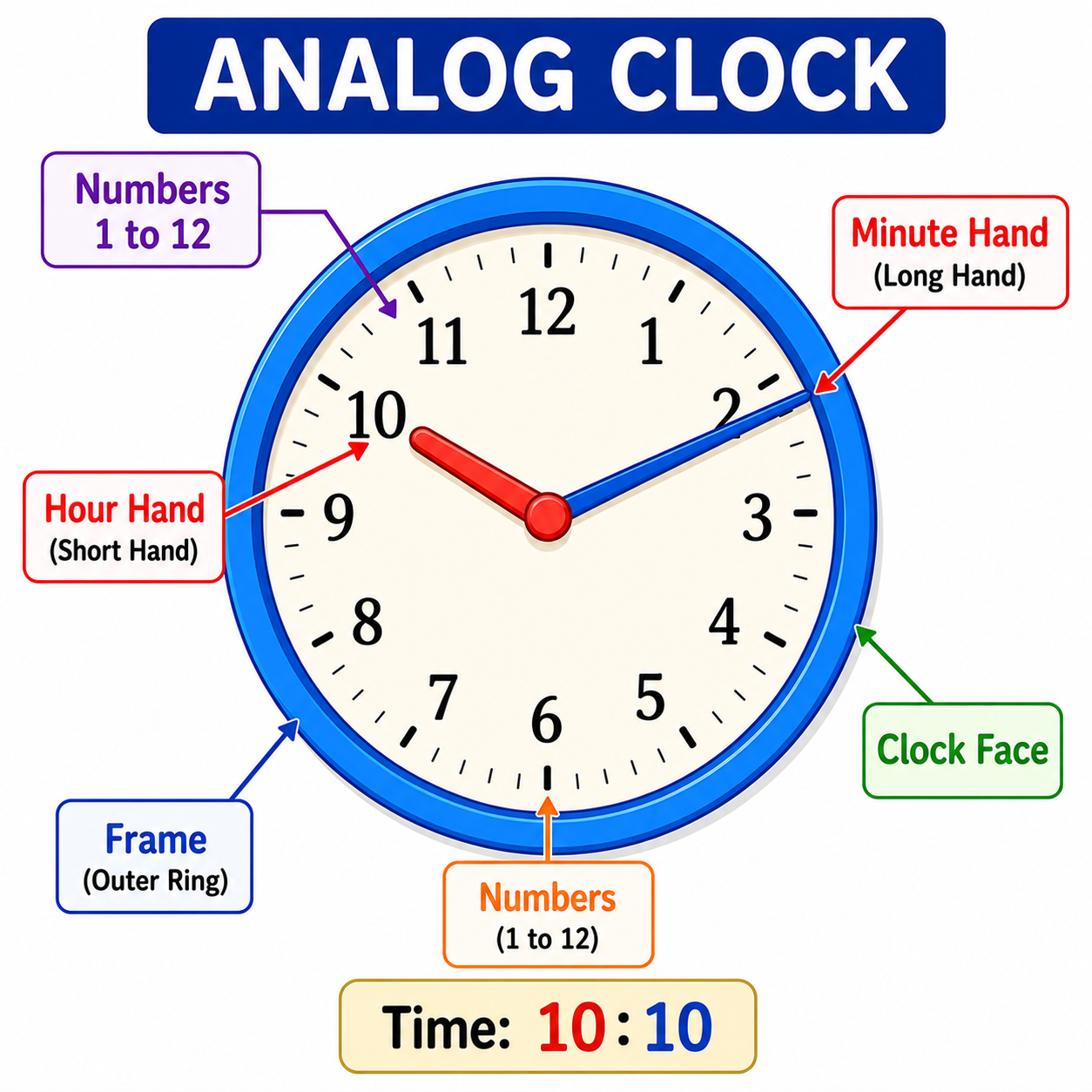
A clock has two main hands:
| Hand | What It Shows | How to Identify |
|---|---|---|
| Hour Hand (short hand) | The hour (1 to 12) | It is shorter and thicker |
| Minute Hand (long hand) | The minutes (0 to 60) | It is longer and thinner |
The clock face has numbers from 1 to 12 arranged in a circle. The minute hand moves faster — it goes around the clock once every hour. The hour hand moves slowly — it takes 12 hours to go around once.
Important: There are 60 minutes in 1 hour. Each number on the clock represents 5 minutes for the minute hand (5, 10, 15, 20, 25, 30, 35, 40, 45, 50, 55, 60).
Telling Time: O'Clock, Half Past, Quarter Past, Quarter To
O'Clock (Exact Hour)
When the minute hand points to 12 and the hour hand points to a number, we say it is that number o'clock.
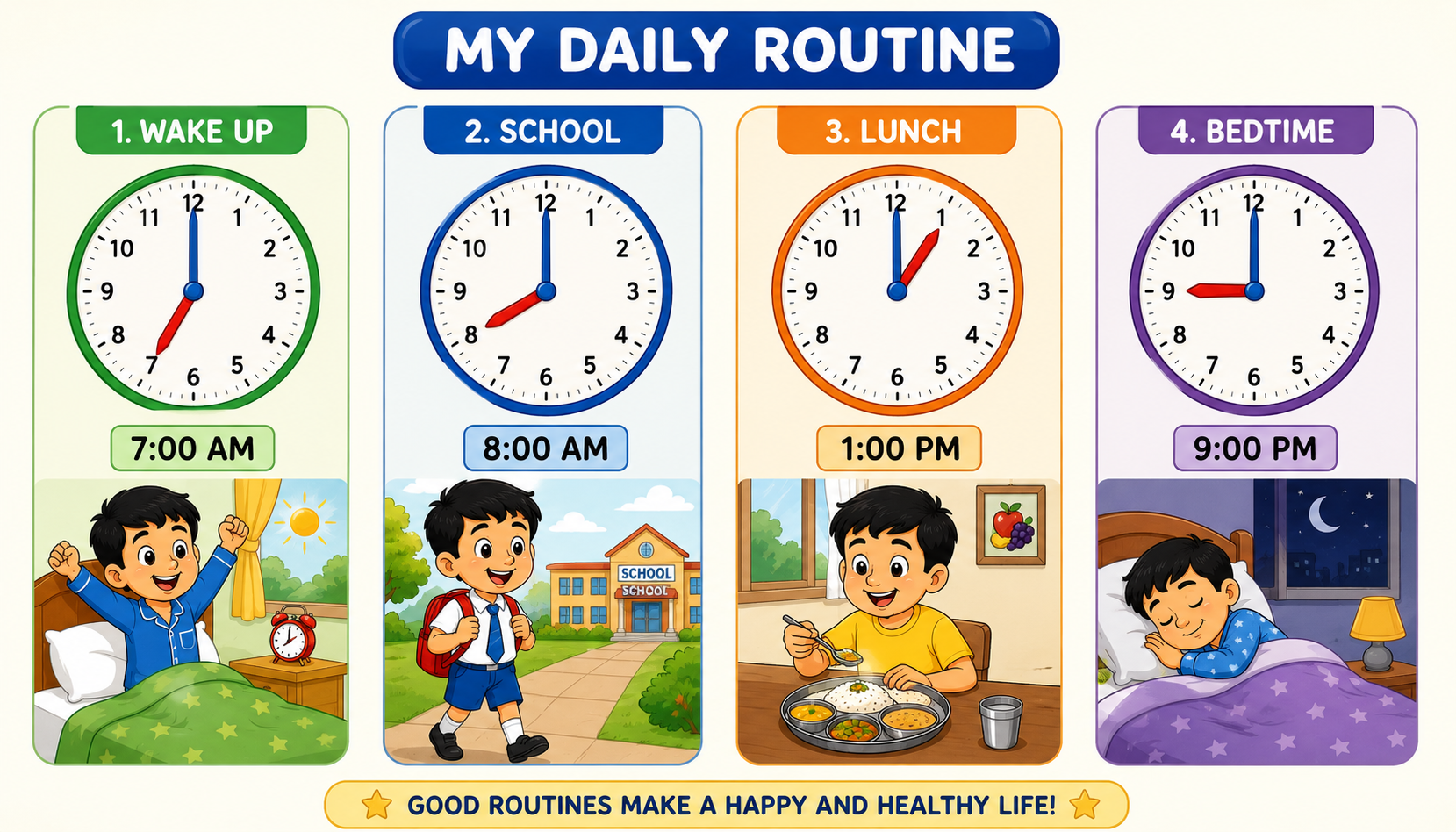
Hour hand on 8, minute hand on 12 → 8 o'clock (school starts!)
Hour hand on 2, minute hand on 12 → 2 o'clock (school ends!)
Hour hand on 7, minute hand on 12 → 7 o'clock (wake up time)
Half Past (30 minutes)
When the minute hand points to 6, it means 30 minutes have passed. We say "half past" the hour.
Hour hand between 8 and 9, minute hand on 6 → Half past 8 (8:30) — Assembly time!
Hour hand between 12 and 1, minute hand on 6 → Half past 12 (12:30) — Lunch break!
Quarter Past (15 minutes)
When the minute hand points to 3, it means 15 minutes have passed. We say "quarter past" the hour.
Hour hand just past 9, minute hand on 3 → Quarter past 9 (9:15)
Hour hand just past 4, minute hand on 3 → Quarter past 4 (4:15) — Snack time!
Quarter To (45 minutes)
When the minute hand points to 9, it means 45 minutes have passed (or 15 minutes are left for the next hour). We say "quarter to" the next hour.
Minute hand on 9, hour hand almost at 8 → Quarter to 8 (7:45) — Get ready for school!
Minute hand on 9, hour hand almost at 1 → Quarter to 1 (12:45)
AM and PM — The 12-Hour Clock
A day has 24 hours, but a clock only shows 12 numbers. So the clock goes around twice in one day. To tell which half of the day we mean, we use AM and PM.
| Term | Full Form | Time Period | Examples |
|---|---|---|---|
| AM | Ante Meridiem (before noon) | 12:00 midnight to 11:59 in the morning | 7:00 AM (wake up), 8:00 AM (school starts), 10:30 AM (break time) |
| PM | Post Meridiem (after noon) | 12:00 noon to 11:59 at night | 12:30 PM (lunch), 2:00 PM (school ends), 9:00 PM (bedtime) |
Arjun's Daily Routine (Indian Context)
| Time | Activity | AM or PM? |
|---|---|---|
| 6:30 | Wake up | AM |
| 7:00 | Brush teeth, bath | AM |
| 7:30 | Breakfast (poha/idli) | AM |
| 8:00 | School starts | AM |
| 10:30 | Tiffin break | AM |
| 12:30 | Lunch break | PM |
| 2:00 | School ends | PM |
| 4:00 | Play time / Games | PM |
| 6:00 | Homework | PM |
| 8:00 | Dinner | PM |
| 9:00 | Bedtime | PM |
Duration / Elapsed Time
Elapsed time means how long something takes — the time between the start and the end of an activity.
Formula: Elapsed Time = End Time − Start Time
School starts at 8:00 AM and ends at 2:00 PM.
From 8:00 AM to 2:00 PM = 6 hours. So school lasts 6 hours.
Maths class starts at 9:00 AM and ends at 9:45 AM.
From 9:00 to 9:45 = 45 minutes. The maths class is 45 minutes long.
The Rajdhani Express leaves Delhi at 4:30 PM and reaches Jaipur at 7:00 PM.
From 4:30 PM to 7:00 PM: 4:30 to 5:00 = 30 min, 5:00 to 7:00 = 2 hours. Total = 2 hours 30 minutes.
Meena's mother started cooking at 6:15 PM and finished at 7:00 PM.
From 6:15 to 7:00 = 45 minutes.
Days, Weeks, Months, and Year
Days of the Week (7 days)
| # | Day | Hindi Name |
|---|---|---|
| 1 | Monday | सोमवार (Somvaar) |
| 2 | Tuesday | मंगलवार (Mangalvaar) |
| 3 | Wednesday | बुधवार (Budhvaar) |
| 4 | Thursday | गुरुवार (Guruvaar) |
| 5 | Friday | शुक्रवार (Shukravaar) |
| 6 | Saturday | शनिवार (Shanivaar) |
| 7 | Sunday | रविवार (Ravivaar) |
Remember: 1 week = 7 days. Most Indian schools have classes from Monday to Saturday (half day on Saturday).
Months of the Year (12 months)
| # | Month | Days | Special Events (India) |
|---|---|---|---|
| 1 | January | 31 | Republic Day (26 Jan) |
| 2 | February | 28 or 29 | Basant Panchami |
| 3 | March | 31 | Holi, Exams |
| 4 | April | 30 | New session starts |
| 5 | May | 31 | Summer vacation |
| 6 | June | 30 | School reopens |
| 7 | July | 31 | Monsoon begins |
| 8 | August | 31 | Independence Day (15 Aug) |
| 9 | September | 30 | Teachers' Day (5 Sep) |
| 10 | October | 31 | Gandhi Jayanti (2 Oct), Dussehra |
| 11 | November | 30 | Diwali, Children's Day (14 Nov) |
| 12 | December | 31 | Christmas, Winter vacation |
Key Facts:
- 1 year = 12 months = 365 days (366 in a leap year)
- February has 28 days normally, 29 days in a leap year
- Months with 30 days: April, June, September, November
- Months with 31 days: January, March, May, July, August, October, December
Word Problems (Indian Context)
Ravi's school starts at 8:00 AM. The first period is 45 minutes long. At what time does the first period end?
Solution: 8:00 AM + 45 minutes = 8:45 AM.
The Shatabdi Express departs from New Delhi at 6:15 AM and arrives in Agra at 8:10 AM. How long is the journey?
Solution: From 6:15 to 7:15 = 1 hour. From 7:15 to 8:10 = 55 minutes. Total = 1 hour 55 minutes.
Anita wakes up at 6:30 AM. She takes 30 minutes to get ready and 15 minutes for breakfast. At what time does she leave for school?
Solution: 6:30 + 30 min = 7:00 AM (ready). 7:00 + 15 min = 7:15 AM (leaves for school).
A cricket match started at 2:00 PM and ended at 5:30 PM. How long did the match last?
Solution: From 2:00 PM to 5:00 PM = 3 hours. From 5:00 to 5:30 = 30 minutes. Total = 3 hours 30 minutes.
Priya started her homework at 5:15 PM and finished at 6:45 PM. How long did she study?
Solution: From 5:15 to 6:15 = 1 hour. From 6:15 to 6:45 = 30 minutes. Total = 1 hour 30 minutes.
Key Words
| Word | Meaning |
|---|---|
| Hour Hand | The short hand on a clock that shows the hour |
| Minute Hand | The long hand on a clock that shows the minutes |
| O'Clock | Exact hour — minute hand points to 12 |
| Half Past | 30 minutes past the hour — minute hand points to 6 |
| Quarter Past | 15 minutes past the hour — minute hand points to 3 |
| Quarter To | 15 minutes before the next hour — minute hand points to 9 |
| AM (Ante Meridiem) | Time from midnight (12:00) to just before noon (11:59) |
| PM (Post Meridiem) | Time from noon (12:00) to just before midnight (11:59) |
| Elapsed Time | The amount of time that passes between a start time and end time |
| Duration | How long an activity or event lasts |
- A clock has 12 numbers. The short hand shows hours, the long hand shows minutes.
- 1 hour = 60 minutes. Each number on the clock = 5 minutes for the minute hand.
- O'clock → minute hand on 12. Half past → minute hand on 6. Quarter past → on 3. Quarter to → on 9.
- AM = midnight to noon. PM = noon to midnight.
- Elapsed time = End time − Start time. Count hours first, then minutes.
- 1 week = 7 days. 1 year = 12 months = 365 days (366 in leap year).
- February has 28 days (29 in a leap year). April, June, September, November have 30 days. The rest have 31.
Finished learning? Now test what you know!