Patterns
Learning Objectives
- Understand what a pattern is and identify the rule behind it.
- Identify, extend, and create shape patterns (repeating and rotating).
- Recognise and continue number patterns (addition, subtraction, multiplication).
- Understand growing patterns where amounts increase step by step.
- Identify symmetry patterns and mirror images in shapes and designs.
- Spot patterns in multiplication tables.
- Relate patterns to Indian art forms — rangoli, kolam, mehndi, and saree borders.
Introduction
Have you ever looked closely at a rangoli design during Diwali? Or noticed the beautiful border on your mother's saree? These designs have something special — they follow a pattern!
A pattern is an arrangement of shapes, numbers, or colours that repeats following a fixed rule. Once you know the rule, you can predict what comes next. Patterns are everywhere — in nature (petals of a sunflower), in music (rhythm of a tabla), in art (mehndi designs), and in mathematics (multiplication tables).
In Class 3, we will explore different types of patterns — shape patterns, colour patterns, number patterns, growing patterns, and symmetry patterns. We will also discover how Indian art uses mathematical patterns beautifully!
What is a Pattern?
A pattern is something that repeats in the same order, following a fixed rule. The part that repeats is called the core (or unit) of the pattern.
Example: Clap, Clap, Stomp, Clap, Clap, Stomp — The core is "Clap, Clap, Stomp".
Example: 5, 10, 15, 20, 25 — The rule is "Add 5 each time".
How to find the rule:
- Look at what repeats or what changes from one step to the next.
- Ask: "What is the same? What is different?"
- Check if your rule works for every part of the pattern.
Shape Patterns (Repeating Patterns)
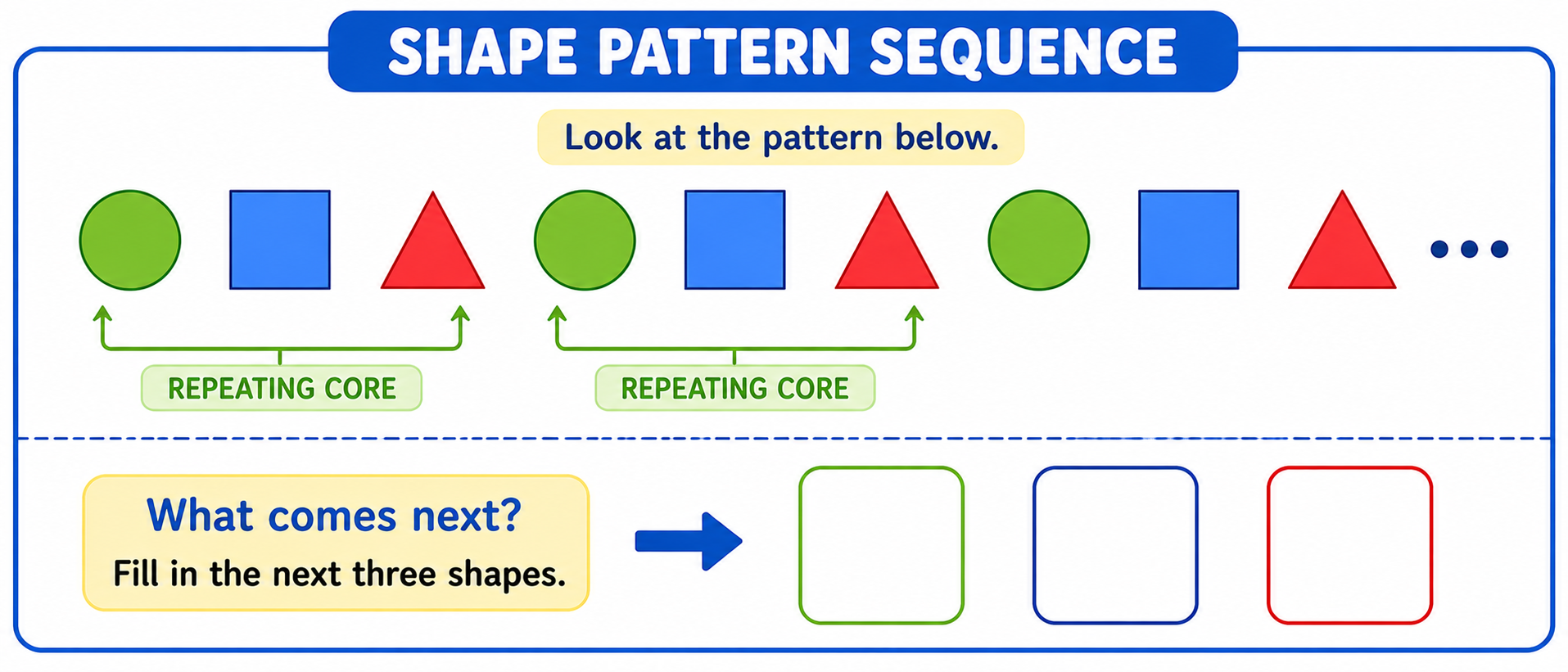
In a shape pattern, shapes repeat in the same order again and again. The group of shapes that repeats is called the core.
Core: Circle, Square, Triangle (3 shapes repeat). Next shape: Circle
Example 2: □ □ ○ □ □ ○ □ □ ○ ...
Core: Square, Square, Circle (group of 3 repeats). Next: Square, Square
Example 3: △ ○ ○ △ ○ ○ △ ○ ○ ...
Core: Triangle, Circle, Circle. Next: Triangle
Tips to identify shape patterns:
- Count how many shapes are in the repeating group (core).
- Check if the same group appears again and again.
- Use the core to predict what comes next.
Colour Patterns
In a colour pattern, colours repeat in a fixed order. These are very common in Indian art!
Core: Red, Blue (AB pattern). Next colour: Red
Example 2: Red, Yellow, Green, Red, Yellow, Green ...
Core: Red, Yellow, Green (ABC pattern). Next: Red
Example 3: Orange, Orange, White, Green, Orange, Orange, White, Green ...
Core: Orange, Orange, White, Green (AABC pattern — like the Indian flag colours!). Next: Orange
Real-life colour patterns:
- Bangles: Red, Green, Red, Green — alternating colours on a bangle set.
- Rangoli: White, Red, Yellow, White, Red, Yellow — colours in rangoli powder designs.
- Saree borders: Gold, Maroon, Gold, Maroon — repeating border patterns.
- Traffic lights: Red, Yellow, Green — a fixed colour sequence.
Number Patterns
In a number pattern, numbers follow a rule. The rule tells us what operation to do to get the next number.
Adding Patterns (Increasing)
| Pattern | Rule | Next 3 Numbers |
|---|---|---|
| 2, 4, 6, 8, 10, ... | Add 2 | 12, 14, 16 |
| 5, 10, 15, 20, 25, ... | Add 5 | 30, 35, 40 |
| 3, 6, 9, 12, 15, ... | Add 3 | 18, 21, 24 |
| 7, 14, 21, 28, 35, ... | Add 7 | 42, 49, 56 |
| 10, 20, 30, 40, 50, ... | Add 10 | 60, 70, 80 |
| 4, 8, 12, 16, 20, ... | Add 4 | 24, 28, 32 |
Subtracting Patterns (Decreasing)
| Pattern | Rule | Next 3 Numbers |
|---|---|---|
| 50, 45, 40, 35, 30, ... | Subtract 5 | 25, 20, 15 |
| 100, 90, 80, 70, 60, ... | Subtract 10 | 50, 40, 30 |
| 30, 27, 24, 21, 18, ... | Subtract 3 | 15, 12, 9 |
| 40, 36, 32, 28, 24, ... | Subtract 4 | 20, 16, 12 |
Pattern: 8, 15, 22, 29, 36, ...
Step 1: Find the difference: 15 − 8 = 7, 22 − 15 = 7, 29 − 22 = 7
Step 2: The difference is always 7. Rule: Add 7
Step 3: Next number: 36 + 7 = 43
Growing Patterns
A growing pattern is a pattern where the amount increases (grows) at each step. Unlike repeating patterns, growing patterns do not repeat the same group — they get bigger!
Step 1: ● (1 dot)
Step 2: ● ● ● (3 dots)
Step 3: ● ● ● ● ● (5 dots)
Step 4: ● ● ● ● ● ● ● (7 dots)
Rule: Add 2 more dots each time. Numbers: 1, 3, 5, 7, 9, ...
Example 2 — Square Pattern:
Step 1: 1 square
Step 2: 4 squares (2×2)
Step 3: 9 squares (3×3)
Step 4: 16 squares (4×4)
Rule: Square numbers! 1, 4, 9, 16, 25, ...
Example 3 — Staircase Pattern:
Step 1: 1 block
Step 2: 1 + 2 = 3 blocks
Step 3: 1 + 2 + 3 = 6 blocks
Step 4: 1 + 2 + 3 + 4 = 10 blocks
Rule: Add one more row each time. Numbers: 1, 3, 6, 10, 15, ...
Symmetry Patterns (Mirror Images)
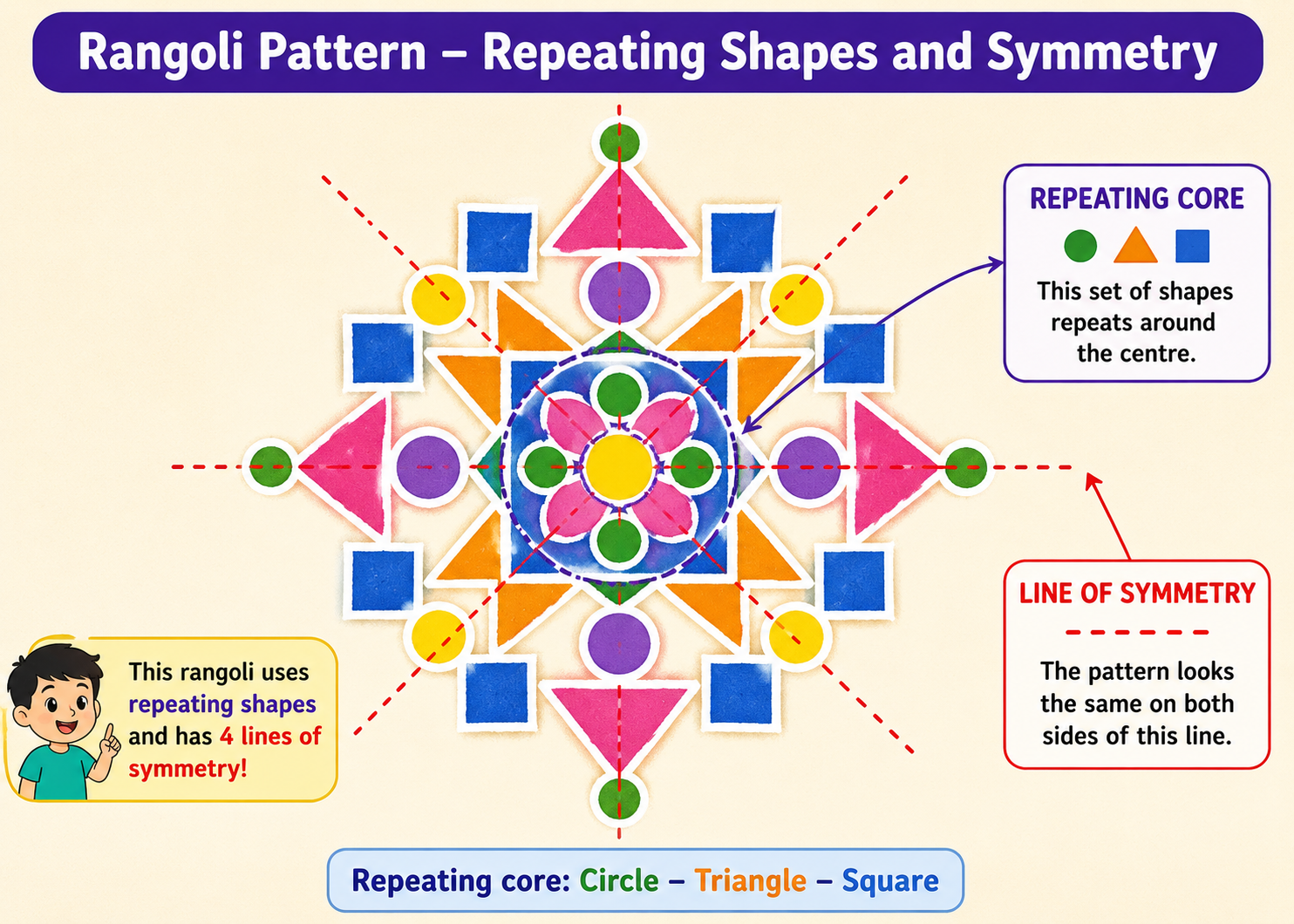
A symmetry pattern is when one half of a design is the mirror image of the other half. If you fold the design along the middle line (called the line of symmetry), both halves match exactly.
• A butterfly — left wing mirrors the right wing.
• The letter "A" — left side mirrors the right side.
• A rangoli design — all four sides are mirror images of each other.
• A kolam design — the pattern is the same on all sides.
Symmetry in Indian art:
- Rangoli: Most rangoli designs have 4-fold symmetry — they look the same from all four sides.
- Kolam: South Indian kolam designs are drawn with dots and loops, creating perfect symmetry.
- Mehndi: Mehndi patterns on both hands are often mirror images of each other.
- Taj Mahal: The building is perfectly symmetrical — left side mirrors the right side.
Letters with symmetry: A, H, I, M, O, T, U, V, W, X, Y (vertical line of symmetry)
Letters with horizontal symmetry: B, C, D, E, H, I, K, O, X
Patterns in Multiplication Tables
Multiplication tables are full of patterns! Let's discover some:
| Table | Pattern in Last Digit | Other Patterns |
|---|---|---|
| Table of 2 | 2, 4, 6, 8, 0, 2, 4, 6, 8, 0 | All answers are even numbers |
| Table of 5 | 5, 0, 5, 0, 5, 0, 5, 0, 5, 0 | Answers end in 5 or 0 only |
| Table of 9 | 9, 8, 7, 6, 5, 4, 3, 2, 1, 0 | Digits add up to 9 (e.g., 18→1+8=9) |
| Table of 10 | 0, 0, 0, 0, 0, 0, 0, 0, 0, 0 | Just add a zero to the number |
| Table of 11 | 1, 2, 3, 4, 5, 6, 7, 8, 9, 0 | Up to 9×11, both digits are the same (11, 22, 33...) |
9 × 1 = 09 → 0 + 9 = 9
9 × 2 = 18 → 1 + 8 = 9
9 × 3 = 27 → 2 + 7 = 9
9 × 4 = 36 → 3 + 6 = 9
9 × 5 = 45 → 4 + 5 = 9
The digits of every answer in the 9 times table add up to 9!
Patterns in Indian Art and Culture
India has a rich tradition of using mathematical patterns in art. Let's explore some:
🪷 Rangoli Patterns
Rangoli is drawn during festivals like Diwali, Pongal, and Onam. Rangoli designs use:
- Repeating patterns: The same motif (flower, leaf, diya) repeats around a centre.
- Symmetry: The design looks the same from all sides (rotational symmetry).
- Colour patterns: Colours alternate in a fixed order.
🌀 Kolam Designs (South India)
Kolam is drawn with rice flour every morning in front of homes in Tamil Nadu, Karnataka, and Andhra Pradesh. Kolam uses:
- Dot patterns: Dots are placed in a grid, then connected with curves.
- Loop patterns: A single continuous line loops around all dots without lifting.
- Growing patterns: Simple kolams grow into complex ones by adding more dots.
✋ Mehndi Patterns
Mehndi (henna) designs on hands use repeating patterns:
- Paisley shapes repeating in a row.
- Flower petals arranged in a circle (rotational pattern).
- Leaf patterns along fingers (repeating with size change — growing pattern).
🧵 Saree Border Designs
The border of a saree has a repeating pattern that goes all along the edge:
- Geometric shapes (triangles, diamonds) repeating.
- Flower-vine patterns that repeat every few centimetres.
- Colour patterns in the weave (gold, red, gold, red).
Key Words
| Word | Meaning |
|---|---|
| Pattern | An arrangement that repeats or follows a fixed rule |
| Core | The smallest part of a pattern that repeats |
| Rule | The instruction that tells how the pattern works (e.g., "Add 3") |
| Repeating pattern | A pattern where the same group repeats again and again |
| Growing pattern | A pattern where the amount increases at each step |
| Number pattern | A sequence of numbers that follows a rule |
| Shape pattern | A sequence of shapes that repeats in a fixed order |
| Symmetry | When one half is the mirror image of the other half |
| Line of symmetry | The line along which a shape can be folded to get matching halves |
| Sequence | An ordered list of numbers or objects following a pattern |
- A pattern is an arrangement that repeats or follows a fixed rule.
- The core is the smallest repeating unit of a pattern.
- In number patterns, find the difference between consecutive numbers to discover the rule.
- In shape patterns, identify the group of shapes that keeps repeating.
- Growing patterns increase at each step — they do not repeat the same group.
- Symmetry means one half mirrors the other half exactly.
- Multiplication tables have many patterns (e.g., table of 9: digits always add to 9).
- Indian art forms like rangoli, kolam, and mehndi are based on mathematical patterns.
- To extend a pattern: find the rule → apply it → predict the next items.
Finished learning? Now test what you know!