Identify even and odd numbers up to 100 and beyond.
Understand the ones-digit rule for identifying even and odd numbers.
Learn addition rules: Even + Even, Odd + Odd, Even + Odd.
Recognise patterns in even and odd number sequences.
Apply even-odd concepts to solve real-life problems.
Understand that 0 is an even number.
Explore subtraction and multiplication rules for even and odd numbers.
📖 Introduction
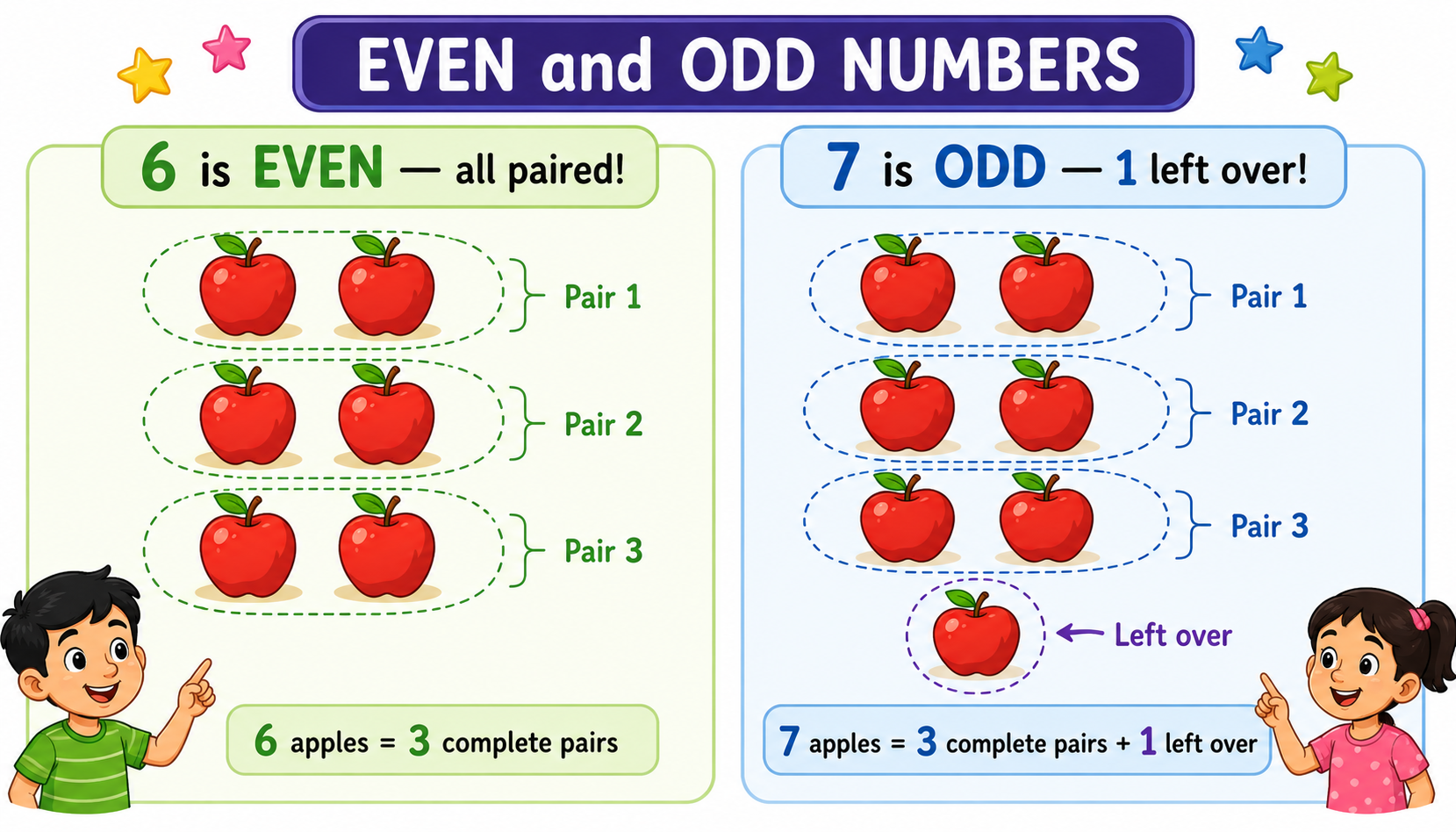
Arjun's mother made 12 laddoos for a festival. She asked Arjun to share them equally between himself and his sister Sita. Arjun gave 6 laddoos to Sita and kept 6 for himself. Both got the same number — nothing was left over! This is because 12 is an even number.
The next day, she made 15 laddoos. When Arjun tried to share equally, each got 7 laddoos but 1 was left over. This is because 15 is an odd number.
In this chapter, we will learn how to quickly identify even and odd numbers, discover interesting patterns, and understand what happens when we add, subtract, or multiply them.
What Are Even Numbers?
A number is called even if it can be divided into two equal groups with nothing left over. In other words, when we divide an even number by 2, the remainder is 0.
Even numbers always end in 0, 2, 4, 6, or 8.
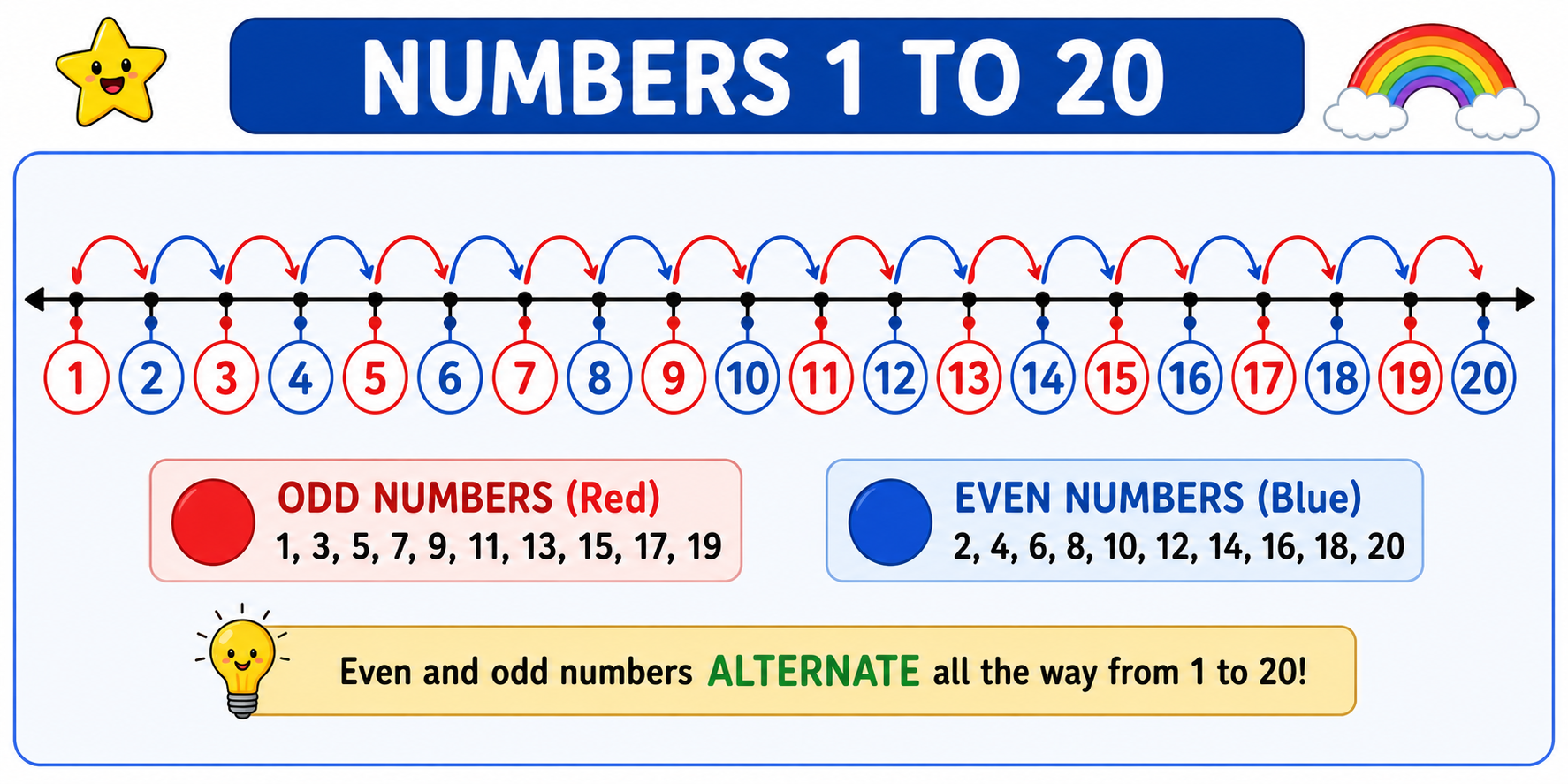
Even numbers from 2 to 20:
2, 4, 6, 8, 10, 12, 14, 16, 18, 20
Example 1: Ravi has 8 cricket balls. He puts them in 2 equal groups — 4 balls in each group. No ball is left over. So 8 is even.
Example 2: There are 24 students in Class 3A. The teacher divides them into 2 teams for a relay race. Each team gets 12 students. So 24 is even.
Example 3: Sita has ₹50. She shares equally with her friend. Each gets ₹25. So 50 is even.
How to Identify Even and Odd Numbers — The Ones Digit Rule
You do not need to divide every number by 2 to check if it is even or odd. There is a simple trick:
The Ones Digit Rule: Look at the last digit (ones place) of any number.
• If the ones digit is 0, 2, 4, 6, or 8 → the number is EVEN.
• If the ones digit is 1, 3, 5, 7, or 9 → the number is ODD.
This rule works for ALL numbers — small or big!
Let's practise:
• Is 56 even or odd? → Ones digit is 6 → 56 is EVEN ✓
• Is 83 even or odd? → Ones digit is 3 → 83 is ODD ✓
• Is 100 even or odd? → Ones digit is 0 → 100 is EVEN ✓
• Is 247 even or odd? → Ones digit is 7 → 247 is ODD ✓
• Is 1,000 even or odd? → Ones digit is 0 → 1,000 is EVEN ✓
• Is 999 even or odd? → Ones digit is 9 → 999 is ODD ✓
Addition Rules for Even and Odd Numbers
When we add even and odd numbers, the result follows a pattern. Let us learn these rules:
Rule 1: Even + Even = Even
When you add two even numbers, the answer is always even.
Think of it this way: The even number is fully paired. The odd number brings 1 leftover. That leftover has no partner, so the result is odd.
Patterns in Even and Odd Numbers
Even and odd numbers follow beautiful patterns. Let us explore some:
Pattern 1: Alternating sequence
Numbers alternate between odd and even: 1(O), 2(E), 3(O), 4(E), 5(O), 6(E), 7(O), 8(E)...
Pattern 2: Skip counting by 2
Starting from any even number and adding 2 always gives the next even number: 2, 4, 6, 8, 10...
Starting from any odd number and adding 2 always gives the next odd number: 1, 3, 5, 7, 9...
Pattern 3: Between two consecutive even numbers, there is always one odd number
Between 4 and 6, there is 5 (odd). Between 10 and 12, there is 11 (odd).
Pattern 4: The sum of first N even numbers
2 = 2, 2+4 = 6, 2+4+6 = 12, 2+4+6+8 = 20
Pattern 5: House numbers
On many Indian streets, one side has even house numbers (2, 4, 6, 8...) and the other side has odd house numbers (1, 3, 5, 7...).
Special Facts About Even and Odd Numbers
Is 0 even or odd?
0 is an even number! We can divide 0 into two equal groups: 0 and 0. Also, 0 ÷ 2 = 0 with no remainder. The ones digit of 0 is 0, which is in the even list.
Is 2 special?
2 is the smallest even number and the only even prime number. All other even numbers can be divided by 2, so they are not prime.
Subtraction rules:
• Even − Even = Even (10 − 4 = 6) ✓
• Odd − Odd = Even (9 − 3 = 6) ✓
• Even − Odd = Odd (10 − 3 = 7) ✓
• Odd − Even = Odd (9 − 4 = 5) ✓
Multiplication rules:
• Even × Even = Even (4 × 6 = 24) ✓
• Even × Odd = Even (4 × 3 = 12) ✓
• Odd × Odd = Odd (3 × 5 = 15) ✓
Real-Life Examples from India
Cricket: A cricket team has 11 players — that's an odd number! If you add both teams, 11 + 11 = 22 players on the field — that's even (Odd + Odd = Even).
Sharing laddoos: If Amma makes 18 laddoos for 2 children, each gets 9. If she makes 19, one laddoo is left over!
Auto-rickshaw wheels: An auto has 3 wheels (odd). A car has 4 wheels (even). A bicycle has 2 wheels (even).
Days in a week: There are 7 days in a week — that's odd! There are 12 months in a year — that's even!
📝 Key Words
Word
Meaning
Even number
A number that is exactly divisible by 2 (remainder = 0). Ends in 0, 2, 4, 6, or 8.
Odd number
A number that leaves remainder 1 when divided by 2. Ends in 1, 3, 5, 7, or 9.
Ones digit
The last digit (rightmost) of a number, also called the units place.
Remainder
The amount left over after dividing.
Divisible
A number that can be divided exactly without any remainder.
Consecutive
Numbers that come one after another (e.g., 5, 6, 7).
Pattern
A repeated arrangement that follows a rule.
⭐ Key Points to Remember
Even numbers end in 0, 2, 4, 6, or 8. They are exactly divisible by 2.
Odd numbers end in 1, 3, 5, 7, or 9. They leave remainder 1 when divided by 2.
To check any number, just look at the ones digit (last digit).
0 is an even number.
Even + Even = Even, Odd + Odd = Even, Even + Odd = Odd.
Even × anything = Even. Odd × Odd = Odd.
Numbers alternate between odd and even: O, E, O, E, O, E...
Between 1 and 100, there are 50 even numbers and 50 odd numbers.
Finished learning? Now test what you know!
🎯 Quick Quiz — Test Yourself!
Answer these questions right here. You get instant feedback — no paper needed!
Score: 0 / 8
1. Which of these is an even number?
24 ends in 4, so it is even. Even numbers end in 0, 2, 4, 6 or 8.
2. Which of these is an odd number?
53 ends in 3, so it is odd. Odd numbers end in 1, 3, 5, 7 or 9.
3. Even numbers always end in:
Even numbers end in 0, 2, 4, 6 or 8.
4. Is 100 even or odd?
100 ends in 0, so it is even.
5. Is the number 46 even or odd?
46 ends in 6, so it is even.
6. Is the number 71 even or odd?
71 ends in 1, so it is odd.
7. Is the number 99 even or odd?
99 ends in 9, so it is odd.
8. Is the number 58 even or odd?
58 ends in 8, so it is even.
✏️ Practice Questions
A. Fill in the Blanks (10)
1. 46 is an number because its ones digit is .
2. 73 is an number because its ones digit is .
3. Even + Even = . (even / odd)
4. Odd + Odd = . (even / odd)
5. The next even number after 88 is .
6. The next odd number after 55 is .
7. The smallest even number is .
8. There are even numbers between 1 and 20.
9. Even × Odd = . (even / odd)
10. 100 is an number because its ones digit is .
B. Choose the Correct Answer (MCQ - 5)
1. Which of the following is an odd number?
a) 48b) 62c) 57d) 84
2. What is 13 + 17?
a) 30 (even)b) 31 (odd)c) 29 (odd)d) 28 (even)
3. Sita has 25 bangles. Can she divide them equally between her two hands?
a) Yes, 12 eachb) No, 1 will be left overc) Yes, 13 each
4. Which rule is correct?
a) Odd × Odd = Evenb) Even × Odd = Oddc) Even × Even = Evend) Odd + Even = Even
5. How many odd numbers are there between 1 and 50?
a) 20b) 25c) 30d) 50
C. Short Answer (5)
1. Write all even numbers between 41 and 60.
2. Arjun has 33 stickers. He wants to share them equally with his friend Ravi. Can he do it? Explain why or why not.
3. Write the ones digit of each number and tell if it is even or odd: 156, 289, 430, 517, 672.
4. Sita adds two odd numbers: 15 + 21. Will the answer be even or odd? Verify by calculating.
5. A bus has 45 seats. Is 45 even or odd? If 2 students sit on each seat, will all seats be full?
D. True or False (5)
1. The sum of two even numbers is always even.
2. 0 is an odd number.
3. If a number ends in 4, it is always even.
4. Odd × Odd = Even.
5. Between 1 and 100, there are more even numbers than odd numbers.
E. Match the Following (5)
Column A
Column B
1. 14 + 8
a) Odd result
2. 7 + 9
b) Even result
3. 12 + 5
c) Even result
4. 3 × 5
d) Odd result
5. 6 × 4
e) Even result
🎨 Activity: Even-Odd Number Hunt
Materials needed: A newspaper or magazine, a pencil, and two coloured crayons (blue and red).
Instructions:
1. Open any page of a newspaper or magazine.
2. Find 10 numbers on the page (prices, dates, page numbers, scores, etc.).
3. Write them down. Circle even numbers in blue and odd numbers in red.
4. Count: How many are even? How many are odd?
5. Pick any two numbers and add them. Predict whether the answer will be even or odd using the rules you learned. Then check!
Want to review the lesson again?
Mathematics
Even and Odd Numbers
Class 3 | CBSE / NCERT / ICSE
Name: Class: Date:
Learning Objectives
Identify even and odd numbers up to 100 and beyond.
Understand the ones-digit rule for identifying even and odd numbers.
Learn addition rules: Even + Even, Odd + Odd, Even + Odd.
Recognise patterns in even and odd number sequences.
Apply even-odd concepts to solve real-life problems.
Understand that 0 is an even number.
Explore subtraction and multiplication rules for even and odd numbers.
Introduction
Arjun's mother made 12 laddoos for a festival. She asked Arjun to share them equally between himself and his sister Sita. Arjun gave 6 laddoos to Sita and kept 6 for himself. Both got the same — nothing was left over! This is because 12 is an even number.
The next day, she made 15 laddoos. When Arjun tried to share equally, each got 7 laddoos but 1 was left over. This is because 15 is an odd number.
What Are Even Numbers?
A number is called even if it can be divided into two equal groups with nothing left over. When we divide an even number by 2, the remainder is 0. Even numbers always end in 0, 2, 4, 6, or 8.
Even numbers from 2 to 20: 2, 4, 6, 8, 10, 12, 14, 16, 18, 20 Example: Ravi has 8 cricket balls. He puts them in 2 equal groups — 4 in each. No ball left over. So 8 is even.
Even Number
÷ 2
Remainder
2
1
0
4
2
0
6
3
0
8
4
0
10
5
0
12
6
0
14
7
0
16
8
0
18
9
0
20
10
0
What Are Odd Numbers?
A number is called odd if it cannot be divided into two equal groups. When we divide an odd number by 2, the remainder is always 1. Odd numbers always end in 1, 3, 5, 7, or 9.
Odd numbers from 1 to 19: 1, 3, 5, 7, 9, 11, 13, 15, 17, 19 Example: Sita has 9 mangoes. She shares with her brother — each gets 4, but 1 is left over. So 9 is odd.
Odd Number
÷ 2
Remainder
1
0
1
3
1
1
5
2
1
7
3
1
9
4
1
11
5
1
13
6
1
15
7
1
17
8
1
19
9
1
The Ones Digit Rule
To check if a number is even or odd, look at the last digit (ones place):
• Ones digit is 0, 2, 4, 6, or 8 → EVEN • Ones digit is 1, 3, 5, 7, or 9 → ODD
Is 56 even or odd? → Ones digit is 6 → EVEN ✓
Is 83 even or odd? → Ones digit is 3 → ODD ✓
Is 247 even or odd? → Ones digit is 7 → ODD ✓
Is 1,000 even or odd? → Ones digit is 0 → EVEN ✓
• Numbers alternate: O, E, O, E, O, E...
• Skip counting by 2 from even gives even: 2, 4, 6, 8...
• Skip counting by 2 from odd gives odd: 1, 3, 5, 7...
• Between two consecutive even numbers is always one odd number.
Special Facts
• 0 is even (0 ÷ 2 = 0, remainder 0)
• 2 is the smallest even number and the only even prime number
• Subtraction: Even − Even = Even, Odd − Odd = Even, Even − Odd = Odd
• Multiplication: Even × Even = Even, Even × Odd = Even, Odd × Odd = Odd
Real-Life Examples
• Cricket team: 11 players (odd). Both teams: 11 + 11 = 22 (even)
• Indian coins: ₹1 (odd), ₹2 (even), ₹5 (odd), ₹10 (even)
• Auto-rickshaw: 3 wheels (odd). Car: 4 wheels (even)
• Days in a week: 7 (odd). Months in a year: 12 (even)
Key Words
Word
Meaning
Even number
Exactly divisible by 2 (remainder = 0). Ends in 0, 2, 4, 6, or 8.
Odd number
Leaves remainder 1 when divided by 2. Ends in 1, 3, 5, 7, or 9.
Ones digit
The last digit (rightmost) of a number.
Remainder
The amount left over after dividing.
Divisible
Can be divided exactly without remainder.
Consecutive
Numbers that come one after another.
Pattern
A repeated arrangement following a rule.
⭐ Key Points to Remember
Even numbers end in 0, 2, 4, 6, or 8. They are exactly divisible by 2.
Odd numbers end in 1, 3, 5, 7, or 9. They leave remainder 1 when divided by 2.
To check any number, just look at the ones digit (last digit).
0 is an even number.
Even + Even = Even, Odd + Odd = Even, Even + Odd = Odd.
Even × anything = Even. Odd × Odd = Odd.
Numbers alternate between odd and even: O, E, O, E...
Between 1 and 100, there are 50 even numbers and 50 odd numbers.
A. Fill in the Blanks (10)
1. 46 is an number because its ones digit is .
2. 73 is an number because its ones digit is .
3. Even + Even = . (even / odd)
4. Odd + Odd = . (even / odd)
5. The next even number after 88 is .
6. The next odd number after 55 is .
7. The smallest even number is .
8. There are even numbers between 1 and 20.
9. Even × Odd = . (even / odd)
10. 100 is an number because its ones digit is .
B. Choose the Correct Answer (MCQ - 5)
1. Which of the following is an odd number?
a) 48b) 62c) 57d) 84
2. What is 13 + 17?
a) 30 (even)b) 31 (odd)c) 29 (odd)d) 28 (even)
3. Sita has 25 bangles. Can she divide them equally between her two hands?
a) Yes, 12 eachb) No, 1 will be left overc) Yes, 13 each
4. Which rule is correct?
a) Odd × Odd = Evenb) Even × Odd = Oddc) Even × Even = Even
5. How many odd numbers are there between 1 and 50?
a) 20b) 25c) 30d) 50
C. Short Answer (5)
1. Write all even numbers between 41 and 60.
2. Arjun has 33 stickers. He wants to share them equally with his friend Ravi. Can he do it? Explain.
3. Write the ones digit and tell if even or odd: 156, 289, 430, 517, 672.
4. Sita adds two odd numbers: 15 + 21. Will the answer be even or odd? Verify.
5. A bus has 45 seats. Is 45 even or odd? If 2 students sit on each seat, will all seats be full?
D. True or False (5)
1. The sum of two even numbers is always even.
2. 0 is an odd number.
3. If a number ends in 4, it is always even.
4. Odd × Odd = Even.
5. Between 1 and 100, there are more even numbers than odd numbers.
E. Match the Following (5)
Column A
Column B
1. 14 + 8
a) Odd result
2. 7 + 9
b) Even result
3. 12 + 5
c) Even result
4. 3 × 5
d) Odd result
5. 6 × 4
e) Even result
Activity: Even-Odd Number Hunt
Find 10 numbers from a newspaper. Write E (even) or O (odd) next to each: