Weather and Seasons
Learning Objectives
- I can describe different types of weather (sunny, rainy, cloudy, windy, foggy, stormy).
- I can explain the difference between weather and climate.
- I can name India's three main seasons and their months.
- I can describe how seasons affect our clothes, food, activities, and festivals.
- I can name simple weather instruments and what they measure.
- I can explain how animals and plants respond to changing seasons.
Introduction
Have you noticed how some days are hot and sunny, while other days are cold or rainy? The condition of the air around us — whether it is hot, cold, wet, or dry — is called weather.
In India, we experience different types of weather throughout the year. Our country has three main seasons: Summer, Monsoon (Rainy), and Winter. Each season brings its own special weather, food, clothes, and festivals!
Let us learn about weather and seasons and how they affect our daily lives.
What is Weather?
Weather is the condition of the air at a particular place and time. It can change every day or even every hour!
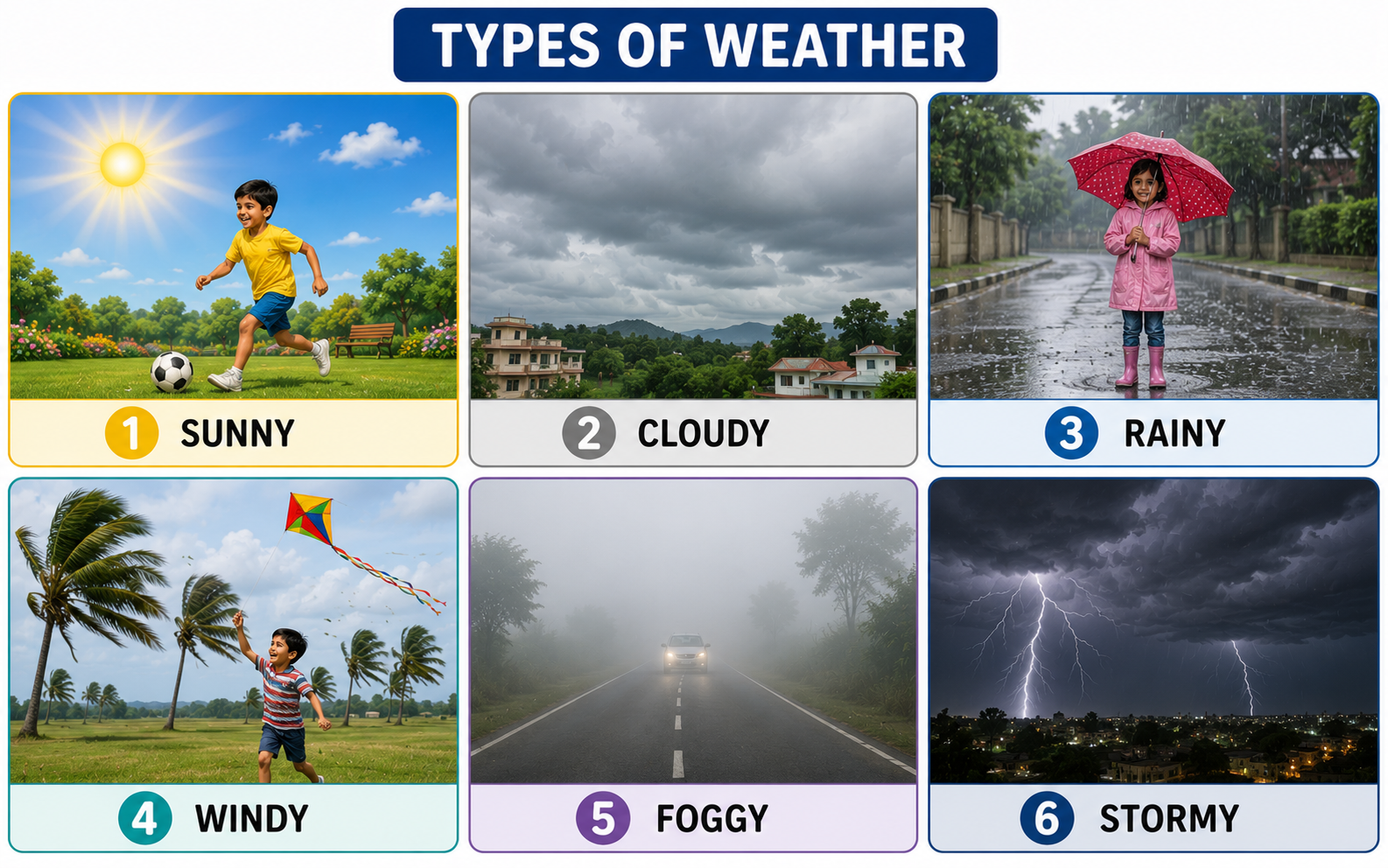
Here are the different types of weather:
| Weather Type | What It Looks Like | How It Feels |
|---|---|---|
| ☀️ Sunny | Clear blue sky, bright sunshine | Hot and bright; we feel warm |
| ☁️ Cloudy | Sky covered with grey or white clouds | Cool; sun is hidden |
| 🌧️ Rainy | Dark clouds, water falls from sky | Wet and cool; puddles form |
| 💨 Windy | Trees sway, papers fly, dust blows | Breezy; can be cold or warm |
| 🌫️ Foggy | White mist covers everything; hard to see far | Cold and damp; common in winter mornings |
| ⛈️ Stormy | Thunder, lightning, heavy rain, strong winds | Scary; we stay indoors |
What is Climate?
Climate is the usual weather of a place over a long time (many years). Weather changes daily, but climate stays mostly the same.
| Weather | Climate |
|---|---|
| Changes every day | Stays the same for years |
| "Today is rainy" | "Mumbai gets heavy rain every July" |
| Short-term (hours/days) | Long-term (years) |
| Can be different tomorrow | Does not change quickly |
- Rajasthan — Hot and dry climate (desert). Very little rain.
- Kashmir — Cold climate. Snowfall in winter.
- Cherrapunji (Meghalaya) — Very wet climate. One of the rainiest places on Earth!
- Chennai — Hot and humid climate near the sea.
India's Three Main Seasons
India has three main seasons. Each season lasts for a few months and brings different weather.
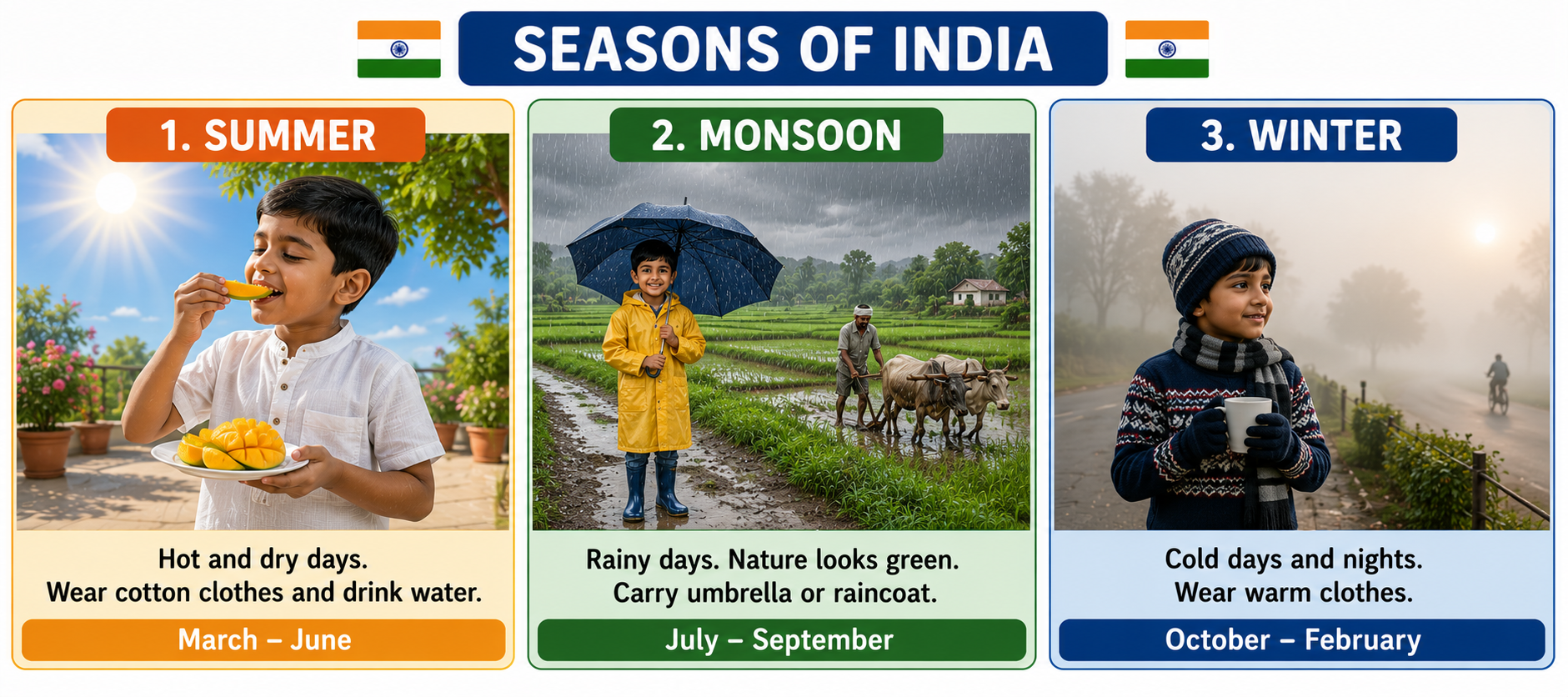
☀️ 1. Summer Season (Grishma Ritu) — March to June
| Feature | Details |
|---|---|
| Weather | Very hot and dry; temperature can reach 45°C in some places |
| Hottest places | Rajasthan, Delhi, Uttar Pradesh, Vidarbha (Maharashtra) |
| Clothes | Light cotton clothes, white/light colours, hats, sunglasses |
| Food | Mangoes, watermelon, ice cream, lassi, nimbu paani, sugarcane juice |
| Activities | Summer holidays! Swimming, playing indoors, visiting hill stations |
| Festivals | Holi (March), Baisakhi (April), Rath Yatra (June/July) |
🌧️ 2. Monsoon / Rainy Season (Varsha Ritu) — July to September
| Feature | Details |
|---|---|
| Weather | Heavy rainfall, dark clouds, thunder and lightning |
| Rainiest places | Cherrapunji (Meghalaya), Western Ghats, Assam, Kerala |
| Clothes | Raincoat, umbrella, gumboots (waterproof shoes) |
| Food | Pakoras, chai, corn (bhutta), khichdi, hot soup |
| Activities | Paper boats in puddles, watching rain, indoor games |
| Festivals | Teej (July/August), Onam (August/September), Janmashtami |
| Importance | Farmers plant crops (rice, wheat); rivers and lakes fill up; trees turn green |
❄️ 3. Winter Season (Sheet Ritu) — November to February
| Feature | Details |
|---|---|
| Weather | Cold, foggy mornings, short days, long nights |
| Coldest places | Kashmir, Ladakh, Shimla, Darjeeling, Delhi (fog) |
| Clothes | Sweaters, jackets, woollen caps, gloves, shawls, socks |
| Food | Gajar ka halwa, til ladoo, hot chocolate, soup, sarson ka saag |
| Activities | Sitting in the sun, bonfires, playing outdoors in the afternoon |
| Festivals | Diwali (Oct/Nov), Christmas (December), Makar Sankranti (January), Lohri, Pongal, Republic Day |
How Seasons Affect Us
Seasons change many things in our daily life:
| What Changes | Summer | Monsoon | Winter |
|---|---|---|---|
| Clothes | Cotton, light colours | Raincoat, umbrella | Woollen, layers |
| Food | Cold drinks, fruits | Hot snacks, chai | Hot food, sweets |
| Activities | Swimming, holidays | Indoor games | Bonfires, kite flying |
| Festivals | Holi, Baisakhi | Teej, Onam | Diwali, Makar Sankranti |
| Fruits | Mango, watermelon, litchi | Jamun, plum, peach | Orange, guava, apple |
Weather Instruments
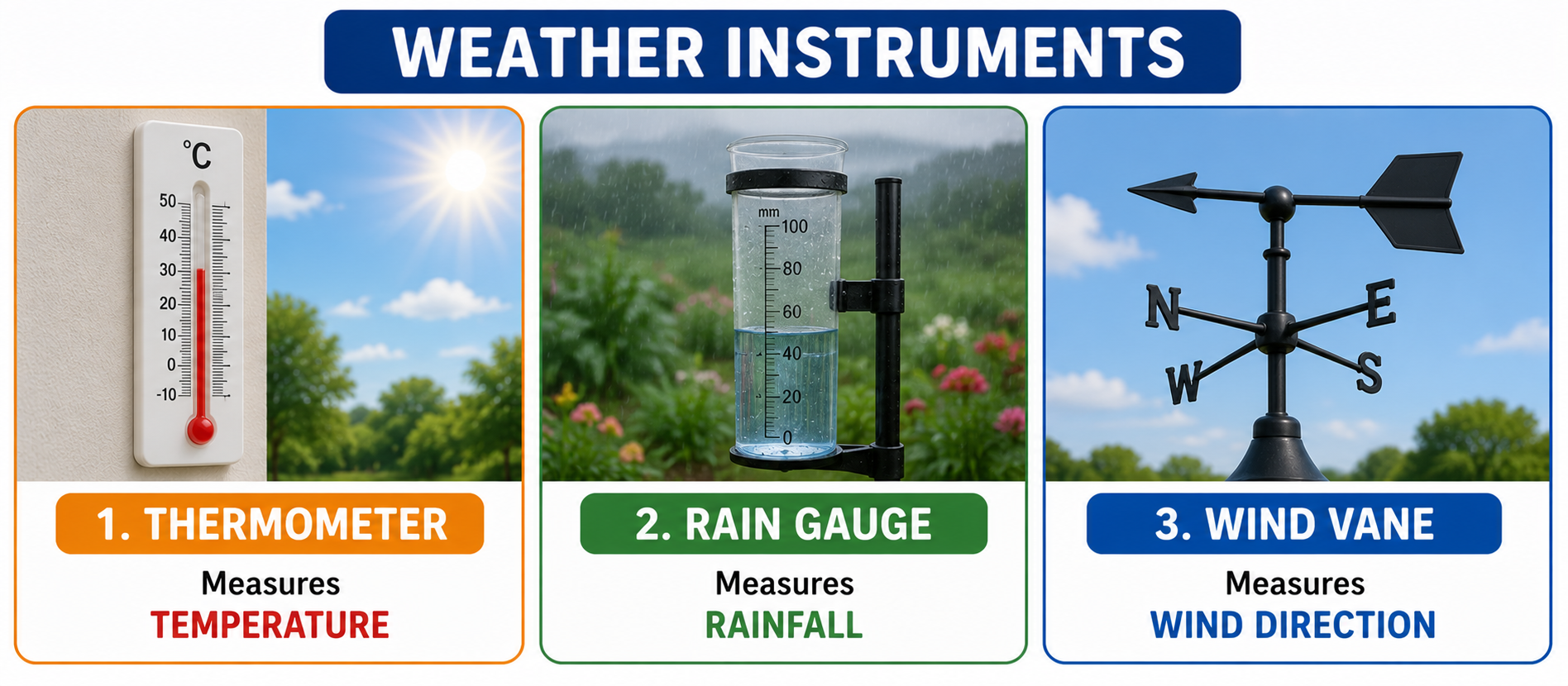
Scientists use special tools called weather instruments to measure and predict weather:
| Instrument | What It Measures | How It Works |
|---|---|---|
| 🌡️ Thermometer | Temperature (how hot or cold) | Mercury rises when hot, falls when cold. Measured in °C. |
| 🌧️ Rain Gauge | Rainfall (how much rain fell) | Collects rainwater in a measuring tube. Measured in mm. |
| 🌬️ Wind Vane | Wind direction (where wind comes from) | Arrow points in the direction the wind is blowing from. |
How Animals and Plants Respond to Seasons
Animals and plants also change their behaviour with the seasons:
| Response | What Happens | Examples |
|---|---|---|
| Migration | Animals travel to warmer places in winter | Siberian Crane comes to India; butterflies travel long distances |
| Hibernation | Some animals sleep through winter to save energy | Bears, frogs, snakes, squirrels go into deep sleep |
| Shedding leaves | Trees drop leaves in autumn/winter to save water | Peepal, Neem, Banyan shed leaves before summer |
| New leaves & flowers | Trees grow new leaves and bloom in spring | Gulmohar, Amaltas bloom in summer; mango trees flower |
| Thick fur/feathers | Animals grow thicker coats in winter | Dogs, cats, horses grow thicker fur in cold months |
| Storing food | Animals collect and store food before winter | Squirrels store nuts; ants store food grains |
Key Words
| Word | Meaning |
|---|---|
| Weather | The condition of air at a place and time (hot, cold, rainy, windy) |
| Climate | The usual weather of a place over many years |
| Season | A time of year with a particular type of weather |
| Temperature | How hot or cold something is, measured in degrees Celsius (°C) |
| Monsoon | Season of heavy rainfall in India (July–September) |
| Thermometer | Instrument that measures temperature |
| Rain gauge | Instrument that measures how much rain has fallen |
| Migration | Animals travelling long distances to find better weather/food |
| Hibernation | Deep sleep some animals take during cold winter months |
| Forecast | Prediction of what the weather will be like |
- Weather is the daily condition of air (sunny, rainy, cloudy, windy, foggy, stormy).
- Climate is the usual weather of a place over many years.
- India has three main seasons: Summer (March–June), Monsoon (July–September), Winter (November–February).
- Seasons affect our clothes, food, activities, and festivals.
- Thermometer measures temperature; rain gauge measures rainfall; wind vane shows wind direction.
- Animals respond to seasons by migrating, hibernating, or growing thicker fur.
- Plants shed leaves in winter and grow new leaves and flowers in spring/summer.
Finished learning? Now test what you know!