Rocks and Soil
Learning Objectives
- I can describe what rocks are and their different properties.
- I can name the three types of rocks and give examples.
- I can list the uses of rocks in daily life.
- I can explain what soil is made of.
- I can identify the three types of soil and their properties.
- I can describe the layers of soil.
- I can explain how soil is formed through weathering.
- I can describe soil erosion and ways to prevent it.
Let Us Begin!
Look around you — the ground beneath your feet, the mountains in the distance, the pebbles by the river. All of these are made of rocks and soil!
Rocks are one of the oldest things on Earth. Some rocks are millions of years old! And soil — the soft brown layer on top — is where plants grow and gives us food.
India has many famous rocks — the beautiful white marble of the Taj Mahal comes from Rajasthan, and the strong granite used in temples comes from Tamil Nadu. Let us explore the wonderful world of rocks and soil!
What Are Rocks?
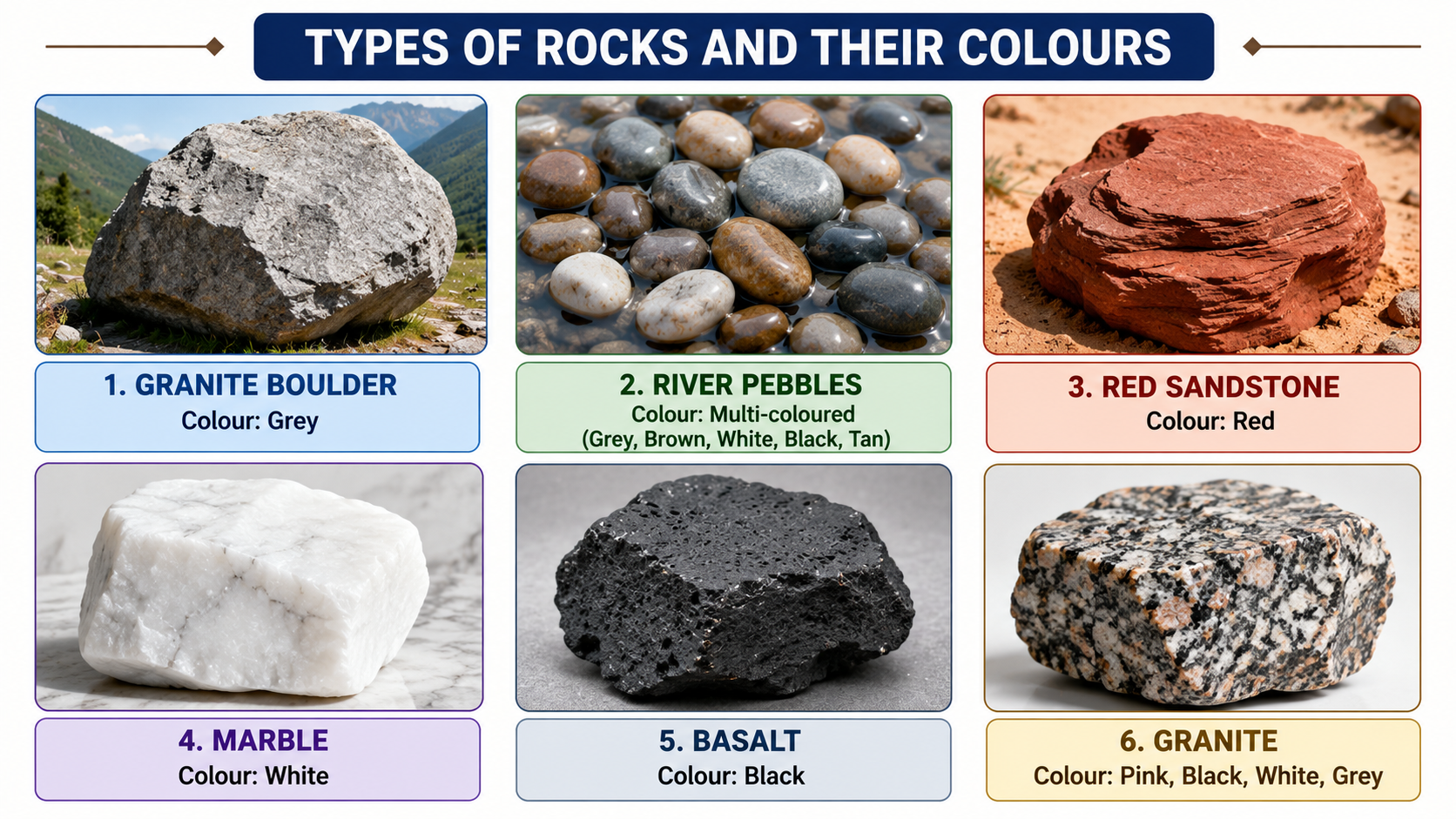
Rocks are hard, natural, non-living things found on the Earth. They are made up of minerals. Rocks come in different shapes, sizes, and colours.
- Rocks can be very big (like mountains) or very small (like pebbles and sand grains).
- Rocks can be rough or smooth, dull or shiny.
- Rocks come in many colours — white, black, grey, red, brown, pink, and even green.
- Some rocks are very hard (like granite), while some are soft (like chalk).
- The outer layer of the Earth is made up of rocks.
Types of Rocks
There are three main types of rocks:
| Type of Rock | How It Is Formed | Properties | Examples |
|---|---|---|---|
| Igneous Rocks (Fire rocks) | Formed when hot melted rock (magma/lava) from inside the Earth cools down and becomes hard | Very hard and strong; no layers; may have crystals | Granite, Basalt, Pumice |
| Sedimentary Rocks (Layered rocks) | Formed when tiny pieces of rocks, sand, shells, and dead plants settle in layers and get pressed together over time | Soft compared to igneous; have visible layers; may contain fossils | Sandstone, Limestone, Chalk, Shale |
| Metamorphic Rocks (Changed rocks) | Formed when existing rocks are changed by great heat and pressure deep inside the Earth | Very hard; may have bands or wavy patterns; shiny | Marble, Slate, Quartzite |
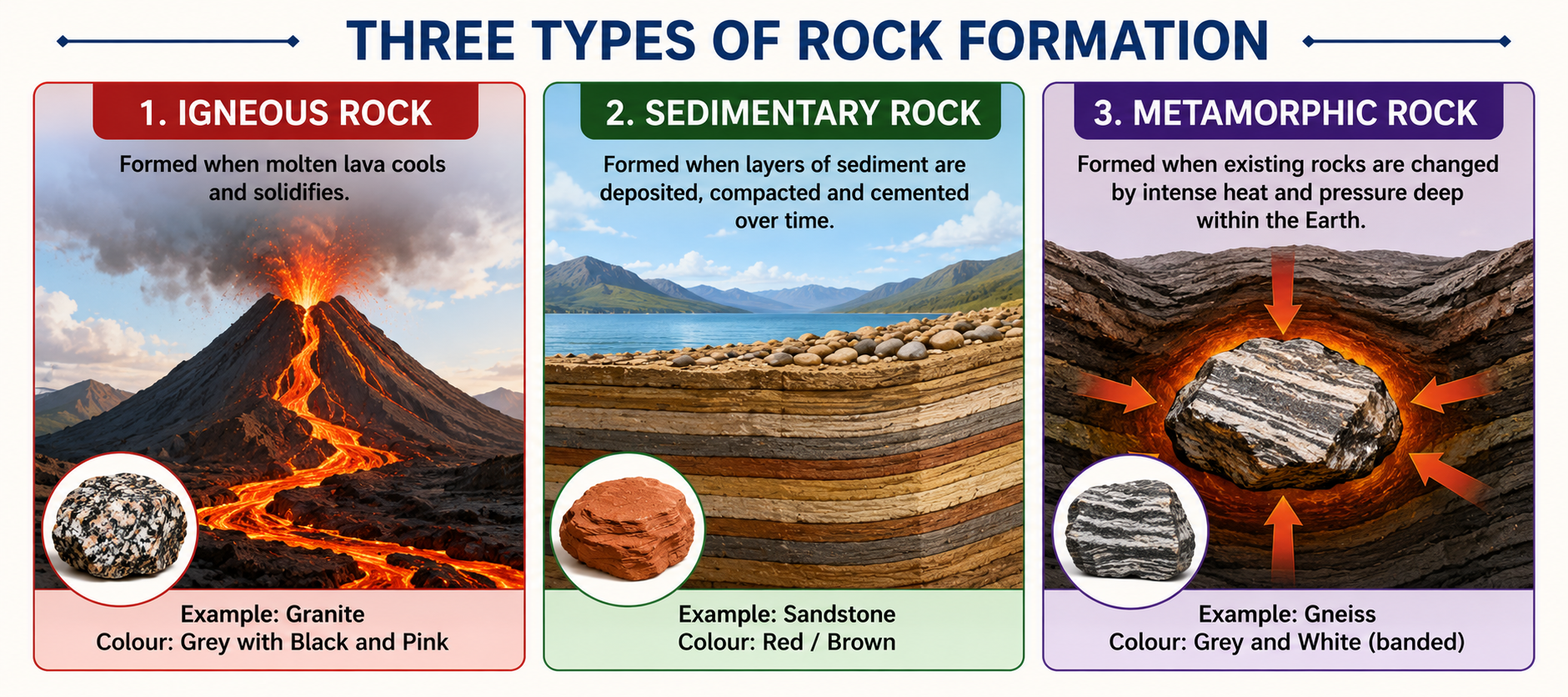
- Granite (Igneous) — Found in Tamil Nadu, Karnataka, Rajasthan. Used in temples like Brihadeeswarar Temple in Thanjavur.
- Basalt (Igneous) — The Deccan Plateau is made of basalt. The Ajanta and Ellora caves are carved in basalt rock.
- Sandstone (Sedimentary) — Red Fort in Delhi and Qutub Minar are made of red sandstone.
- Marble (Metamorphic) — The Taj Mahal in Agra is made of white marble from Makrana, Rajasthan.
- Slate (Metamorphic) — Used for roofing in hilly areas of Himachal Pradesh.
Uses of Rocks
Rocks are very useful to us in many ways:
| Use | Rock Used | Example |
|---|---|---|
| Building houses and monuments | Granite, Marble, Sandstone | Taj Mahal (marble), Red Fort (sandstone) |
| Making roads | Basalt, Granite (crushed) | Highways and village roads across India |
| Making statues and sculptures | Marble, Granite | Statues of leaders, temple carvings |
| Making jewellery | Precious stones (gems) | Diamond, Ruby, Emerald, Sapphire |
| Writing on blackboard | Chalk (limestone) | Classroom chalk |
| Making cement | Limestone | Used in construction |
| Making slate boards | Slate | Writing slates for children |
| Fuel and energy | Coal (sedimentary) | Power plants, cooking |
What Is Soil?
Soil is the thin layer of loose material that covers the surface of the Earth. It is a mixture of:
- Tiny rock pieces — broken down from big rocks over time
- Dead plants and animals (humus) — gives soil its dark colour and nutrients
- Water — needed by plant roots
- Air — fills the spaces between soil particles
- Tiny living things — earthworms, insects, bacteria that make soil healthy
Types of Soil
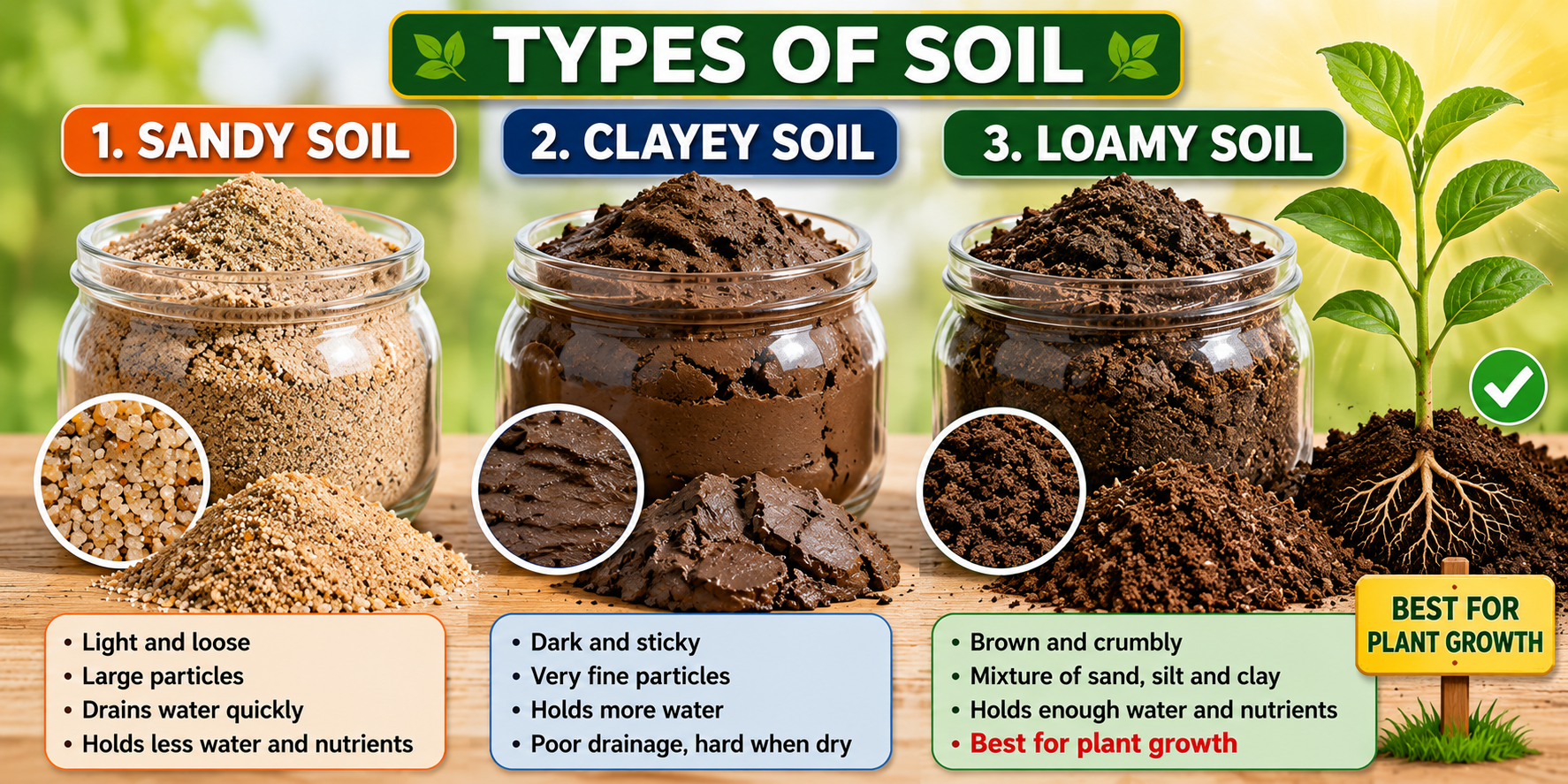
There are three main types of soil found in India:
| Type of Soil | Properties | Good For | Found In (India) |
|---|---|---|---|
| Sandy Soil | Light, loose, large particles; does not hold water well; dries quickly; light brown/yellow colour | Growing coconut, watermelon, groundnut, cactus | Rajasthan, Gujarat (desert areas), coastal areas |
| Clayey Soil | Heavy, sticky when wet; very fine particles; holds lots of water; cracks when dry; dark colour | Growing rice (paddy), wheat; making pots and bricks | Punjab, Haryana, parts of Maharashtra (black cotton soil) |
| Loamy Soil | Mix of sand, clay, and humus; soft and crumbly; holds the right amount of water; dark brown | Best for growing most plants — vegetables, fruits, flowers | Indo-Gangetic plains (UP, Bihar), river valleys |
Take some soil from your garden. Add water and squeeze it in your hand:
- If it falls apart easily → Sandy soil
- If it sticks together and feels smooth → Clayey soil
- If it holds shape but crumbles when poked → Loamy soil
Uses of Soil
| Use | How |
|---|---|
| Growing plants and crops | Farmers grow rice, wheat, vegetables, fruits in soil |
| Making pots and pottery | Potters (kumhars) use clayey soil to make beautiful pots, diyas, and matkas |
| Making bricks | Clayey soil is shaped into bricks and baked in kilns for building houses |
| Home for animals | Earthworms, ants, rabbits, and snakes live in soil |
| Making mud houses | In villages, houses are made with mud (kutcha houses) |
| Filtering water | Soil layers naturally filter and clean rainwater |
Layers of Soil
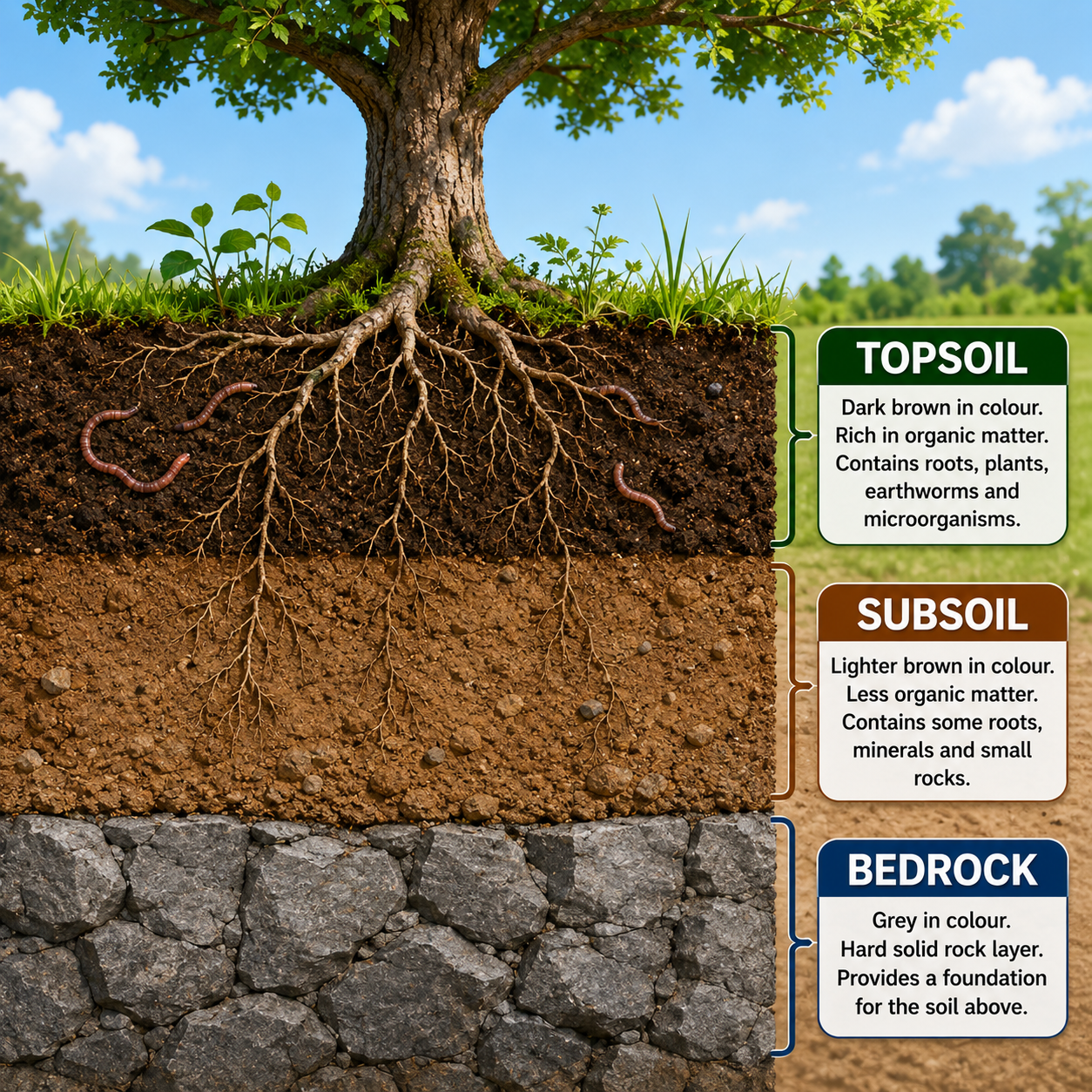
If we dig deep into the ground, we can see different layers. These layers are called the soil profile:
| Layer | Name | What It Contains |
|---|---|---|
| Top layer | Topsoil (A-horizon) | Dark, rich in humus; plant roots grow here; earthworms and insects live here |
| Middle layer | Subsoil (B-horizon) | Lighter colour; has less humus; contains minerals washed down from topsoil |
| Bottom layer | Bedrock (C-horizon) | Solid rock; very hard; no plants can grow here |
How Is Soil Formed?
Soil is formed very slowly over thousands of years through a process called weathering. Big rocks break into smaller and smaller pieces:
- Sun: Heat from the sun makes rocks expand (get bigger). At night they cool and shrink. This repeated expanding and shrinking causes cracks.
- Water: Rain water enters cracks in rocks. When it freezes, it expands and breaks the rock apart. Flowing rivers also wear down rocks.
- Wind: Strong winds carry sand particles that rub against rocks and slowly wear them down.
- Plants: Plant roots grow into cracks in rocks and slowly push them apart.
- Living things: Earthworms, insects, and bacteria mix dead leaves with rock pieces to make rich soil.
Soil Erosion and Conservation
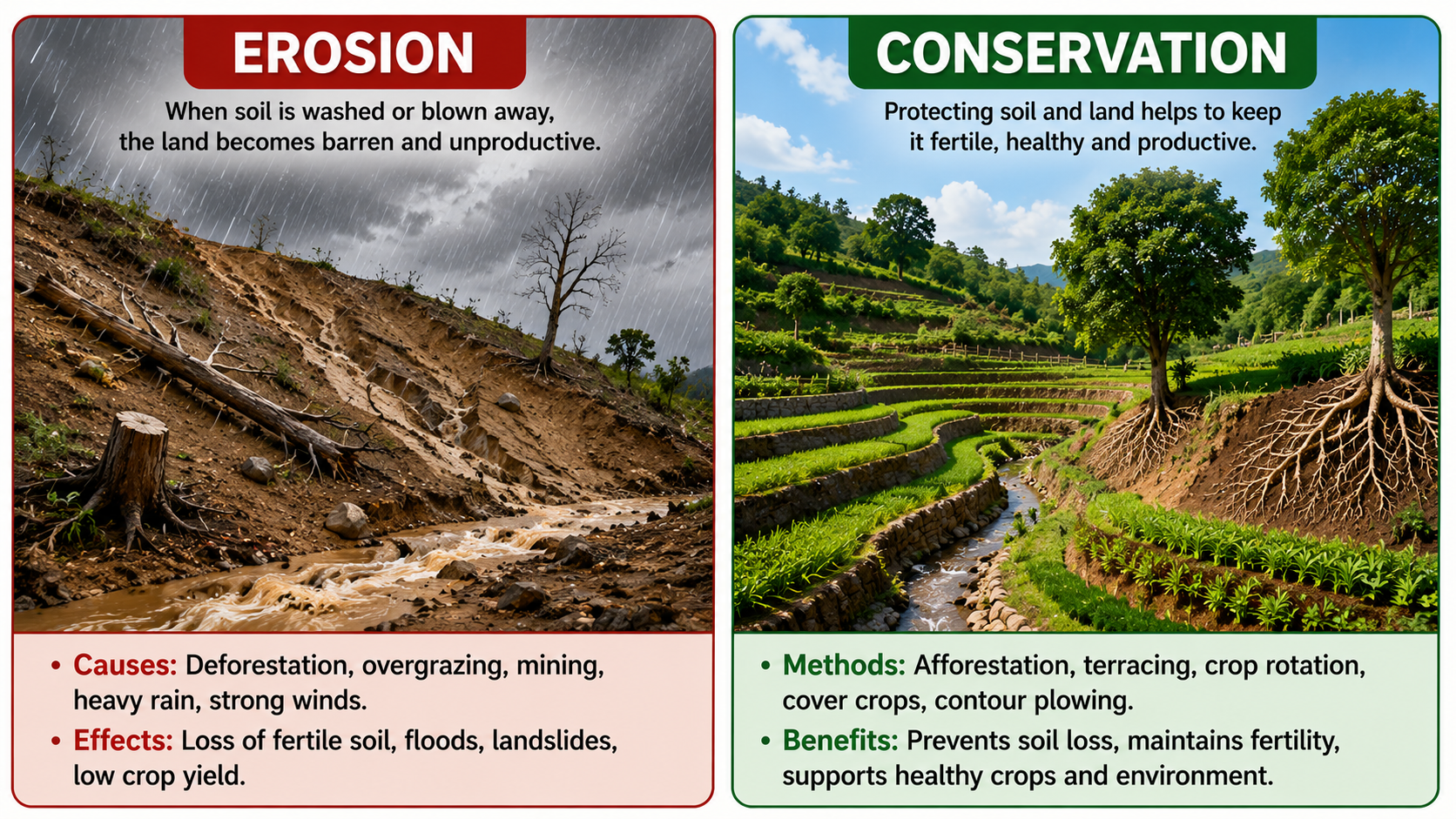
Soil erosion means the top layer of soil is carried away by wind, water, or human activities. This is harmful because topsoil is the most fertile layer.
Causes of soil erosion:
- Cutting down trees (deforestation)
- Overgrazing by animals
- Heavy rainfall and floods
- Strong winds in dry areas
- Farming on steep slopes without care
How to prevent soil erosion (Soil Conservation):
- Plant more trees (afforestation) — roots hold soil firmly
- Terrace farming — making steps on hillsides (seen in Uttarakhand, Meghalaya)
- Building dams and bunds — to control water flow
- Avoid overgrazing — do not let too many animals eat grass in one area
- Crop rotation — growing different crops in turns to keep soil healthy
- Cover crops — keeping soil covered with plants so wind cannot blow it away
Key Words
| Word | Meaning |
|---|---|
| Rock | A hard, natural, non-living thing made of minerals |
| Mineral | Natural substance that makes up rocks |
| Igneous | Rock formed from cooled magma or lava (fire rock) |
| Sedimentary | Rock formed from layers of sand, shells, and mud pressed together |
| Metamorphic | Rock changed by heat and pressure into a new form |
| Soil | Loose material on Earth's surface made of rock pieces, humus, water, and air |
| Humus | Dark material in soil made from dead plants and animals; makes soil fertile |
| Weathering | Breaking down of rocks into smaller pieces by sun, water, wind, and plants |
| Soil erosion | Removal of topsoil by wind, water, or human activities |
| Soil conservation | Protecting soil from being washed or blown away |
- Rocks are hard, natural, non-living things of different shapes, sizes, and colours.
- Three types of rocks: Igneous (fire), Sedimentary (layers), Metamorphic (changed).
- Rocks are used for building, roads, statues, jewellery, chalk, and fuel.
- Soil is a mixture of tiny rock pieces, humus, water, air, and living things.
- Three types of soil: Sandy (loose, dry), Clayey (sticky, heavy), Loamy (best for plants).
- Soil has three layers: Topsoil, Subsoil, and Bedrock.
- Soil is formed by weathering — sun, water, wind, and plants break rocks over time.
- Soil erosion removes fertile topsoil. We prevent it by planting trees and terrace farming.
Finished learning? Now test what you know!