Water
Learning Objectives
- I can list the different sources of water.
- I can describe the three states of water (solid, liquid, gas).
- I can explain the water cycle.
- I can list the uses of water in daily life.
- I can tell the difference between clean and dirty water.
- I can describe ways to save water and keep it clean.
Let Us Begin!
What is the first thing you do when you feel thirsty? You drink water! Water is one of the most important things on Earth.
We use water for drinking, cooking, bathing, washing, and growing food. Plants and animals also need water to live. Without water, life on Earth would not exist.
Let us learn about water — where it comes from, how we use it, and why we must save every drop!
Sources of Water
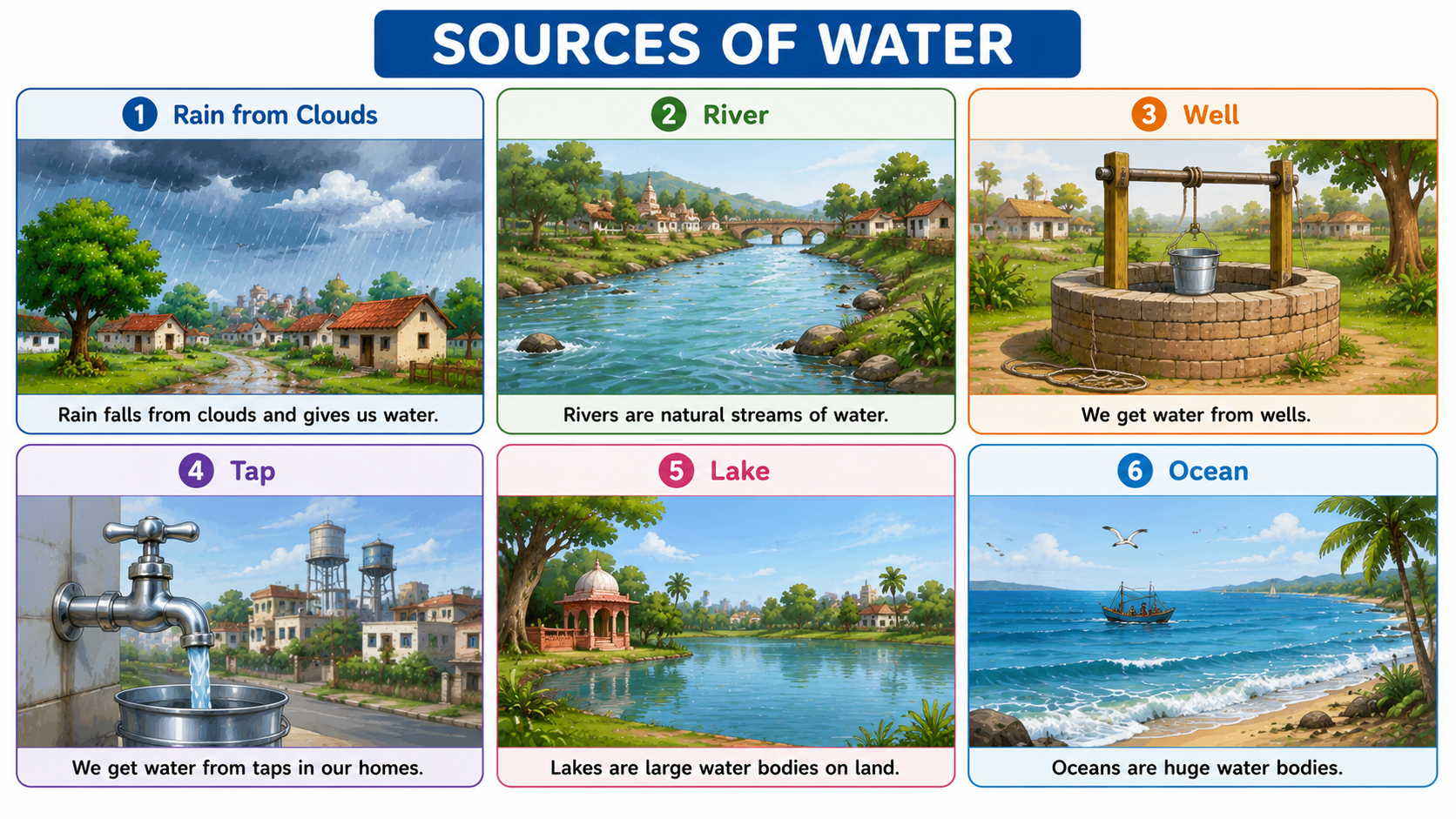
Water comes from many different places. These are called sources of water:
| Source | Type | Description |
|---|---|---|
| Rain | Natural | Water falls from clouds as rain — the main source of all water |
| River | Natural | Large flowing water (Ganga, Yamuna, Brahmaputra, Godavari) |
| Lake | Natural | Still water surrounded by land (Dal Lake, Chilika Lake) |
| Pond | Natural | Small body of still water, often in villages |
| Well | Man-made | Deep hole dug to reach underground water |
| Tube well / Borewell | Man-made | Machine-drilled deep well with a pump |
| Tap water | Man-made | Water supplied through pipes from treatment plants |
| Ocean / Sea | Natural | Huge body of salty water (cannot drink directly) |
| Spring | Natural | Water flowing out from underground through rocks |
Three States of Water
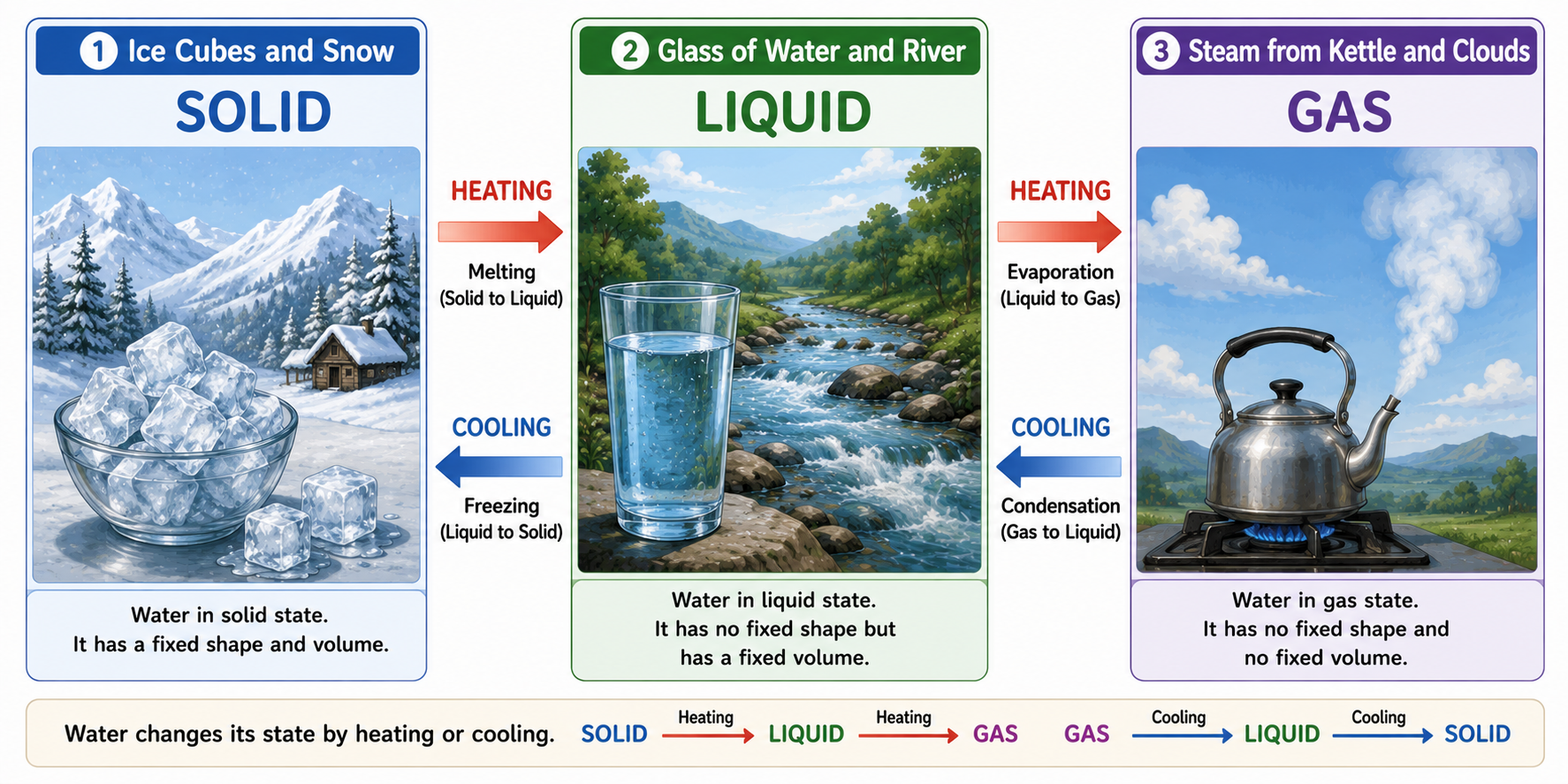
Water can exist in three forms (states):
| State | Form | Example | How It Changes |
|---|---|---|---|
| Solid | Ice | Ice cubes, snow, glaciers, hail | Water freezes below 0°C |
| Liquid | Water | Tap water, river water, rain | Normal temperature |
| Gas | Water vapour / Steam | Steam from hot tea, clouds, fog | Water boils at 100°C |
Changing States:
- Melting: Ice (solid) → Water (liquid) — when heated
- Evaporation: Water (liquid) → Water vapour (gas) — when heated by sun
- Condensation: Water vapour (gas) → Water droplets (liquid) — when cooled
- Freezing: Water (liquid) → Ice (solid) — when cooled below 0°C
The Water Cycle
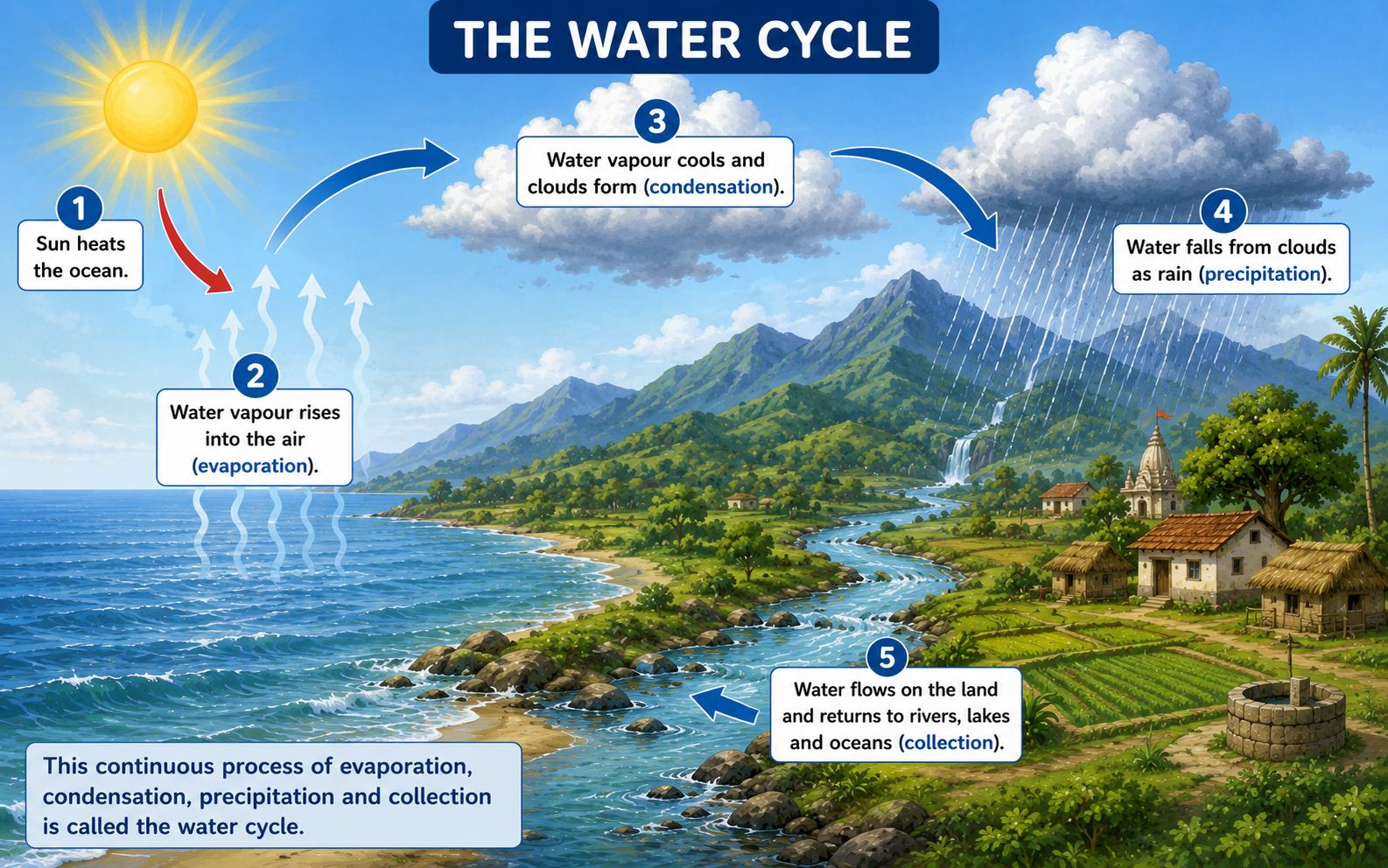
Water keeps moving in a circle between the Earth and the sky. This is called the water cycle:
- Evaporation: The Sun heats water in rivers, lakes, and oceans. Water turns into water vapour (gas) and rises up into the sky.
- Condensation: High up in the sky, water vapour cools down and forms tiny water droplets. These droplets come together to form clouds.
- Precipitation: When clouds become heavy with water, the water falls back to Earth as rain (or snow/hail in cold places).
- Collection: Rain water flows into rivers, lakes, and oceans. Some seeps into the ground (groundwater). The cycle starts again!
Uses of Water
We use water in many ways every day:
| Use | Examples |
|---|---|
| Drinking | We drink 6-8 glasses of water daily to stay healthy |
| Cooking | Boiling rice, making dal, preparing tea |
| Bathing & Washing | Taking bath, washing hands, brushing teeth |
| Cleaning | Washing clothes, mopping floors, cleaning utensils |
| Farming | Watering crops — rice, wheat, vegetables need lots of water |
| For animals | Animals drink water; fish live in water |
| For plants | Plants need water to grow and make food |
| Factories | Making paper, cloth, medicines, steel |
| Transport | Ships and boats travel on water |
| Electricity | Dams use flowing water to generate electricity (hydropower) |
Clean Water vs Dirty Water
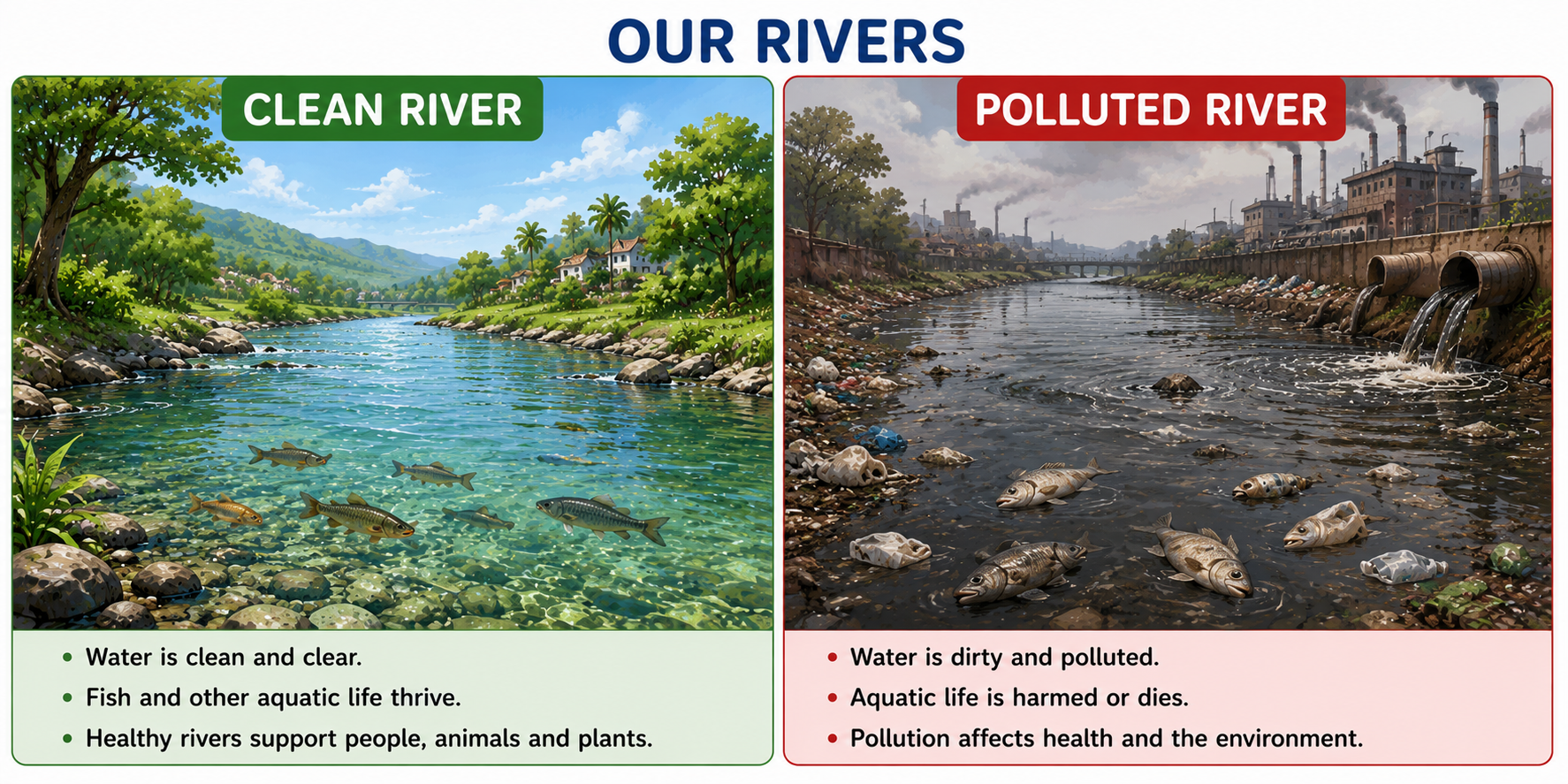
| Clean Water | Dirty (Polluted) Water |
|---|---|
| Clear, no colour | Muddy, coloured, or cloudy |
| No smell | Bad smell |
| No germs (safe to drink) | Full of germs (causes diseases) |
| Comes from filtered taps, RO purifiers | Comes from drains, polluted rivers |
What Makes Water Dirty?
- Factory waste dumped into rivers
- Garbage and plastic thrown into water bodies
- Sewage (toilet waste) flowing into rivers
- Washing clothes and animals in ponds/rivers
- Pesticides from farms flowing into water
Diseases from Dirty Water: Cholera, Typhoid, Diarrhoea, Jaundice
How to Make Water Safe to Drink
- Boiling: Boil water for 10-15 minutes to kill germs
- Filtering: Use a water filter or RO purifier
- Chlorine tablets: Add chlorine tablets to kill germs
- Alum (Fitkari): Add alum to settle mud and dirt
- Cloth filtering: Pour water through a clean cloth to remove dirt
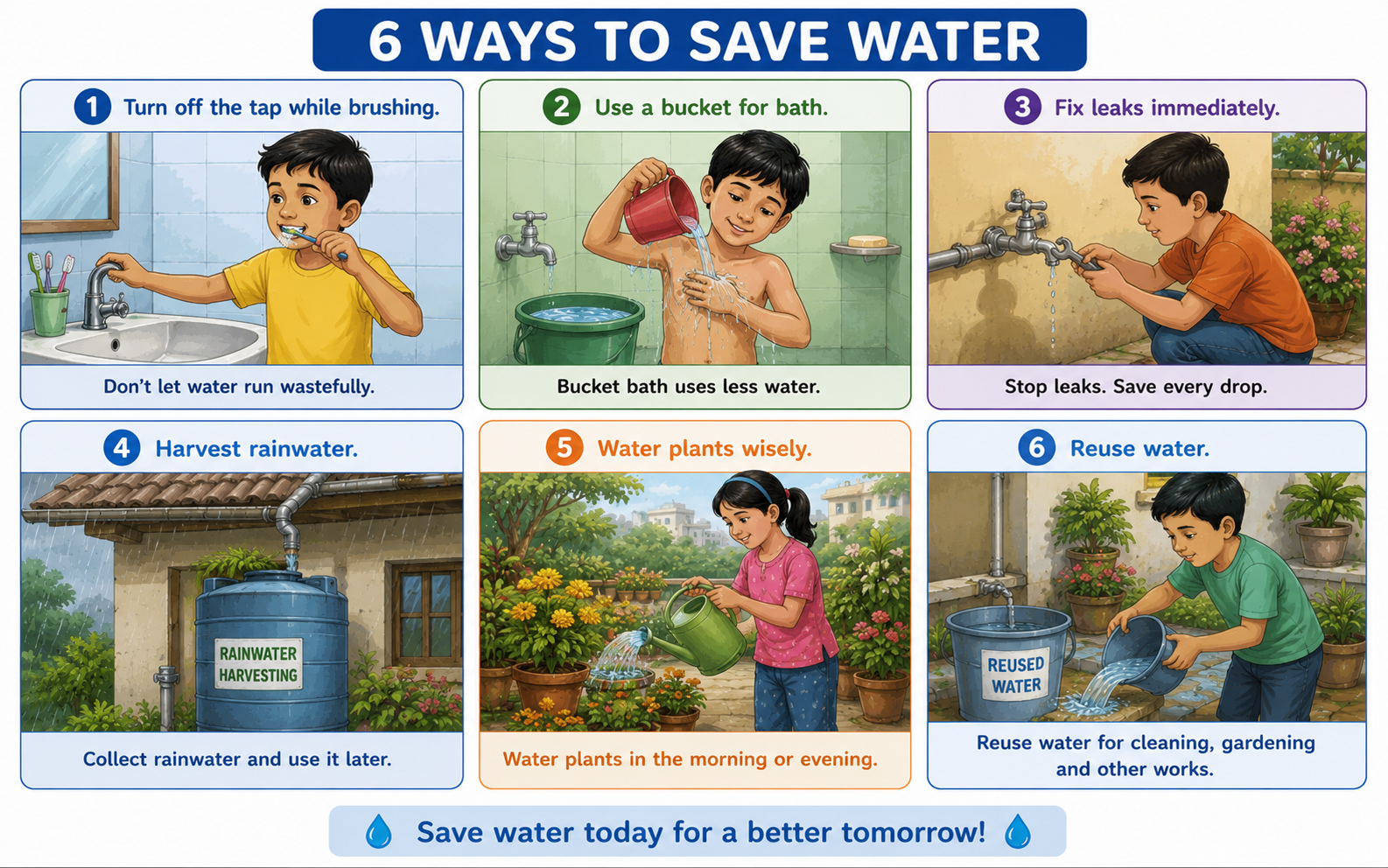
Save Water!
Fresh water is limited. We must save every drop:
- 💧 Turn off the tap while brushing teeth or soaping hands
- 🚿 Take short baths — use a bucket instead of a shower
- 🔧 Fix leaking taps immediately
- 🌧️ Collect rainwater (rainwater harvesting)
- 🌱 Water plants in the evening (less evaporation)
- 🚗 Use a bucket to wash cars, not a hose pipe
- ♻️ Reuse water — use washing machine water for mopping
- 🚫 Do not throw garbage into rivers, lakes, or ponds
Interesting Facts About Water
- 🌍 About 71% of Earth's surface is covered with water.
- 💧 Only 3% of Earth's water is fresh water — the rest is salty ocean water.
- 🏔️ The Ganga is India's longest river (2,525 km) and is considered sacred.
- 🌧️ Mawsynram in Meghalaya receives the highest rainfall in the world!
- 🐫 A camel can drink 200 litres of water in just 3 minutes.
- 🧊 About 69% of fresh water is frozen in glaciers and ice caps.
- 💦 Our body is about 70% water — that's why we need to drink water every day.
Key Words
| Word | Meaning |
|---|---|
| Evaporation | Water turning into water vapour (liquid → gas) |
| Condensation | Water vapour turning into water droplets (gas → liquid) |
| Precipitation | Water falling from clouds as rain, snow, or hail |
| Water cycle | The continuous movement of water between Earth and sky |
| Groundwater | Water stored underground in soil and rocks |
| Water pollution | When harmful things make water dirty and unsafe |
| Rainwater harvesting | Collecting and storing rainwater for later use |
| Hydropower | Electricity made using the force of flowing water |
| Glacier | A large mass of ice found on mountains |
| Filtration | Removing dirt from water by passing through a filter |
- Sources of water: rain, rivers, lakes, wells, borewells, taps, oceans.
- Water exists in 3 states: Solid (ice), Liquid (water), Gas (steam/vapour).
- The water cycle: Evaporation → Condensation → Precipitation → Collection.
- We use water for drinking, cooking, bathing, farming, factories, and electricity.
- Dirty water causes diseases. Always drink boiled or filtered water.
- Save water: close taps, fix leaks, take bucket baths, harvest rainwater.
- Only 3% of Earth's water is fresh — we must not waste it!
Finished learning? Now test what you know!