I can name and describe different types of houses in India.
I can list the materials used to build different houses.
I can identify the main parts of a house.
I can explain how houses are different in different places (plains, hills, deserts, near water).
I can describe how houses have changed over time.
📖 Let Us Begin!
After a long day at school, where do you go? Home! Our home is the place where we feel safe, comfortable, and happy. It protects us from rain, heat, cold, and wild animals.
A house is also called a shelter. Just like birds build nests and animals live in dens, we humans build houses to live in. But did you know that not all houses look the same? People in different parts of India live in very different types of houses!
Let us learn about the different types of houses, what they are made of, and why they are built differently in different places.
Why We Need Houses
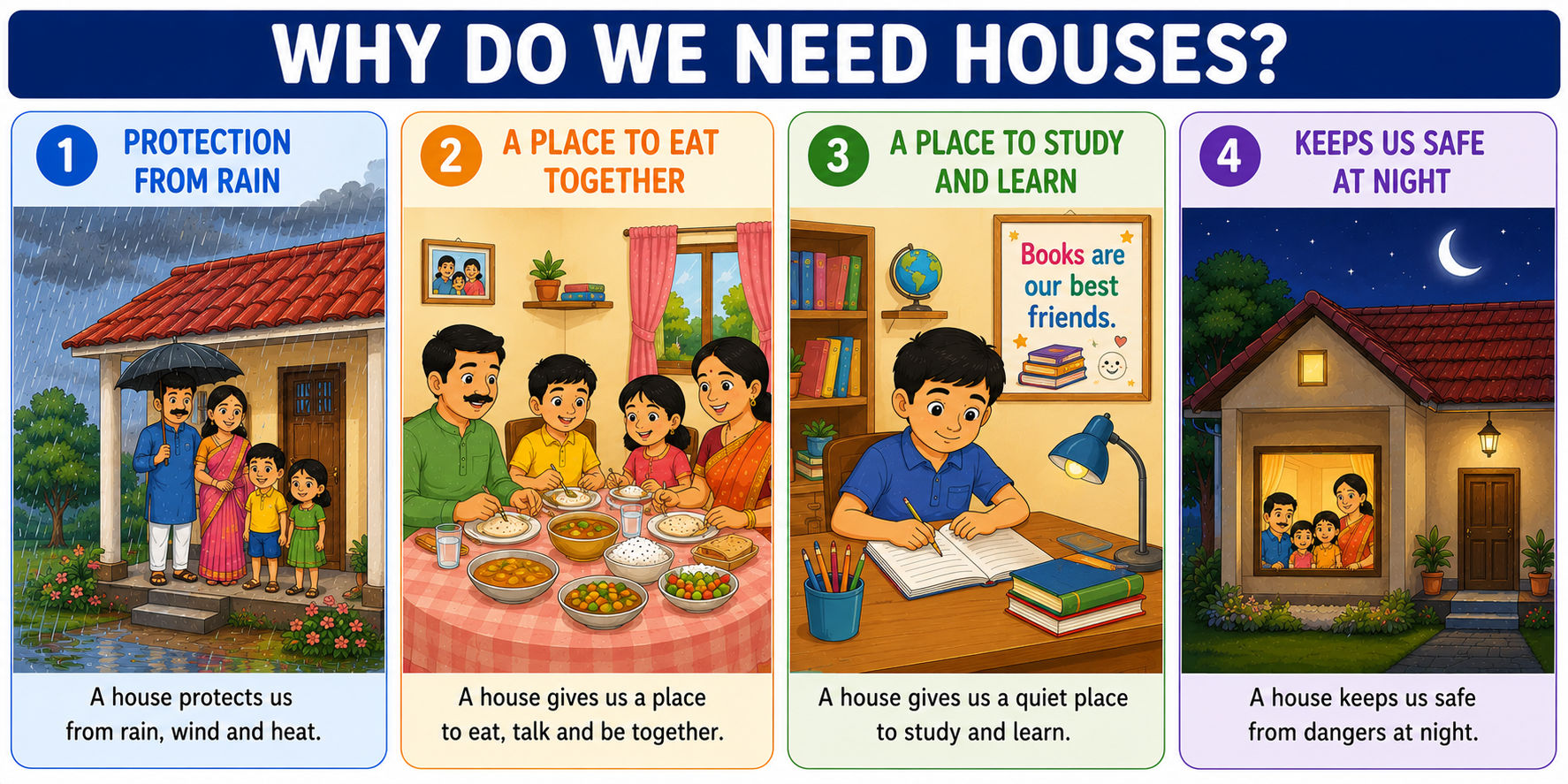
A house is one of our basic needs. We need a house to:
Protect us from weather — rain, heat, cold, storms, and strong winds
Keep us safe — from wild animals, thieves, and strangers
Give us a place to rest — we sleep, eat, study, and play at home
Store our belongings — clothes, food, books, and other things
Live with our family — a house brings the family together
Keep us healthy — a clean house with fresh air keeps us away from diseases
Think about it: What would happen if we had no house? Where would we sleep when it rains? Where would we keep our things safe? A house is not a luxury — it is a necessity!
Types of Houses
India is a big country with many different types of houses. The type of house people live in depends on the climate, materials available, and money they have. Let us learn about the main types:
1. Pucca House (Permanent House)
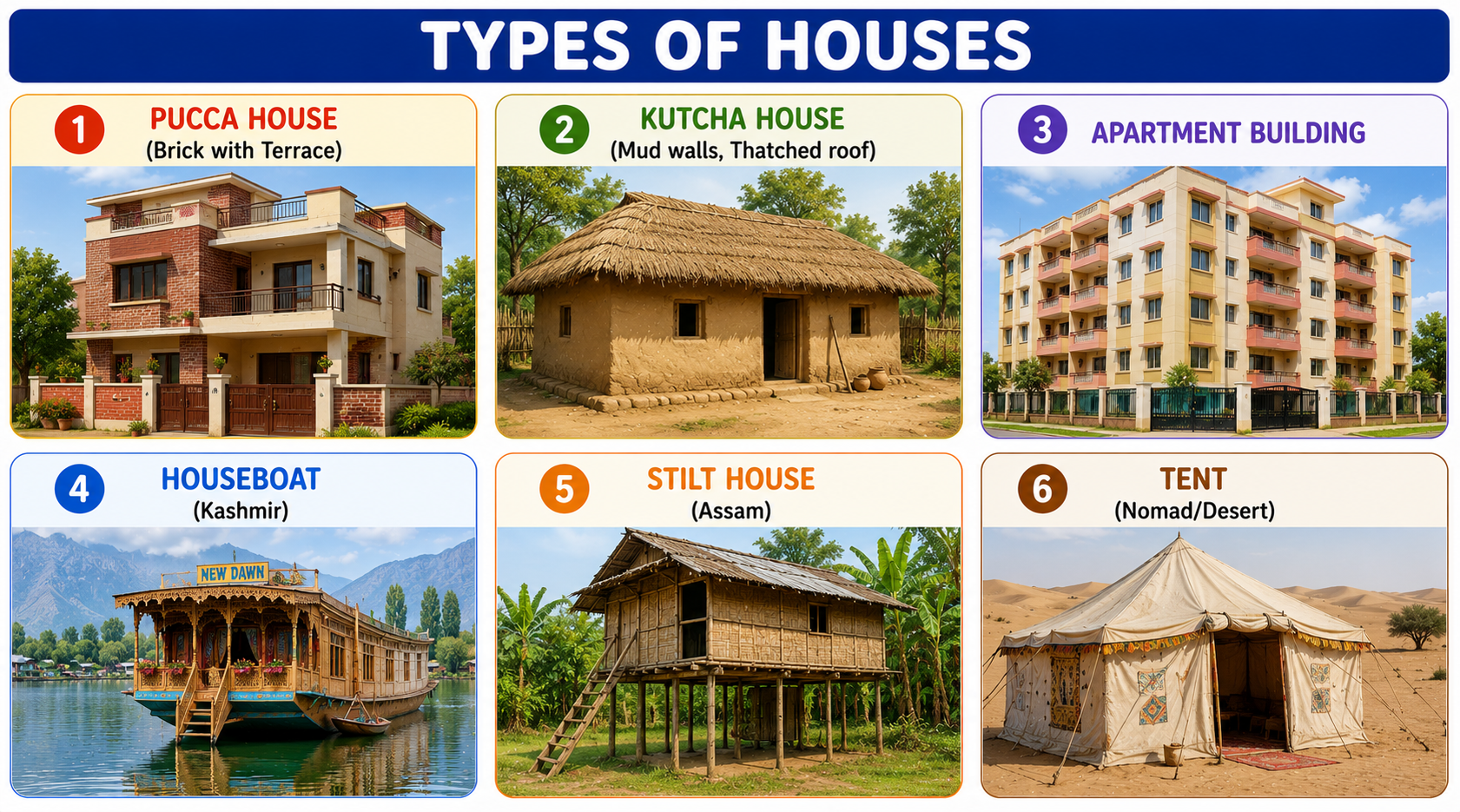
A pucca house is a strong, permanent house made of bricks, cement, concrete, and steel. It has a proper roof, walls, doors, and windows. Most houses in cities and towns are pucca houses. They last for many years and can withstand rain and storms.
Example: Ravi lives in a pucca house in Jaipur. His house has two floors, a terrace, and a small garden.
2. Kutcha House (Temporary House)
A kutcha house is made of mud, straw, bamboo, leaves, and thatch. These houses are not very strong and can get damaged by heavy rain or storms. Many people in villages live in kutcha houses. They are easy and cheap to build.
Example: Meena's grandmother lives in a kutcha house in a village in Bihar. The walls are made of mud and the roof is made of straw.
3. Flat / Apartment
An apartment (or flat) is a house inside a big building with many floors. Many families live in the same building, each in their own flat. Apartments are common in big cities like Mumbai, Delhi, Kolkata, and Bengaluru where there is less space.
Example: Arjun lives on the 5th floor of an apartment building in Mumbai. His building has 12 floors and a lift.
4. Bungalow
A bungalow is a big, independent house with a large compound, garden, and sometimes a garage. Bungalows have lots of space and are usually found in less crowded areas. They are expensive to build.
Example: The District Collector of Arjun's town lives in a big bungalow with a beautiful garden.
5. Houseboat
A houseboat is a house built on a boat that floats on water. In Kashmir, houseboats called shikaras float on Dal Lake. In Kerala, houseboats (called kettuvallam) float on the backwaters. People live, cook, and sleep on these boats!
Example: Tourists visiting Srinagar stay in beautiful houseboats on Dal Lake.
6. Stilt House
Stilt houses are built on tall poles (stilts) above the ground or water. They are found in areas that get heavy rainfall and floods, like Assam and Meghalaya in North-East India. The raised floor keeps the house safe from flood water and snakes.
Example: In Majuli island in Assam, many houses are built on bamboo stilts to stay above flood water.
7. Igloo
An igloo is a dome-shaped house made of blocks of ice and snow. Igloos are found in very cold places like the Arctic region (not in India). The Inuit people build igloos. The thick ice walls keep the cold wind out and trap body heat inside.
8. Tent
A tent is a temporary shelter made of cloth, canvas, or animal skin stretched over poles. Tents are used by people who move from place to place, like nomads in Rajasthan and Gujjar tribes in Jammu & Kashmir. Soldiers also live in tents.
Example: The Changpa nomads of Ladakh live in tents called "rebo" as they move with their yak and goat herds.
Materials Used to Build Houses
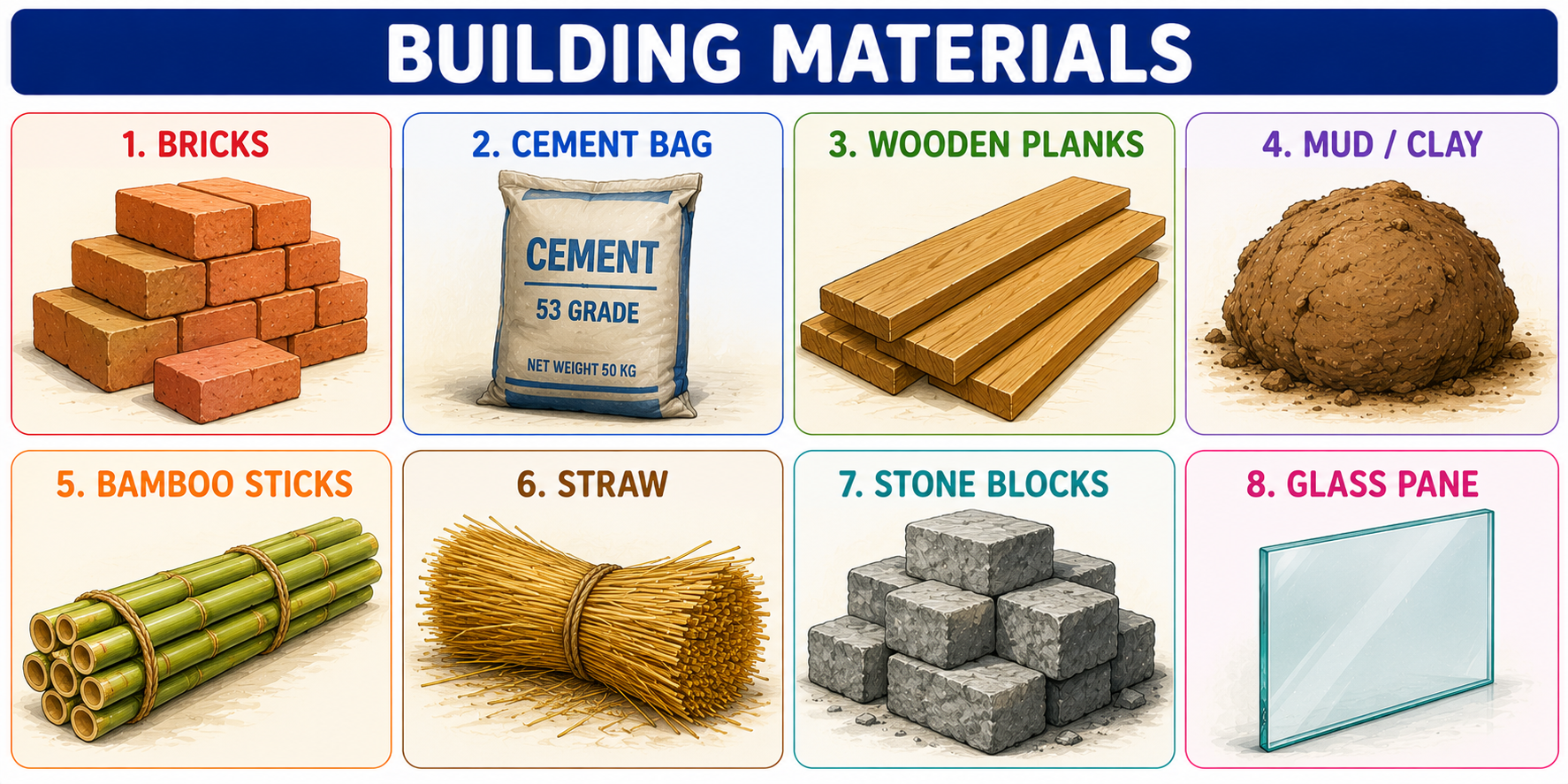
Different houses are made of different materials. The materials depend on what is available in that area and how much money people have.
Material
Used In
Why It Is Used
Bricks
Pucca houses, apartments
Strong, long-lasting, fire-resistant
Cement & Concrete
Pucca houses, buildings
Holds bricks together; makes strong floors and roofs
Steel & Iron
Buildings, bridges
Very strong; used in pillars and beams
Wood
Doors, windows, furniture, hill houses
Easy to cut and shape; keeps houses warm
Mud
Kutcha houses in villages
Freely available; keeps house cool in summer
Straw & Thatch
Roofs of kutcha houses
Light, cheap, easy to find in villages
Bamboo
Houses in North-East India, stilt houses
Strong, flexible, grows quickly
Stone
Houses in hilly areas (Rajasthan, Himachal)
Very strong; available in rocky areas
Glass
Windows in modern houses
Lets light in; keeps wind and dust out
Ice & Snow
Igloos in Arctic
Only material available in frozen lands
Think about it: Why do people in villages use mud and straw? Because these materials are freely available around them and cost very little money. People use what nature gives them!
Parts of a House
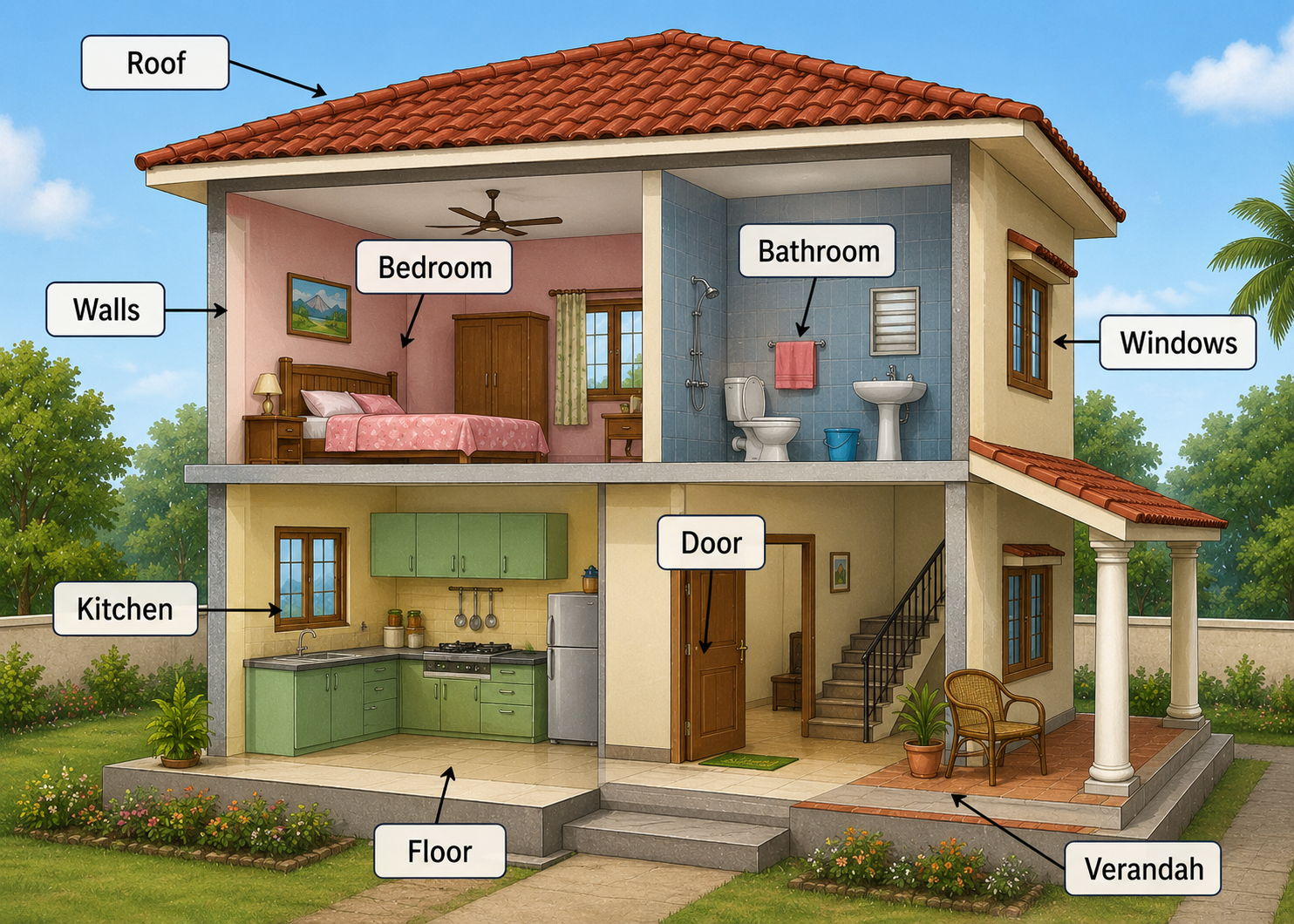
Every house, whether big or small, has some important parts:
Part
What It Does
Roof
Covers the top of the house; protects from rain, sun, and cold
Walls
Support the roof; protect from wind, animals, and give privacy
Floor
The base we walk on; keeps us above the ground
Doors
Let us enter and exit; can be locked for safety
Windows
Let fresh air and sunlight come in; we can see outside
Kitchen
Where food is cooked
Bedroom
Where we sleep and rest
Bathroom
Where we bathe and wash
Verandah / Balcony
Open area to sit and enjoy fresh air
Terrace
Open area on the roof; used for drying clothes
Example
Ravi's House
Ravi lives in a pucca house in Jaipur. His house has: a strong concrete roof, brick walls painted yellow, a wooden door with a lock, glass windows with curtains, a kitchen where his mother cooks, two bedrooms, one bathroom, and a small verandah where his grandfather sits in the evening.
Houses in Different Places
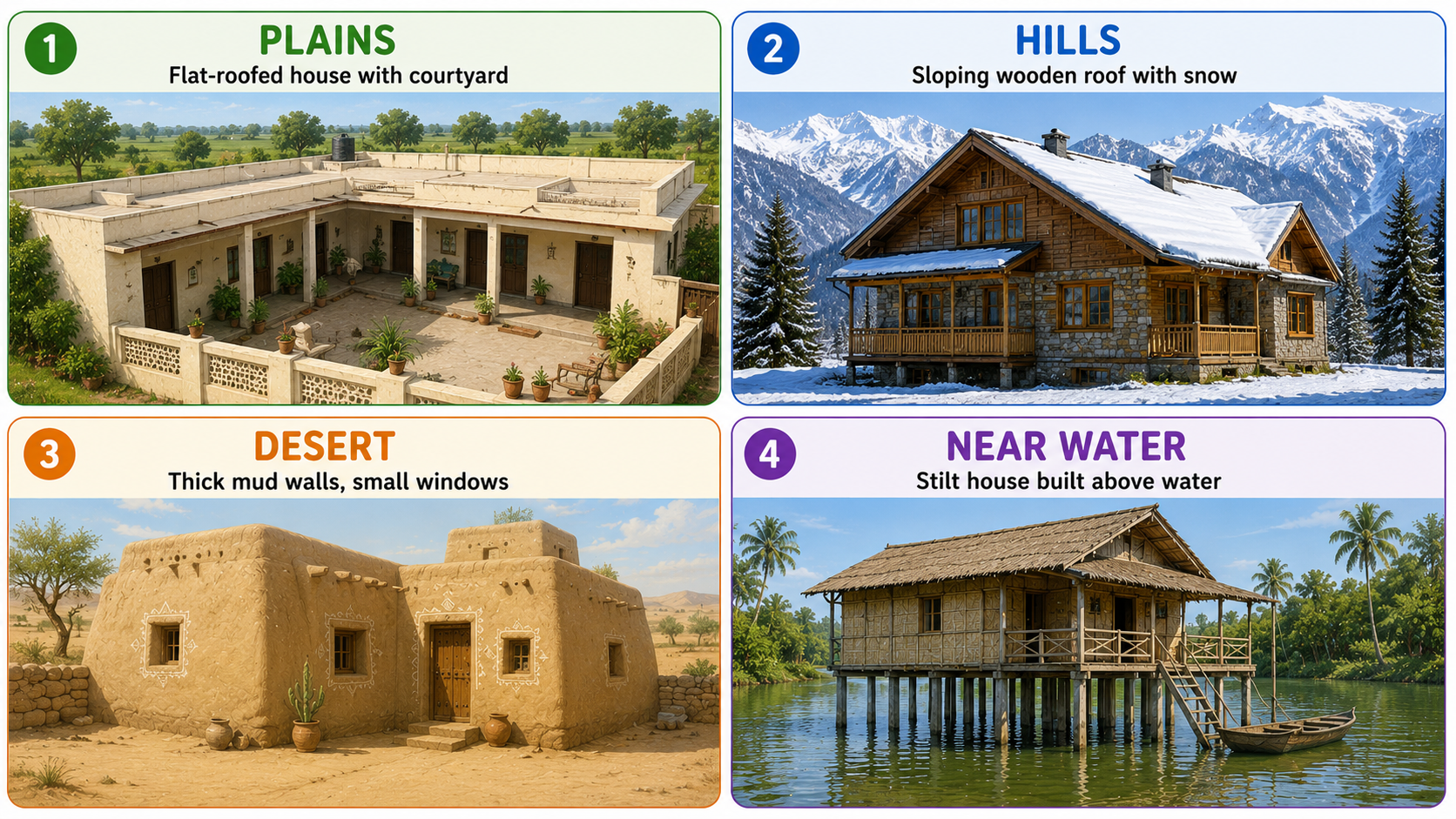
India has many different climates — hot plains, cold mountains, dry deserts, and wet coastal areas. People build houses that suit the climate of their place.
1. Houses on the Plains
The plains of India (like Uttar Pradesh, Punjab, Bihar) have hot summers and cold winters. Houses here have:
Flat roofs (for sleeping on the terrace in summer)
Thick walls to keep the house cool
Big windows for air circulation
A courtyard (aangan) in the middle for family gatherings
2. Houses in the Hills
Hill areas (like Himachal Pradesh, Uttarakhand, Darjeeling) get heavy rain and snowfall. Houses here have:
Sloping roofs — so rain and snow slide off easily
Made of wood and stone — to keep warm
Built on higher ground — to avoid landslides
Small windows — to keep cold wind out
3. Houses in the Desert
Desert areas (like Rajasthan, Kutch in Gujarat) are very hot in the day and cold at night. Houses here have:
Thick mud walls — keep the house cool during the day
Flat roofs — very little rain, so no need for sloping roofs
Small windows — to keep hot sand and dust out
Light colours (white, cream) — reflect sunlight and keep house cool
4. Houses Near Water
Areas near rivers, lakes, or the sea (like Assam, Kerala, West Bengal) get heavy rainfall and floods. Houses here have:
Sloping roofs — for heavy rain to flow off quickly
Built on stilts — to stay above flood water
Made of bamboo and wood — light materials that don't get damaged easily by water
Houseboats — in Kashmir and Kerala, people live on water
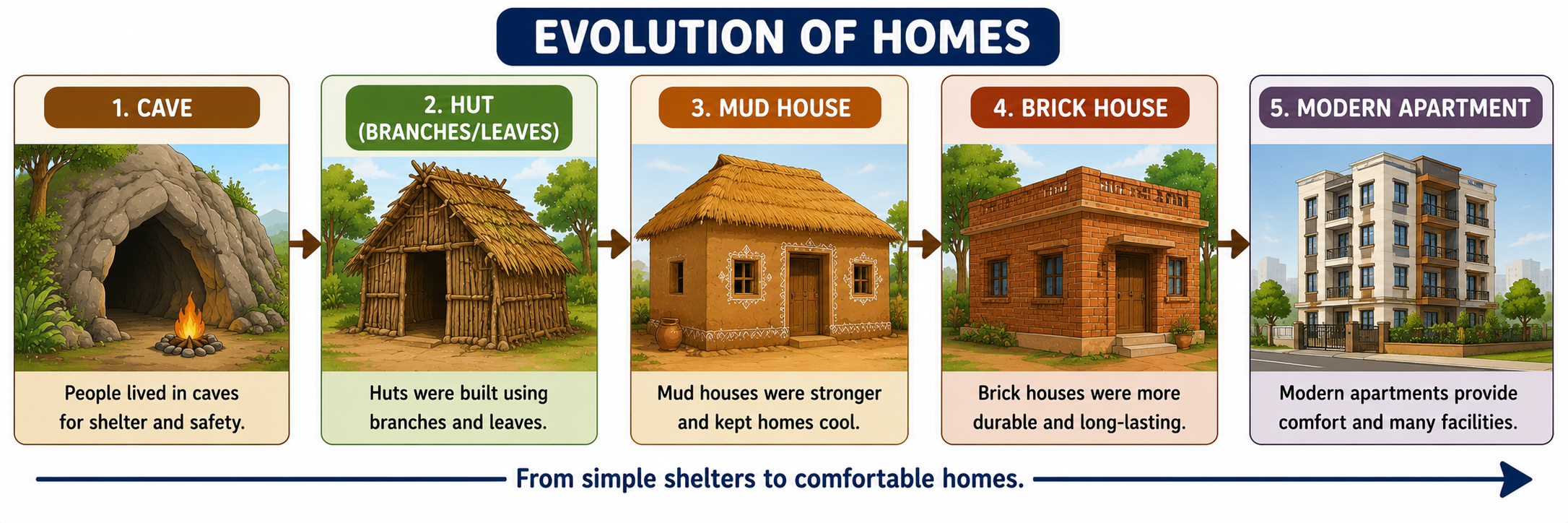
How Houses Have Changed Over Time
Long ago, early humans did not have houses like we do today. Let us see how houses changed over thousands of years:
Time Period
Type of Shelter
Description
Very long ago (Stone Age)
Caves
Early humans lived in natural caves to hide from wild animals and rain
Later (when humans learned farming)
Huts
People made huts from branches, leaves, mud, and animal skin
Ancient times
Mud houses
People built proper houses with mud walls and thatched roofs
A few hundred years ago
Brick houses
People learned to make bricks and build stronger houses
Today (Modern times)
Apartments & skyscrapers
We build tall buildings with cement, steel, and glass
Did you know? The Indus Valley Civilization (about 5000 years ago) had well-planned cities with brick houses, proper drainage, and even bathrooms! The city of Mohenjo-daro had some of the most advanced houses of ancient times.
📝 Key Words
Word
Meaning
Shelter
A place that protects us from weather, danger, and gives us a place to live
Pucca house
A strong, permanent house made of bricks, cement, and concrete
Kutcha house
A temporary house made of mud, straw, bamboo, or leaves
Apartment / Flat
A house inside a multi-storey building where many families live
Houseboat
A house built on a boat that floats on water
Stilt house
A house built on tall poles above the ground or water
Igloo
A dome-shaped house made of ice blocks, found in Arctic regions
Nomad
A person who moves from place to place and does not live in one fixed house
Sloping roof
A roof that is tilted so that rain and snow can slide off easily
Terrace
An open flat area on the roof of a house
⭐ Key Points to Remember
A house (shelter) protects us from weather, keeps us safe, and gives us a place to live with family.
Pucca houses are made of bricks and cement; kutcha houses are made of mud and straw.
Other types of houses include apartments, bungalows, houseboats, stilt houses, igloos, and tents.
Houses are built using materials like bricks, cement, wood, mud, bamboo, stone, and glass.
Houses in plains have flat roofs; houses in hills have sloping roofs; houses near water are on stilts.
Desert houses have thick walls and small windows to keep out heat and sand.
Houses have changed over time — from caves to huts to mud houses to modern apartments.
Finished learning? Now test what you know!
🎯 Quick Quiz — Test Yourself!
Answer these 8 questions about shelter and houses. Read each one carefully and pick the best answer!
Score: 0 / 8
1. Why do we need a house (shelter)?
A house protects us from weather, keeps us safe, and gives us a place to live with family.
2. A house made of bricks and cement is called a...
A pucca house is made of strong materials like bricks and cement.
3. A kutcha house is usually made of...
A kutcha house is made of mud and straw.
4. A house made of ice, found in very cold places, is called an...
An igloo is a house made of ice, found in very cold snowy regions.
5. Why do houses in hilly areas have sloping roofs?
Sloping roofs let rain and snow slide off easily in hilly areas.
6. Houses built near water on tall poles are called...
Stilt houses are built on tall poles to stay above water.
7. Name any ONE material used to build houses.
Houses are built using bricks, cement, wood, mud, bamboo, stone, and glass.
8. Why do desert houses have thick walls and small windows?
Thick walls and small windows keep the hot sun and sand out of desert homes.
✏️ Practice Questions
A. Fill in the Blanks
1. A house protects us from rain, heat, cold, and .
2. A strong house made of bricks and cement is called a house.
3. A house made of mud and straw is called a house.
4. Houseboats in Kashmir float on Lake.
5. Houses in hilly areas have roofs so that rain and snow can slide off.
6. Stilt houses are built on tall above the ground.
7. An igloo is made of blocks of .
8. People who move from place to place are called .
9. Early humans lived in to protect themselves from wild animals.
10. lets sunlight into the house through windows.
B. Multiple Choice Questions
1. Which type of house is made of bricks and cement?
3. Why do houses in hilly areas have sloping roofs?
(a) To look beautiful(b) So rain and snow slide off(c) To save money(d) To keep animals out
4. Which material is used to build kutcha houses?
(a) Steel(b) Glass(c) Mud and straw(d) Concrete
5. Stilt houses are found in areas that have:
(a) Snowfall(b) Heavy floods(c) Earthquakes(d) Deserts
C. Short Answer Questions
1. Why do we need a house? Write any three reasons.
2. What is the difference between a pucca house and a kutcha house?
3. Why do houses in hilly areas have sloping roofs?
4. Name any three materials used to build houses.
5. How did early humans protect themselves before they learned to build houses?
D. True or False
1. A kutcha house is stronger than a pucca house.
2. Houses in the desert have thick walls to keep out heat.
3. An igloo is made of wood and leaves.
4. Stilt houses protect people from floods.
5. All houses in India look the same.
E. Match the Following
Column A
Column B
1. Houseboat
a. Made of ice blocks
2. Igloo
b. Built on stilts above water
3. Stilt house
c. Floats on Dal Lake in Kashmir
4. Tent
d. Made of mud and straw
5. Kutcha house
e. Used by nomads who travel
🎨 Fun Activity
Activity: My Dream House
Draw your dream house in the space below. Think about:
What materials would you use? (bricks, wood, glass, bamboo?)
How many rooms would it have?
Would it have a garden, a terrace, or a balcony?
Where would it be — in a city, village, hill, or near water?
Draw your dream house here:
Write 3 sentences about your dream house:
Want to review the lesson again?
EVS / Science
Shelter
Class 3 | CBSE / NCERT / ICSE
Name: Class: Date:
Learning Objectives
I can explain why we need houses (shelter).
I can name and describe different types of houses in India.
I can list the materials used to build different houses.
I can identify the main parts of a house.
I can explain how houses are different in different places.
I can describe how houses have changed over time.
Why We Need Houses
A house is one of our basic needs. It protects us from rain, heat, cold, and storms. It keeps us safe from wild animals and strangers. A house gives us a place to rest, sleep, eat, study, and live with our family. A clean house keeps us healthy.
Types of Houses
Type
Made Of
Where Found
Pucca house
Bricks, cement, concrete, steel
Cities and towns all over India
Kutcha house
Mud, straw, bamboo, leaves
Villages (Bihar, UP, Rajasthan)
Apartment / Flat
Concrete, steel, glass
Big cities (Mumbai, Delhi, Kolkata)
Bungalow
Bricks, cement, wood
Less crowded areas, cantonment
Houseboat
Wood, floats on water
Kashmir (Dal Lake), Kerala
Stilt house
Bamboo, wood, on tall poles
Assam, Meghalaya (flood areas)
Igloo
Ice and snow blocks
Arctic region (not in India)
Tent
Cloth, canvas, animal skin
Nomads in Rajasthan, Ladakh
Materials Used to Build Houses
Material
Used In
Why
Bricks
Pucca houses
Strong, long-lasting
Cement & Concrete
Buildings, floors, roofs
Holds bricks; makes strong structures
Wood
Doors, windows, hill houses
Easy to shape; keeps warm
Mud
Kutcha houses in villages
Free; keeps house cool
Straw & Thatch
Roofs of kutcha houses
Light, cheap, easy to find
Bamboo
North-East India houses
Strong, flexible, grows fast
Stone
Hilly areas (Rajasthan, Himachal)
Very strong; available in rocky areas
Glass
Windows
Lets light in; blocks wind
Parts of a House
Part
What It Does
Roof
Protects from rain, sun, and cold
Walls
Support roof; protect from wind; give privacy
Floor
Base we walk on
Doors
Let us enter/exit; can be locked
Windows
Let fresh air and sunlight in
Kitchen
Where food is cooked
Bedroom
Where we sleep and rest
Bathroom
Where we bathe and wash
Verandah
Open area to sit and enjoy fresh air
Terrace
Open area on roof for drying clothes
Houses in Different Places
Place
Climate
House Features
Plains (UP, Punjab)
Hot summers, cold winters
Flat roofs, thick walls, big windows, courtyard
Hills (Himachal, Uttarakhand)
Heavy rain, snowfall
Sloping roofs, wood & stone, small windows
Desert (Rajasthan, Kutch)
Very hot days, cold nights
Thick mud walls, flat roofs, small windows, light colours
Near water (Assam, Kerala)
Heavy rainfall, floods
Sloping roofs, stilts, bamboo & wood, houseboats
How Houses Have Changed Over Time
Time
Shelter
Description
Stone Age
Caves
Natural caves for hiding from animals
After farming began
Huts
Branches, leaves, mud, animal skin
Ancient times
Mud houses
Mud walls, thatched roofs
Few hundred years ago
Brick houses
Stronger, more permanent
Today
Apartments
Cement, steel, glass — tall buildings
Did you know? The Indus Valley Civilization (5000 years ago) had well-planned cities with brick houses, drainage, and bathrooms!
Key Words
Word
Meaning
Shelter
A place that protects us from weather and danger
Pucca house
Strong house made of bricks, cement, concrete
Kutcha house
Temporary house made of mud, straw, bamboo
Apartment
House in a multi-storey building
Houseboat
House on a boat that floats on water
Stilt house
House on tall poles above ground/water
Igloo
Dome-shaped house made of ice blocks
Nomad
Person who moves from place to place
Sloping roof
Tilted roof for rain/snow to slide off
Terrace
Open flat area on the roof
⭐ Key Points to Remember
A house protects us from weather, keeps us safe, and gives us a place to live.