Maths
Skip Counting
Learning Objectives
- Count by 2s up to 20.
- Count by 3s up to 30.
- Count by 5s up to 50.
- Count by 10s up to 100.
- Identify and extend skip counting patterns.
- Use skip counting to solve real-life problems.
Let Us Begin!
Meena is counting her biscuits. Instead of counting one by one, she counts them in groups of 2: "2, 4, 6, 8..." This is called skip counting! Skip counting means jumping over some numbers and counting in equal steps. It helps us count faster and is the first step towards multiplication.
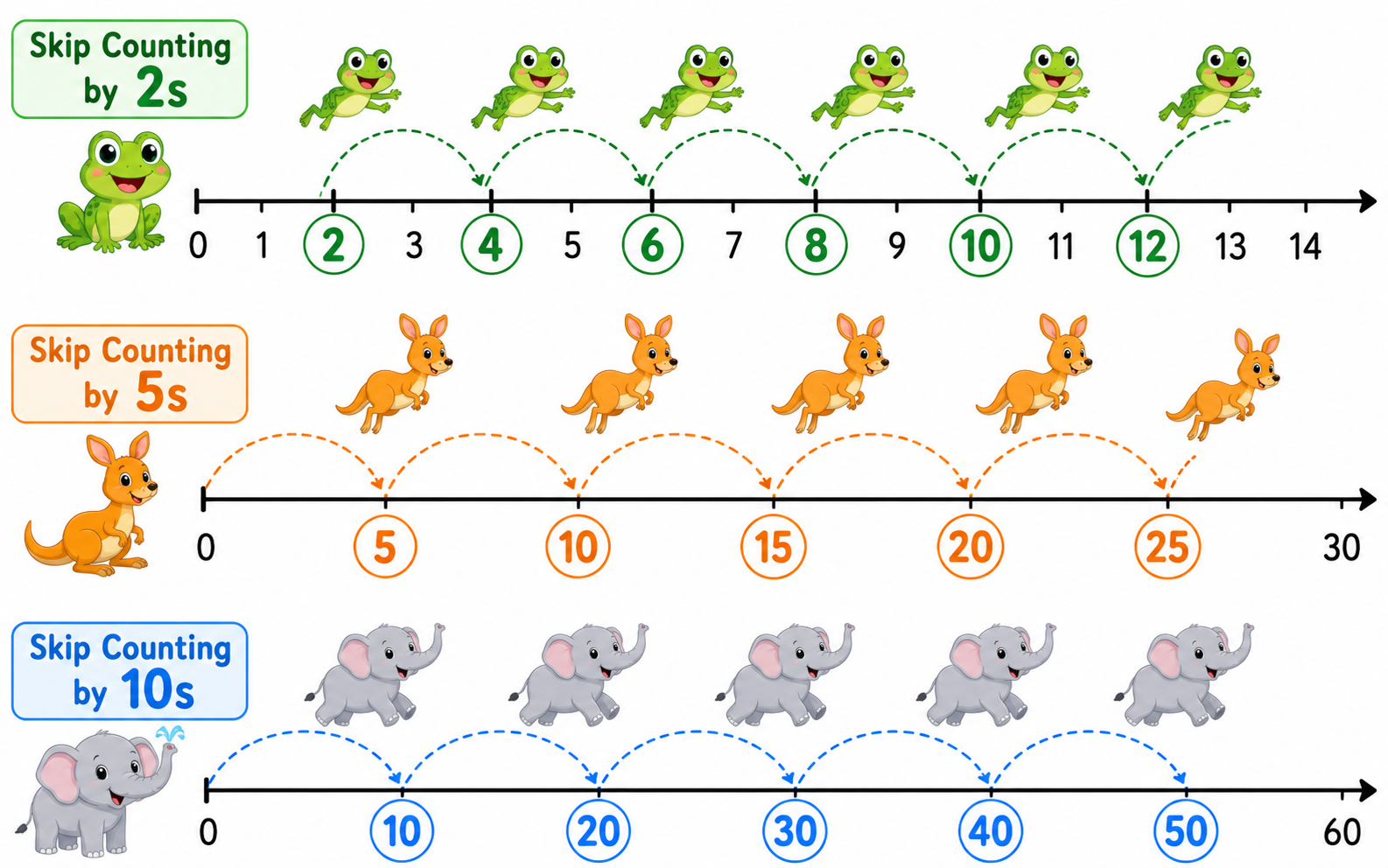
Counting by 2s
We add 2 each time. These are the even numbers!
Count by 2s up to 20:
2, 4, 6, 8, 10, 12, 14, 16, 18, 20
Example 1: Ravi has 5 pairs of shoes. Count the shoes: 2, 4, 6, 8, 10. He has 10 shoes!
Example 2: Sita counts the wheels on 4 bicycles: 2, 4, 6, 8. There are 8 wheels.
Example 3: Count the eyes of 6 children: 2, 4, 6, 8, 10, 12. There are 12 eyes.
2, 4, 6, 8, 10, 12, 14, 16, 18, 20
Example 1: Ravi has 5 pairs of shoes. Count the shoes: 2, 4, 6, 8, 10. He has 10 shoes!
Example 2: Sita counts the wheels on 4 bicycles: 2, 4, 6, 8. There are 8 wheels.
Example 3: Count the eyes of 6 children: 2, 4, 6, 8, 10, 12. There are 12 eyes.
Tip: When you count by 2s, you always land on even numbers!
Counting by 3s
We add 3 each time.
Count by 3s up to 30:
3, 6, 9, 12, 15, 18, 21, 24, 27, 30
Example: Arjun has 5 packets of samosas. Each packet has 3 samosas. Count: 3, 6, 9, 12, 15. He has 15 samosas!
3, 6, 9, 12, 15, 18, 21, 24, 27, 30
Example: Arjun has 5 packets of samosas. Each packet has 3 samosas. Count: 3, 6, 9, 12, 15. He has 15 samosas!
Counting by 5s
We add 5 each time. These numbers always end in 0 or 5.
Count by 5s up to 50:
5, 10, 15, 20, 25, 30, 35, 40, 45, 50
Example 1: Sita has 4 packets of 5 biscuits each. Count: 5, 10, 15, 20. She has 20 biscuits.
Example 2: Count ₹5 coins: If you have 6 coins, count 5, 10, 15, 20, 25, 30. You have ₹30!
5, 10, 15, 20, 25, 30, 35, 40, 45, 50
Example 1: Sita has 4 packets of 5 biscuits each. Count: 5, 10, 15, 20. She has 20 biscuits.
Example 2: Count ₹5 coins: If you have 6 coins, count 5, 10, 15, 20, 25, 30. You have ₹30!
Tip: Look at your hand — you have 5 fingers. Use your fingers to count by 5s!
Counting by 10s
We add 10 each time. These numbers always end in 0.
Count by 10s up to 100:
10, 20, 30, 40, 50, 60, 70, 80, 90, 100
Example 1: Arjun has 6 bags with 10 marbles each. Count: 10, 20, 30, 40, 50, 60. He has 60 marbles.
Example 2: Count ₹10 notes: If you have 5 notes, count 10, 20, 30, 40, 50. You have ₹50!
10, 20, 30, 40, 50, 60, 70, 80, 90, 100
Example 1: Arjun has 6 bags with 10 marbles each. Count: 10, 20, 30, 40, 50, 60. He has 60 marbles.
Example 2: Count ₹10 notes: If you have 5 notes, count 10, 20, 30, 40, 50. You have ₹50!
Counting by 10s is the fastest! It helps us count big numbers quickly.
Skip Counting Chart
| Skip by | Numbers | Pattern |
|---|---|---|
| 2s | 2, 4, 6, 8, 10, 12, 14, 16, 18, 20 | All even numbers |
| 3s | 3, 6, 9, 12, 15, 18, 21, 24, 27, 30 | Add 3 each time |
| 5s | 5, 10, 15, 20, 25, 30, 35, 40, 45, 50 | End in 0 or 5 |
| 10s | 10, 20, 30, 40, 50, 60, 70, 80, 90, 100 | End in 0 |
Key Words
| Word | Meaning |
|---|---|
| Skip counting | Counting by jumping over numbers in equal steps |
| Count by 2s | Adding 2 each time: 2, 4, 6, 8... |
| Count by 3s | Adding 3 each time: 3, 6, 9, 12... |
| Count by 5s | Adding 5 each time: 5, 10, 15, 20... |
| Count by 10s | Adding 10 each time: 10, 20, 30, 40... |
| Pattern | Numbers that follow a rule |
⭐ Key Points to Remember
- Skip counting means adding the same number each time.
- Counting by 2s gives even numbers: 2, 4, 6, 8, 10...
- Counting by 3s: 3, 6, 9, 12, 15...
- Counting by 5s gives numbers ending in 0 or 5: 5, 10, 15, 20...
- Counting by 10s gives numbers ending in 0: 10, 20, 30, 40...
- Skip counting helps us count large groups quickly.
- Skip counting is the first step to learning multiplication!
Finished learning? Now test what you know!