Maths
Word Problems
Learning Objectives
- Read and understand simple word problems.
- Identify whether to add or subtract to solve a problem.
- Use clue words to decide the operation.
- Solve addition word problems with numbers up to 50.
- Solve subtraction word problems with numbers up to 50.
- Write the answer with the correct unit (rupees, mangoes, children, etc.).
Let Us Begin!
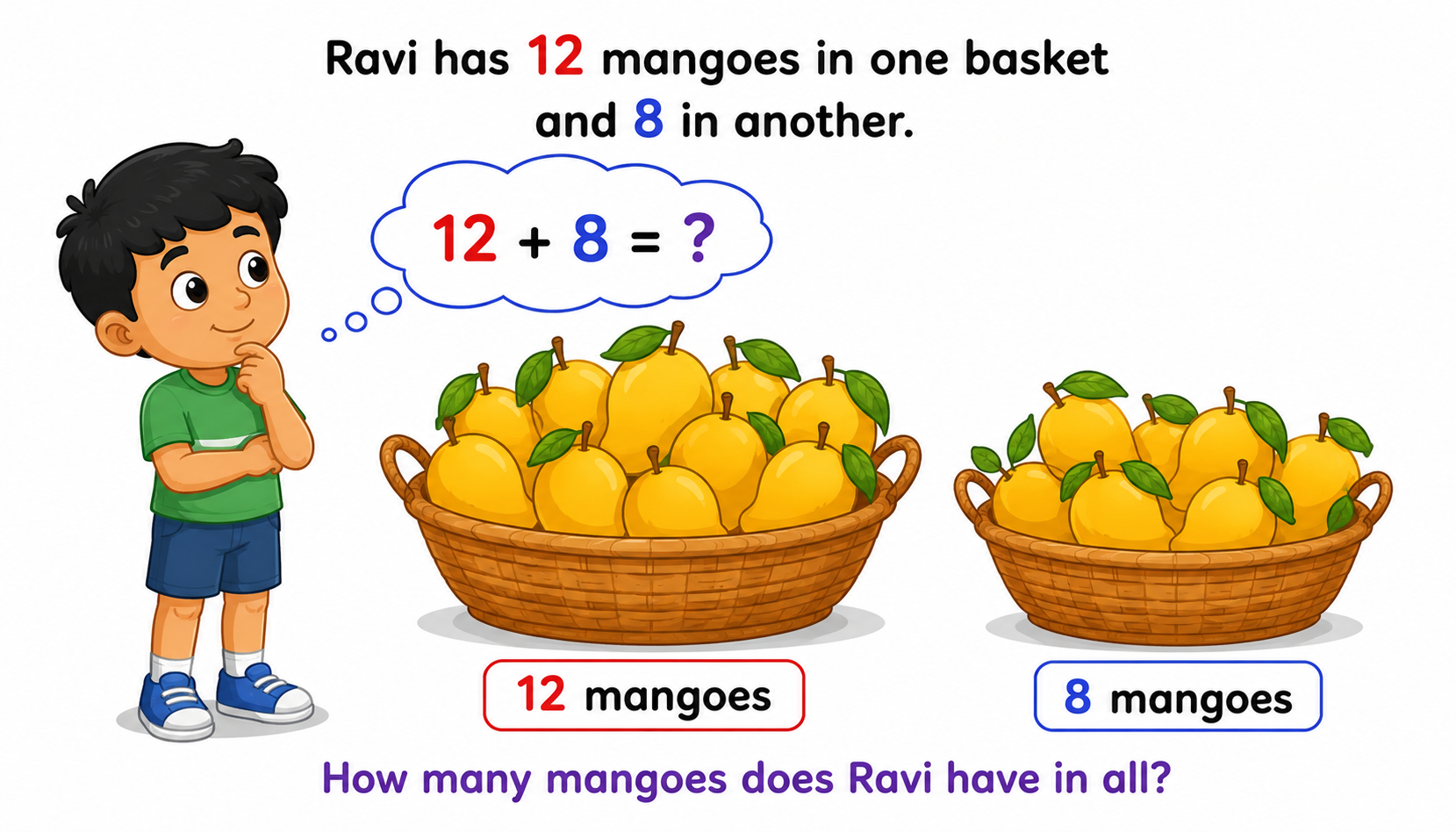
Ravi has 12 mangoes. His friend Arjun gives him 8 more. How many mangoes does Ravi have now? This is a word problem!
Word problems are maths questions written as stories. We need to read carefully, find the numbers, and decide whether to add (+) or subtract (−). Let us learn how to solve word problems step by step.
How to Solve a Word Problem (4 Steps)
Step 1: READ the problem carefully. Read it twice if needed.
Step 2: FIND the numbers and the question (what is being asked?).
Step 3: DECIDE — do we add or subtract? Look for clue words.
Step 4: SOLVE — write the number sentence and the answer with the unit.
Step 2: FIND the numbers and the question (what is being asked?).
Step 3: DECIDE — do we add or subtract? Look for clue words.
Step 4: SOLVE — write the number sentence and the answer with the unit.
Clue Words
| Clue Words for Addition (+) | Clue Words for Subtraction (−) |
|---|---|
| in all, together, total, altogether | left, remaining, left over |
| how many in all, both together | gave away, flew away, ate, lost |
| more, joined, came | how many more, difference |
Tip: If things are coming together or increasing → ADD. If things are going away or decreasing → SUBTRACT.
Addition Word Problems (Solved Examples)
Problem 1: Meena has 15 red bangles and 12 green bangles. How many bangles does she have in all?
Numbers: 15 and 12. Clue: "in all" → ADD
15 + 12 = 27 bangles ✓
Numbers: 15 and 12. Clue: "in all" → ADD
15 + 12 = 27 bangles ✓
Problem 2: Arjun had ₹20. His grandfather gave him ₹15 more on Diwali. How much money does Arjun have now?
Numbers: 20 and 15. Clue: "more" → ADD
20 + 15 = ₹35 ✓
Numbers: 20 and 15. Clue: "more" → ADD
20 + 15 = ₹35 ✓
Problem 3: There are 18 boys and 14 girls in Class 2A. How many children are there altogether?
Numbers: 18 and 14. Clue: "altogether" → ADD
18 + 14 = 32 children ✓
Numbers: 18 and 14. Clue: "altogether" → ADD
18 + 14 = 32 children ✓
Subtraction Word Problems (Solved Examples)
Problem 4: Sita had 30 laddoos for Diwali. She gave 14 to her neighbours. How many laddoos are left?
Numbers: 30 and 14. Clue: "left" → SUBTRACT
30 − 14 = 16 laddoos ✓
Numbers: 30 and 14. Clue: "left" → SUBTRACT
30 − 14 = 16 laddoos ✓
Problem 5: There were 45 birds on a banyan tree. 18 birds flew away. How many birds are still on the tree?
Numbers: 45 and 18. Clue: "flew away" → SUBTRACT
45 − 18 = 27 birds ✓
Numbers: 45 and 18. Clue: "flew away" → SUBTRACT
45 − 18 = 27 birds ✓
Problem 6: Ravi scored 42 runs in cricket. Arjun scored 28 runs. How many more runs did Ravi score than Arjun?
Numbers: 42 and 28. Clue: "how many more" → SUBTRACT
42 − 28 = 14 more runs ✓
Numbers: 42 and 28. Clue: "how many more" → SUBTRACT
42 − 28 = 14 more runs ✓
Key Words
| Word | Meaning |
|---|---|
| Word problem | A maths question written as a story |
| Clue word | A word that tells us to add or subtract |
| Number sentence | The maths equation (e.g., 15 + 12 = 27) |
| Sum | The answer to an addition problem |
| Difference | The answer to a subtraction problem |
| Unit | What we are counting (mangoes, rupees, children...) |
⭐ Key Points to Remember
- Read the problem carefully — at least twice!
- Look for clue words to decide if you add or subtract.
- Write the number sentence (e.g., 15 + 12 = 27).
- Always write the unit in your answer (flowers, rupees, birds...).
- Check your answer by reading the problem again.
- "How many more" always means subtract the smaller from the bigger.
Finished learning? Now test what you know!