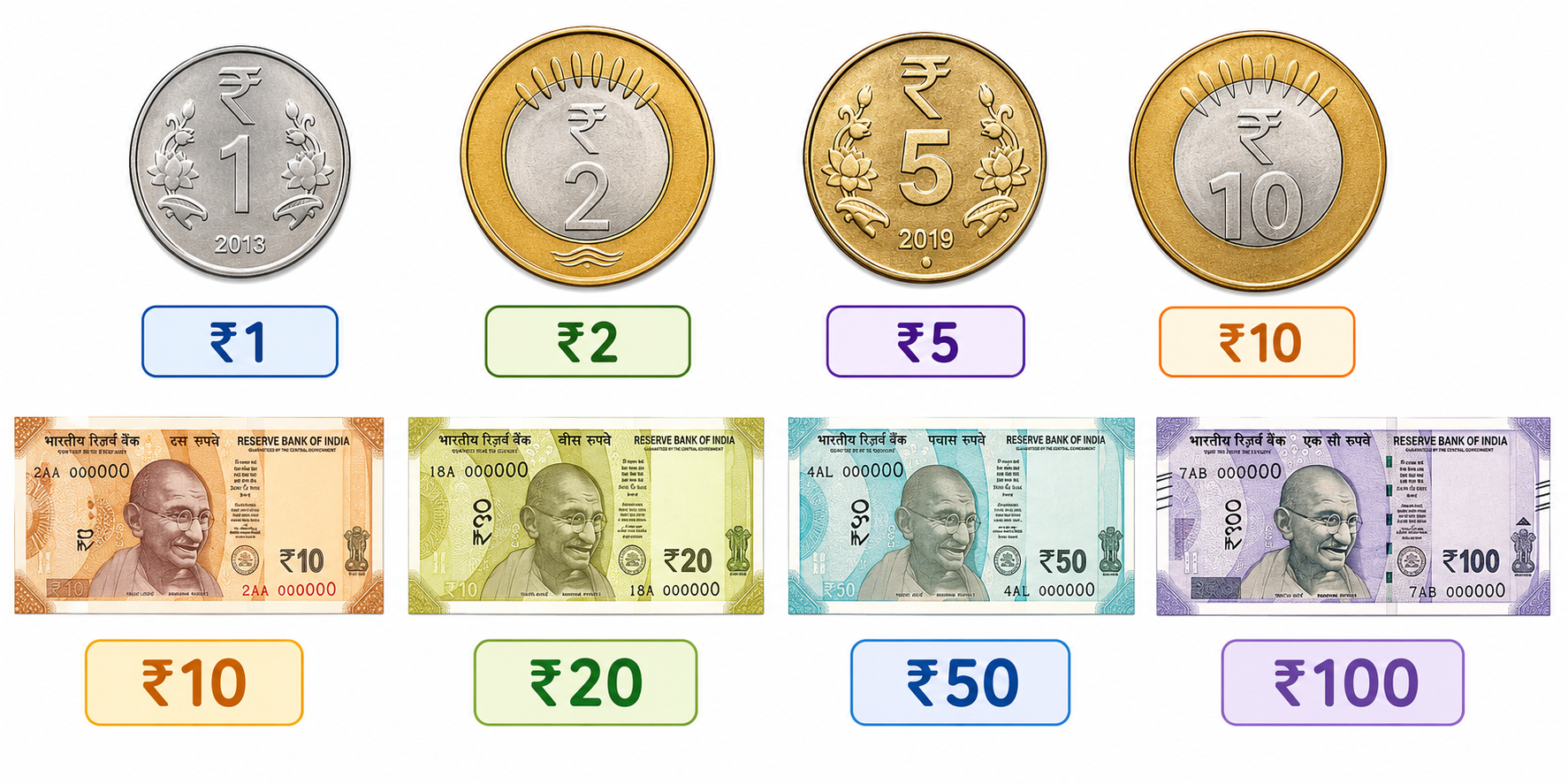
Identify Indian notes: ₹10, ₹20, ₹50, ₹100, and ₹200.
Count a small collection of coins and notes.
Add money amounts to find the total cost.
Solve simple shopping problems (buying and giving change).
📖 Let Us Begin!
Arjun goes to the stationery shop near his school with his mother. He wants to buy a pencil for ₹5 and an eraser for ₹3. How much money does he need? We use money every day to buy things we need.
In India, our money is called Rupees (₹). The symbol ₹ stands for Indian Rupee. Money comes in two forms — coins (round, metal) and notes (flat, paper). Let us learn about Indian money!
Indian Coins
Coins are round and made of metal. We use these coins in India:
Coin
Value
What you can buy
₹1 coin
Re. 1 (one rupee)
A toffee or a small candy
₹2 coin
Rs. 2
A small biscuit packet
₹5 coin
Rs. 5
A pencil or a lollipop
₹10 coin
Rs. 10
A small notebook or a pen
Did you know? For ₹1, we write "Re. 1" (Rupee). For ₹2 or more, we write "Rs." (Rupees). The new symbol is ₹.
Indian Notes
Notes are made of paper (or polymer). Each note has a different colour:
Note
Colour
What you can buy
₹10 note
Chocolate brown
A small notebook
₹20 note
Greenish-yellow
A box of crayons
₹50 note
Fluorescent blue
A storybook
₹100 note
Lavender (light purple)
A lunch box or water bottle
₹200 note
Bright yellow
A school bag strap or toy
All Indian notes have a picture of Mahatma Gandhi on the front and the Ashoka Pillar emblem.
Counting Money
To count money, add the value of each coin or note together.
Example 1: Meena has 3 coins of ₹5 each. How much money does she have?
₹5 + ₹5 + ₹5 = ₹15
Example 2: Ravi has one ₹10 note, one ₹5 coin, and two ₹2 coins. How much money?
₹10 + ₹5 + ₹2 + ₹2 = ₹19
Example 3: Sita has one ₹50 note and one ₹20 note. How much money?
₹50 + ₹20 = ₹70
Shopping Problems (Addition)
When we buy things, we add the prices to find the total cost.
Problem 1: Arjun buys a pencil for ₹5 and a sharpener for ₹4. How much does he pay?
₹5 + ₹4 = ₹9
Problem 2: During Diwali, Priya buys a packet of sparklers for ₹20 and a box of sweets for ₹50. Total cost?
₹20 + ₹50 = ₹70
Giving Change (Subtraction)
When we pay more than the price, the shopkeeper gives us back the extra money. This is called change.
Problem 3: A samosa costs ₹15. Meena gives ₹20. How much change does she get?
₹20 − ₹15 = ₹5 change
Problem 4: Ravi buys a cricket ball for ₹30. He gives a ₹50 note. Change?
₹50 − ₹30 = ₹20 change
100 paise = ₹1 (but paise coins are rarely used now).
Finished learning? Now test what you know!
🎯 Quick Quiz — Test Yourself!
Answer these questions right here. You get instant feedback — no paper needed!
Score: 0 / 8
1. How many paise make one rupee?
1 rupee = 100 paise.
2. ₹10 + ₹5 = ?
₹10 + ₹5 = ₹15.
3. Which of these is an Indian coin?
₹5 is a common coin. ₹100, ₹500 and ₹2000 are notes.
4. Ravi buys a pencil for ₹8 and pays with a ₹10 note. How much change should he get?
₹10 − ₹8 = ₹2 change.
5. ₹20 + ₹10 = ₹? (digits only)
₹20 + ₹10 = ₹30.
6. Meena has ₹15 and spends ₹10. How much is left? (₹, digits only)
₹15 − ₹10 = ₹5.
7. How many paise are there in one rupee? (digits only)
1 rupee = 100 paise.
8. Two ₹20 notes and one ₹10 note make ₹? (digits only)
₹20 + ₹20 + ₹10 = ₹50.
✏️ Practice Questions
A. Fill in the Blanks
1. 2 coins of ₹5 = ₹.
2. A ₹10 note and a ₹2 coin = ₹.
3. The Indian unit of money is called .
4. A pencil costs ₹5 and a rubber costs ₹3. Total cost = ₹.
5. 5 coins of ₹1 = ₹.
6. All Indian notes have a picture of on the front.
7. A ₹50 note and a ₹20 note = ₹.
8. Ravi pays ₹20 for a toy costing ₹12. His change is ₹.
9. Money that is round and made of metal is called a .
10. 3 coins of ₹2 and 1 coin of ₹5 = ₹.
B. Choose the Correct Answer (MCQ)
1. Which is worth more?
a) ₹5 coinb) ₹10 notec) ₹2 coin
2. Sita has ₹20. She buys a book for ₹15. How much is left?
a) ₹35b) ₹5c) ₹10
3. Which note has the highest value?
a) ₹10b) ₹50c) ₹100
4. Whose picture is on Indian notes?
a) Jawaharlal Nehrub) Mahatma Gandhic) Subhas Chandra Bose
5. Arjun has 4 coins of ₹5. How much money does he have?
a) ₹9b) ₹15c) ₹20
C. Short Answer / Word Problems
1. Arjun has 2 coins of ₹5 and 1 coin of ₹2. How much money does he have in all?
2. A samosa costs ₹12 and a juice costs ₹15. How much do both cost together?
3. Meena has a ₹50 note. She buys a toy for ₹30. How much change does she get?
4. Priya buys a notebook for ₹20 and a pen for ₹10. She gives ₹50. What is her change?
5. Ravi has one ₹10 note, two ₹5 coins, and three ₹1 coins. How much money does he have?
D. True or False
1. A ₹10 coin and a ₹10 note have the same value.
2. Notes are made of metal.
3. ₹50 is more than ₹100.
4. We get change when we pay more than the price.
5. Indian money is called Rupees.
E. Match the Following
Column A
Column B
1. ₹1 coin
a) Greenish-yellow note
2. ₹20 note
b) Can buy a toffee
3. ₹100 note
c) Round and metal
4. Coin
d) Lavender colour
5. Change
e) Money returned by shopkeeper
🎨 Activity: Play Shop
Set up a pretend shop at home with your family. Use paper to make coins and notes. Give each item a price (under ₹50). Take turns being the shopkeeper and the customer. Practice counting money and giving correct change!
Want to review the lesson again?
Mathematics
Money
Class 2 | CBSE / NCERT / ICSE
Name: Class / Sec: Date:
🎯 Learning Objectives
Identify Indian coins: ₹1, ₹2, ₹5, and ₹10.
Identify Indian notes: ₹10, ₹20, ₹50, ₹100, and ₹200.
Count a small collection of coins and notes.
Add money amounts to find the total cost.
Solve simple shopping problems (buying and giving change).
📖 Let Us Begin!
Arjun goes to the stationery shop near his school. He wants to buy a pencil for ₹5 and an eraser for ₹3. In India, our money is called Rupees (₹). Money comes as coins (round, metal) and notes (flat, paper).
Indian Coins
Coin
Value
What you can buy
₹1 coin
Re. 1
A toffee
₹2 coin
Rs. 2
A small biscuit
₹5 coin
Rs. 5
A pencil
₹10 coin
Rs. 10
A small notebook
Indian Notes
Note
Colour
What you can buy
₹10 note
Chocolate brown
A small notebook
₹20 note
Greenish-yellow
A box of crayons
₹50 note
Fluorescent blue
A storybook
₹100 note
Lavender
A lunch box
₹200 note
Bright yellow
A toy
All Indian notes have Mahatma Gandhi's picture on the front.