Maths
Patterns
Learning Objectives
- Understand what a repeating pattern is.
- Identify and extend patterns made with shapes, colours, and numbers.
- Find the rule (core) of a pattern.
- Create your own simple repeating patterns.
- Recognise growing patterns (increasing/decreasing).
- Spot patterns in daily life.
Let Us Begin!
Look at a saree border or a rangoli design. You will see the same design repeating again and again. That is a pattern! Patterns are all around us — in nature (petals of a flower), in art (mehndi designs), and in numbers. When something repeats in the same order, it makes a pattern. Let us learn to find, extend, and create patterns.
What is a Pattern?
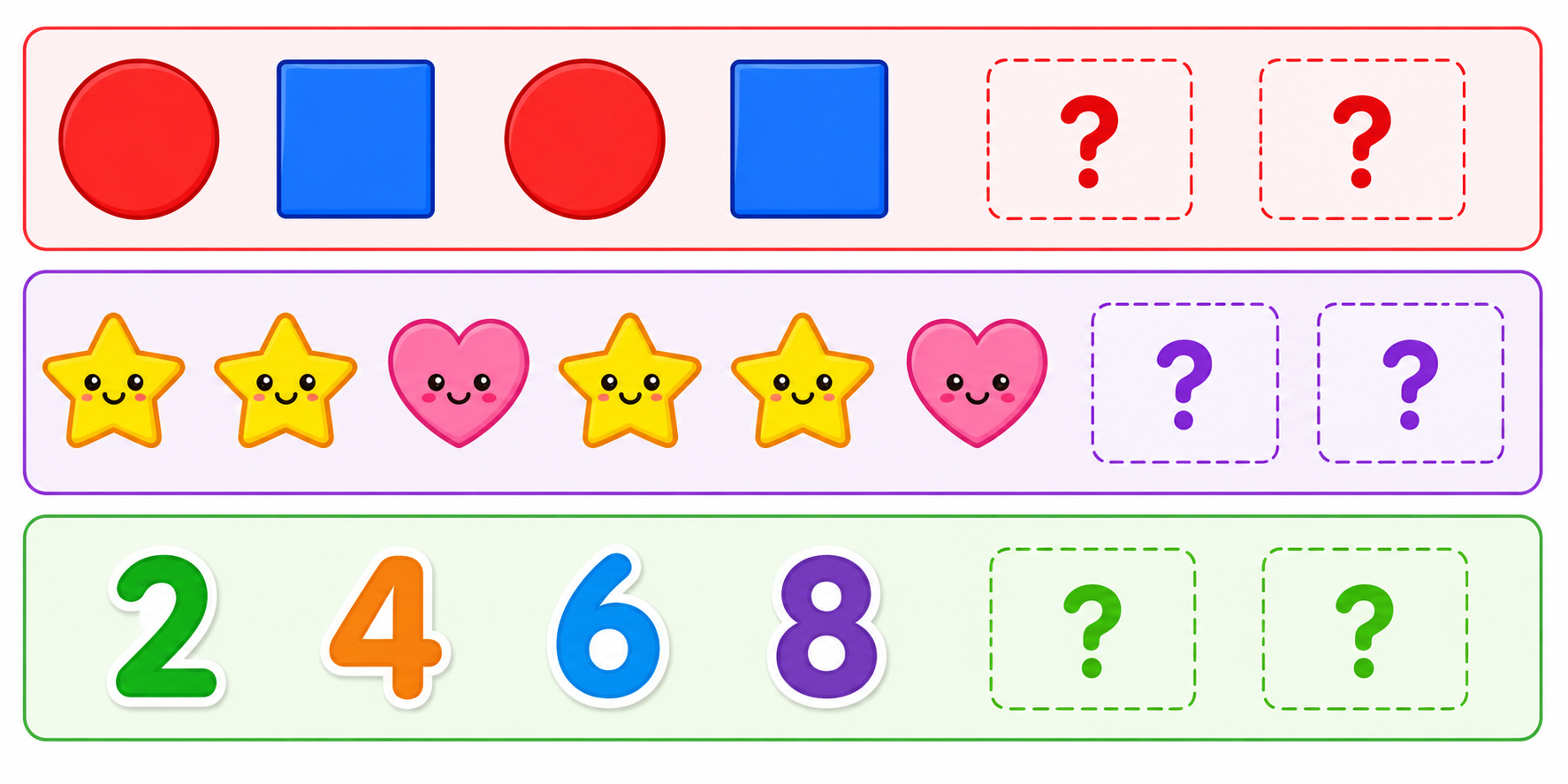
A pattern is something that repeats in the same order. The part that repeats is called the core of the pattern.
Example: 🔴🔵🔴🔵🔴🔵 — The core is "Red, Blue". It repeats 3 times.
Example: Clap, Clap, Stomp, Clap, Clap, Stomp — The core is "Clap, Clap, Stomp".
Example: Clap, Clap, Stomp, Clap, Clap, Stomp — The core is "Clap, Clap, Stomp".
Shape Patterns
In a shape pattern, shapes repeat in the same order.
Example 1: ○ □ ○ □ ○ □ ... → Core: Circle, Square. Next: Circle
Example 2: △ △ ○ △ △ ○ △ △ ... → Core: Triangle, Triangle, Circle. Next: Circle
Example 3: □ △ ○ □ △ ○ □ ... → Core: Square, Triangle, Circle. Next: Triangle, Circle
Example 2: △ △ ○ △ △ ○ △ △ ... → Core: Triangle, Triangle, Circle. Next: Circle
Example 3: □ △ ○ □ △ ○ □ ... → Core: Square, Triangle, Circle. Next: Triangle, Circle
Tip: To find the core, look for the part that keeps repeating. Cover it with your finger and see if the rest matches!
Colour Patterns
In a colour pattern, colours repeat in the same order.
Example 1: Red, Blue, Red, Blue, Red, Blue → Core: Red, Blue
Example 2: Green, Green, Yellow, Green, Green, Yellow → Core: Green, Green, Yellow
Example 3: Orange, White, Green, Orange, White, Green → Core: Orange, White, Green (like our flag! 🇮🇳)
Example 2: Green, Green, Yellow, Green, Green, Yellow → Core: Green, Green, Yellow
Example 3: Orange, White, Green, Orange, White, Green → Core: Orange, White, Green (like our flag! 🇮🇳)
Number Patterns
In a number pattern, numbers change by the same amount each time. This is called the rule.
Example 1: 2, 4, 6, 8, 10, 12 → Rule: Add 2 each time
Example 2: 5, 10, 15, 20, 25 → Rule: Add 5 each time
Example 3: 1, 3, 5, 7, 9, 11 → Rule: Add 2 each time (odd numbers!)
Example 4: 10, 20, 30, 40, 50 → Rule: Add 10 each time
Example 5: 3, 6, 9, 12, 15 → Rule: Add 3 each time
Example 2: 5, 10, 15, 20, 25 → Rule: Add 5 each time
Example 3: 1, 3, 5, 7, 9, 11 → Rule: Add 2 each time (odd numbers!)
Example 4: 10, 20, 30, 40, 50 → Rule: Add 10 each time
Example 5: 3, 6, 9, 12, 15 → Rule: Add 3 each time
Growing and Shrinking Patterns
Growing pattern: 1, 2, 4, 7, 11 → The amount added increases: +1, +2, +3, +4
Shrinking pattern: 20, 18, 16, 14, 12 → Rule: Subtract 2 each time
Real life: Meena saves ₹5 more each week: Week 1 = ₹5, Week 2 = ₹10, Week 3 = ₹15...
Shrinking pattern: 20, 18, 16, 14, 12 → Rule: Subtract 2 each time
Real life: Meena saves ₹5 more each week: Week 1 = ₹5, Week 2 = ₹10, Week 3 = ₹15...
Patterns in Daily Life
Rangoli: Designs repeat in beautiful patterns during Diwali.
Music: Dhol beats follow a pattern — dhum, dhum, ta, dhum, dhum, ta...
Nature: Day, Night, Day, Night — a pattern that never stops!
Saree border: The same design repeats along the edge.
Cricket: Over pattern — 6 balls, then change ends. Repeat!
Music: Dhol beats follow a pattern — dhum, dhum, ta, dhum, dhum, ta...
Nature: Day, Night, Day, Night — a pattern that never stops!
Saree border: The same design repeats along the edge.
Cricket: Over pattern — 6 balls, then change ends. Repeat!
Key Words
| Word | Meaning |
|---|---|
| Pattern | Something that repeats in the same order |
| Repeating | Happening again and again in the same way |
| Rule | The way numbers change in a pattern (e.g., add 2) |
| Core | The part of the pattern that repeats |
| Extend | To continue a pattern by adding more |
| Growing pattern | A pattern where numbers get bigger |
⭐ Key Points to Remember
- A pattern repeats in the same order.
- The "core" is the part that keeps repeating.
- Patterns can be made with shapes, colours, or numbers.
- To extend a pattern, find the rule and keep going.
- Number patterns often add or subtract the same number each time.
- Patterns are everywhere — in rangoli, music, nature, and cricket!
Finished learning? Now test what you know!