Maths
Subtraction
Learning Objectives
- Subtract a 1-digit number from another 1-digit or 2-digit number.
- Subtract two 2-digit numbers using the vertical method.
- Use a number line to subtract.
- Understand subtraction with borrowing (regrouping).
- Solve simple word problems using subtraction.
Let Us Begin!
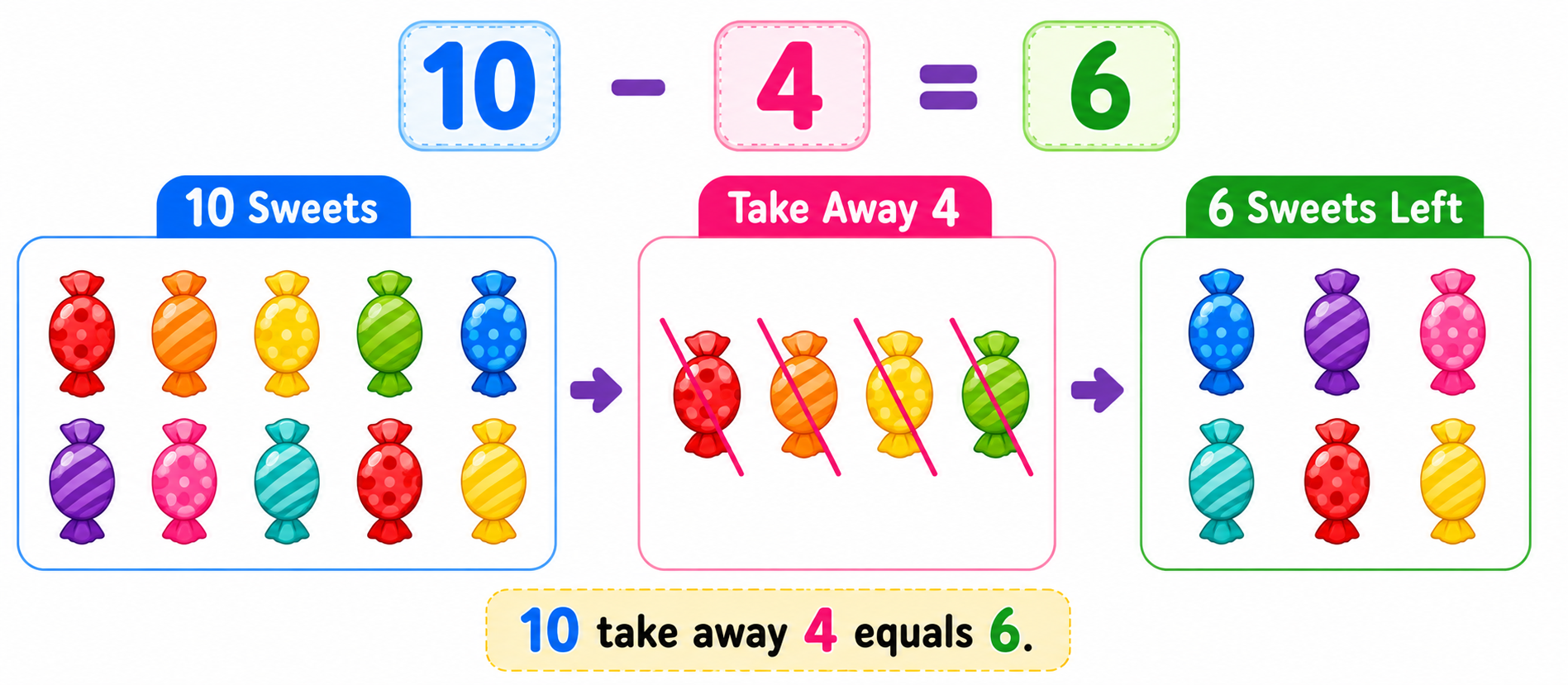
Sita has 15 sweets. She gives 6 to her friend Meena. How many sweets does she have left? We subtract to find out!
Subtraction means taking away. The sign for subtraction is − (minus). The answer we get is called the difference.
15 − 6 = 9. Sita has 9 sweets left!
Subtracting on a Number Line
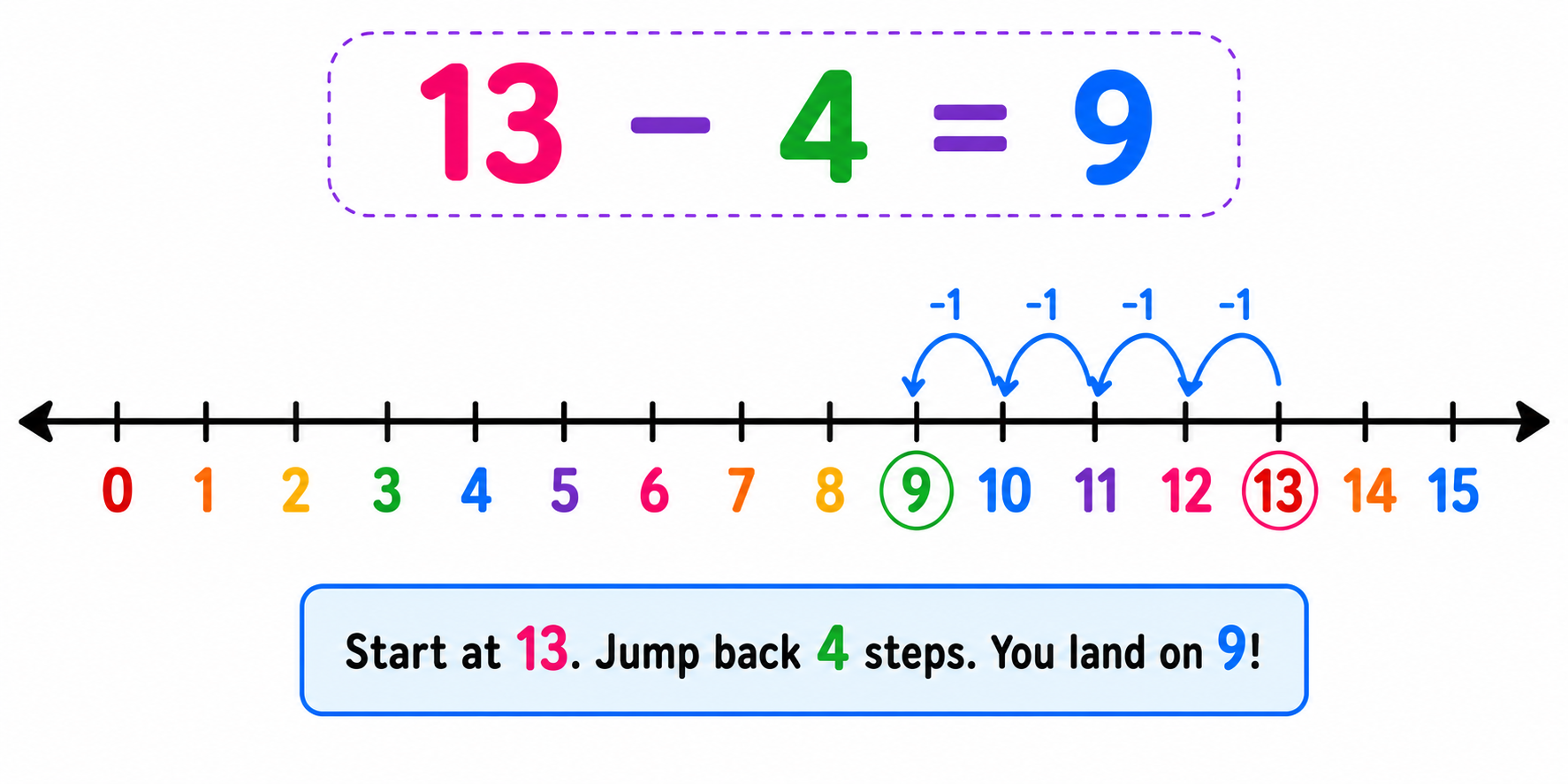
A number line helps us subtract by jumping backward (to the left).
Example: 13 − 4 = ?
Step 1: Start at 13 on the number line.
Step 2: Jump 4 steps backward: 12, 11, 10, 9.
Step 3: You land on 9.
So 13 − 4 = 9.
Step 1: Start at 13 on the number line.
Step 2: Jump 4 steps backward: 12, 11, 10, 9.
Step 3: You land on 9.
So 13 − 4 = 9.
More examples on number line:
10 − 3 = 7 (start at 10, jump 3 backward)
16 − 5 = 11 (start at 16, jump 5 backward)
20 − 7 = 13 (start at 20, jump 7 backward)
10 − 3 = 7 (start at 10, jump 3 backward)
16 − 5 = 11 (start at 16, jump 5 backward)
20 − 7 = 13 (start at 20, jump 7 backward)
Subtracting 1-Digit Numbers
When both numbers have only 1 digit, we can subtract easily:
Examples:
9 − 4 = 5 8 − 3 = 5 7 − 7 = 0 6 − 2 = 4
5 − 0 = 5 9 − 6 = 3 8 − 5 = 3 7 − 4 = 3
9 − 4 = 5 8 − 3 = 5 7 − 7 = 0 6 − 2 = 4
5 − 0 = 5 9 − 6 = 3 8 − 5 = 3 7 − 4 = 3
Arjun had 9 toffees. He ate 4. How many are left? 9 − 4 = 5 toffees!
Subtracting 2-Digit Numbers (Vertical Method)
Write the bigger number on top. Subtract the ones first, then the tens.
Worked Example 1: 47 − 23 = ?
Step 1: Write 47 on top, 23 below.
Step 2: Subtract ones: 7 − 3 = 4
Step 3: Subtract tens: 4 − 2 = 2
Answer: 24
Step 1: Write 47 on top, 23 below.
Step 2: Subtract ones: 7 − 3 = 4
Step 3: Subtract tens: 4 − 2 = 2
Answer: 24
Worked Example 2: 58 − 15 = ?
Ones: 8 − 5 = 3. Tens: 5 − 1 = 4. Answer: 43
Ones: 8 − 5 = 3. Tens: 5 − 1 = 4. Answer: 43
Worked Example 3: 76 − 34 = ?
Ones: 6 − 4 = 2. Tens: 7 − 3 = 4. Answer: 42
Ones: 6 − 4 = 2. Tens: 7 − 3 = 4. Answer: 42
Remember: Always write the bigger number on top when subtracting!
Subtraction with Borrowing (Regrouping)
Sometimes the top ones digit is smaller than the bottom ones digit. Then we "borrow" 1 ten from the tens column.
Worked Example: 42 − 17 = ?
Step 1: Ones: 2 − 7? We cannot! Borrow 1 ten from 4 (becomes 3). Now ones = 12.
Step 2: Ones: 12 − 7 = 5.
Step 3: Tens: 3 − 1 = 2.
Answer: 25
Step 1: Ones: 2 − 7? We cannot! Borrow 1 ten from 4 (becomes 3). Now ones = 12.
Step 2: Ones: 12 − 7 = 5.
Step 3: Tens: 3 − 1 = 2.
Answer: 25
More examples with borrowing:
31 − 14 = 17 53 − 28 = 25 60 − 35 = 25
31 − 14 = 17 53 − 28 = 25 60 − 35 = 25
Word Problems
Subtraction is used in daily life. Look for words like "left", "remaining", "how many more", "difference", "gave away".
Problem 1: Meena had ₹45. She spent ₹12 on a notebook. How much money is left?
Solution: 45 − 12 = ₹33
Solution: 45 − 12 = ₹33
Problem 2: There are 38 students in a class. 15 went home early. How many students are still in class?
Solution: 38 − 15 = 23 students
Solution: 38 − 15 = 23 students
Problem 3: Arjun had 50 marbles. He gave 22 to Ravi. How many marbles does Arjun have now?
Solution: 50 − 22 = 28 marbles
Solution: 50 − 22 = 28 marbles
Key Words
| Word | Meaning |
|---|---|
| Subtraction | Taking away a number from another number |
| Difference | The answer we get after subtracting |
| Minus (−) | The sign we use for subtraction |
| Take away | Another way to say subtract |
| Left / Remaining | What is still there after taking some away |
| Borrow / Regroup | Taking 1 ten from the tens column when ones are not enough |
⭐ Key Points to Remember
- Subtraction means taking away.
- The answer in subtraction is called the difference.
- Always write the bigger number on top.
- In vertical subtraction, subtract ones first, then tens.
- Subtracting 0 from any number gives the same number: 8 − 0 = 8.
- Any number minus itself equals 0: 5 − 5 = 0.
- If ones on top are smaller, borrow 1 ten from the tens column.
- Clue words: "left", "remaining", "gave away", "how many more".
Finished learning? Now test what you know!