I can understand that air is all around us even though we cannot see it.
I can say why we need air to breathe.
I can explain what wind is.
I can say how to keep air clean.
📖 Let Us Begin!
Can you see air? No! But can you feel it? Yes! When the wind blows, you can feel air on your face.
Air is all around us. We breathe air every second. Without air, we cannot live.
Let us learn about the air around us!
Air Is Everywhere
Air is all around us. It is in our room, in the garden, in the sky, and even under water.
We cannot see air. We cannot smell clean air. But we can feel air when it moves.
How do we know air is there?
Blow into your hand. You can feel the air! Blow up a balloon. The balloon gets big because of air inside it. Shake a fan near your face. You feel the moving air.
Ravi blew up a balloon. When he let it go, the air came out and the balloon flew around the room. Air was inside the balloon!
Properties of Air
Air has some special properties that make it different from other things:
Air is everywhere — it fills every empty space around us.
We cannot see air — air is invisible, but we can feel it when it moves.
Air has no colour — clean air is completely colourless.
Air has no smell — clean air has no odour. (Smells we notice are carried by air, not the air itself.)
Air has no taste — we cannot taste clean air.
Air takes up space — blow up a balloon and it gets bigger because air fills the space inside.
Air has weight — a balloon filled with air is slightly heavier than an empty balloon.
Simple Experiment — Air Takes Up Space
Push an empty bottle into a bucket of water with the mouth facing down. You will see bubbles coming out. Those bubbles are air escaping from the bottle! This shows that air was inside the bottle, taking up space.
We Need Air to Breathe
All living things need air to breathe. People, animals, and plants all need air.
When we breathe in, we take in air. When we breathe out, we let out air. We breathe about 15 to 20 times every minute!
If we hold our breath, we feel uncomfortable very quickly. This shows how important air is.
Uses of Air
Use of Air
How It Helps
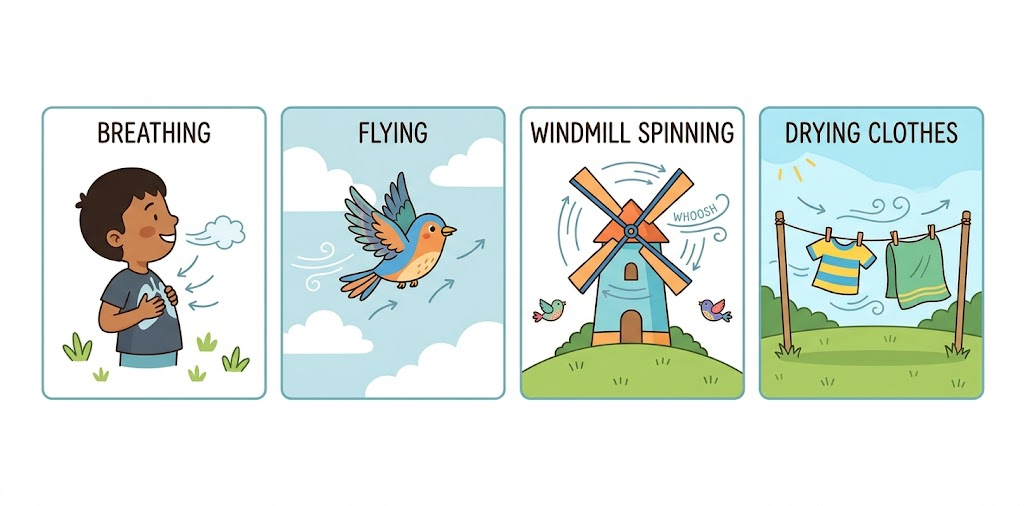
Breathing
We breathe air to live. All living things — people, animals, and plants — need air.
Birds and aeroplanes fly
Air supports the wings of birds and aeroplanes, helping them stay up in the sky.
Windmills
Moving air (wind) turns windmill blades to make electricity.
Drying clothes
Air dries our wet clothes when we hang them outside.
Seeds travel
Air carries seeds of plants like dandelion and cotton to new places, helping plants grow.
Sailing boats
Wind fills the sails of boats and pushes them across water.
Cooling us down
Moving air (breeze) cools us on a hot day.
Meena saw a dandelion flower. When she blew on it, the tiny seeds flew away in the air. Air was carrying the seeds to new places where they would grow into new plants!
Wind
When air moves, it is called wind. Wind can be gentle or strong.
A gentle wind is called a breeze. It feels nice on a hot day. A strong wind can blow away leaves and papers.
Wind helps dry our clothes. Wind helps boats sail on water. Wind turns windmills to make electricity.
Type of Wind
Description
Effect
Breeze
Gentle, soft wind
Cools us down, dries clothes, pleasant to feel
Strong wind
Fast-moving air
Blows away leaves, papers, and light objects
Storm
Very strong, dangerous wind
Can break branches, damage buildings
Cyclone
Extremely powerful rotating wind
Very dangerous, can destroy homes and flood areas
Wind Can Be Useful and Harmful
Useful: Windmills use wind to make electricity. Sailing boats use wind to move. Wind helps seeds travel. Wind dries our clothes. Harmful: Cyclones and storms can destroy homes and crops. Strong winds can uproot trees.
Arjun flew a kite on a windy day. The wind lifted the kite high into the sky. Wind can be so much fun!
Keeping Air Clean
Clean air is good for us. Dirty air (pollution) can make us sick. It can cause coughing, breathing problems, and other illnesses.
Air gets dirty when:
Smoke comes from cars, trucks, and buses.
Factories release smoke and chemicals into the air.
People burn garbage and dry leaves.
Dust rises from roads and construction sites.
We can keep air clean by:
Planting more trees — trees absorb dirty air and give out clean, fresh air.
Avoiding burning garbage — use dustbins instead.
Using less vehicles — walk or cycle for short distances.
Factories should use filters so they do not release smoke.
Using electric vehicles that do not produce smoke.
Trees are our best friends! They take in dirty air (carbon dioxide) and give out clean, fresh air (oxygen). Let us plant more trees and protect the ones we have.
📝 Key Words
Word
Meaning
Air
The invisible gas all around us that we breathe
Breathe
To take air in and let air out of our body
Wind
Moving air
Breeze
A gentle, soft wind
Storm
A very strong, dangerous wind
Cyclone
An extremely powerful rotating wind that can cause great damage
Pollution
When air, water, or land gets dirty and harmful
Oxygen
The part of air that living things need to breathe
Windmill
A machine that uses wind to make electricity
⭐ Key Points to Remember
Air is all around us. We cannot see it but we can feel it.
Air has no colour, no smell, and no taste.
Air takes up space — a balloon gets bigger when filled with air.
All living things — people, animals, and plants — need air to live.
Moving air is called wind. A gentle wind is called a breeze.
Wind can be useful (windmills, sailing, drying clothes) and harmful (cyclones, storms).
Air helps birds and aeroplanes fly, and carries seeds to new places.
Dirty air is called air pollution. It can make us sick.
Planting trees helps keep air clean and fresh.
Finished learning? Now test what you know!
🎯 Quick Quiz — Test Yourself!
Answer these questions right here. You get instant feedback — no paper needed!
Score: 0 / 8
1. We cannot see air, but we can:
Air is all around us. We can feel moving air as wind.
2. Which part of air do living things need to breathe?
Living things breathe in oxygen from the air.
3. Moving air is called:
Moving air is called wind.
4. Which of these needs air to work?
A kite flies because moving air (wind) pushes it up.
5. A windmill turns when the ______ blows.
Wind makes a windmill turn.
6. The part of air we need to stay alive is called ______.
We breathe in oxygen to stay alive.
7. Which of these makes the air dirty?
Smoke from vehicles and factories makes the air dirty (polluted).
8. Which living things give out oxygen and help keep our air clean?
Trees and plants give out oxygen and keep the air clean.
✏️ Practice Questions
A. Fill in the Blanks
1. Air is all us.
2. Moving air is called .
3. We cannot air but we can feel it.
4. Trees give us clean, fresh .
5. A gentle wind is called a .
6. Air has no colour, no smell, and no .
7. A very strong, dangerous rotating wind is called a .
8. Wind turns to make electricity.
B. Multiple Choice Questions
1. What is wind?
(a) Still air(b) Moving air(c) Hot air(d) Cold air
2. Which of these helps keep air clean?
(a) Burning garbage(b) Smoke from cars(c) Planting trees(d) Factory smoke
3. How do we know air is inside a balloon?
(a) The balloon gets big(b) The balloon turns red(c) The balloon gets wet(d) The balloon sinks
5. Air helps seeds travel. Which plant's seeds travel by air?
(a) Mango(b) Dandelion(c) Potato(d) Onion
C. Short Answer Questions
1. Why do we need air?
2. What is air pollution? Name two causes.
3. Name three uses of wind.
4. Write two properties of air.
5. How can we keep air clean? Write two ways.
D. True or False
1. We can see air.
2. Air takes up space.
3. Only humans need air to breathe.
4. A cyclone is a very strong, dangerous wind.
5. Planting trees helps keep air clean.
🎨 Fun Activity -- Feel the Air!
Try these simple activities and write what you notice:
Activity
What I Noticed
Blow into your hand
Blow up a balloon
Fan your face with a book
Want to review the lesson again?
EVS / Science
Air Around Us
Class 2 | CBSE / NCERT / ICSE
Name: Class / Sec: Date:
🎯 Learning Objectives
I can understand that air is all around us even though we cannot see it.
I can say why we need air to breathe.
I can explain what wind is.
I can say how to keep air clean.
📖 Let Us Begin!
Can you see air? No! But can you feel it? Yes! When the wind blows, you can feel air on your face.
Air is all around us. We breathe air every second. Without air, we cannot live.
Air Is Everywhere
Air is all around us — in our room, in the garden, in the sky, and even under water. We cannot see air or smell clean air, but we can feel it when it moves.
How do we know air is there?
Blow into your hand — you can feel the air! Blow up a balloon — it gets big because of air inside. Shake a fan near your face — you feel the moving air.
Ravi blew up a balloon. When he let it go, the air came out and the balloon flew around the room. Air was inside the balloon!
Properties of Air
Air is everywhere — it fills every empty space around us.
We cannot see air — air is invisible, but we can feel it when it moves.
Air has no colour — clean air is completely colourless.
Air has no smell — clean air has no odour.
Air has no taste — we cannot taste clean air.
Air takes up space — blow up a balloon and it gets bigger because air fills the space inside.
Air has weight — a balloon filled with air is slightly heavier than an empty balloon.
Simple Experiment — Air Takes Up Space
Push an empty bottle into a bucket of water with the mouth facing down. You will see bubbles coming out. Those bubbles are air escaping from the bottle — air was inside, taking up space!
We Need Air to Breathe
All living things need air to breathe — people, animals, and plants. When we breathe in, we take in air. When we breathe out, we let out air. We breathe about 15 to 20 times every minute! If we hold our breath, we feel uncomfortable very quickly. This shows how important air is.
EVS / Science
Air Around Us (continued)
Class 2 | CBSE / NCERT / ICSE
Name: Class / Sec: Date:
Uses of Air
Use of Air
How It Helps
Breathing
We breathe air to live. All living things need air.
Birds and aeroplanes fly
Air supports wings, helping them stay up in the sky.
Windmills
Moving air (wind) turns windmill blades to make electricity.
Drying clothes
Air dries our wet clothes when we hang them outside.
Seeds travel
Air carries seeds of plants like dandelion to new places.
Sailing boats
Wind fills the sails of boats and pushes them across water.
Cooling us down
Moving air (breeze) cools us on a hot day.
Meena saw a dandelion flower. When she blew on it, the tiny seeds flew away in the air. Air was carrying the seeds to new places where they would grow into new plants!
Wind
When air moves, it is called wind. A gentle wind is called a breeze. Wind can be useful and harmful.
Type of Wind
Description
Effect
Breeze
Gentle, soft wind
Cools us down, dries clothes, pleasant to feel
Strong wind
Fast-moving air
Blows away leaves, papers, and light objects
Storm
Very strong, dangerous wind
Can break branches, damage buildings
Cyclone
Extremely powerful rotating wind
Very dangerous, can destroy homes and flood areas
Arjun flew a kite on a windy day. The wind lifted the kite high into the sky. Wind can be so much fun!
Keeping Air Clean
Clean air is good for us. Dirty air (pollution) can make us sick — causing coughing and breathing problems.
Air gets dirty when:
Smoke comes from cars, trucks, and buses.
Factories release smoke and chemicals into the air.
People burn garbage and dry leaves.
Dust rises from roads and construction sites.
We can keep air clean by:
Planting more trees — trees absorb dirty air and give out clean, fresh air.
Avoiding burning garbage — use dustbins instead.
Using less vehicles — walk or cycle for short distances.
Factories should use filters so they do not release smoke.
Using electric vehicles that do not produce smoke.
Trees are our best friends! They take in dirty air (carbon dioxide) and give out clean, fresh air (oxygen). Let us plant more trees and protect the ones we have.
📝 Key Words
Word
Meaning
Air
The invisible gas all around us that we breathe
Wind
Moving air
Breeze
A gentle, soft wind
Storm
A very strong, dangerous wind
Cyclone
An extremely powerful rotating wind that can cause great damage
Pollution
When air, water, or land gets dirty and harmful
Oxygen
The part of air that living things need to breathe
Windmill
A machine that uses wind to make electricity
⭐ Key Points to Remember
Air is all around us. We cannot see it but we can feel it.
Air has no colour, no smell, and no taste.
Air takes up space — a balloon gets bigger when filled with air.
All living things — people, animals, and plants — need air to live.
Moving air is called wind. A gentle wind is called a breeze.
Wind can be useful (windmills, sailing, drying clothes) and harmful (cyclones, storms).
Air helps birds and aeroplanes fly, and carries seeds to new places.
Dirty air is called air pollution. It can make us sick.
Planting trees helps keep air clean and fresh.
EVS / Science
Air Around Us — Practice Questions
Class 2
Name: Class / Sec: Date:
A. Fill in the Blanks
1. Air is all us.
2. Moving air is called .
3. We cannot air but we can feel it.
4. Trees give us clean, fresh .
5. A gentle wind is called a .
6. Air has no colour, no smell, and no .
7. A very strong, dangerous rotating wind is called a .
8. Wind turns to make electricity.
B. Multiple Choice Questions
1. What is wind?
(a) Still air(b) Moving air(c) Hot air(d) Cold air
2. Which of these helps keep air clean?
(a) Burning garbage(b) Smoke from cars(c) Planting trees(d) Factory smoke
3. How do we know air is inside a balloon?
(a) The balloon gets big(b) The balloon turns red(c) The balloon gets wet(d) The balloon sinks