Multiplication
Learning Objectives
- Understand multiplication as repeated addition.
- Multiply a 2-digit number by a 1-digit number (with carrying).
- Multiply a 3-digit number by a 1-digit number.
- Learn properties of multiplication (commutative, identity, zero).
- Solve word problems involving multiplication.
- Use multiplication in everyday situations (money, groups, rows).
Introduction
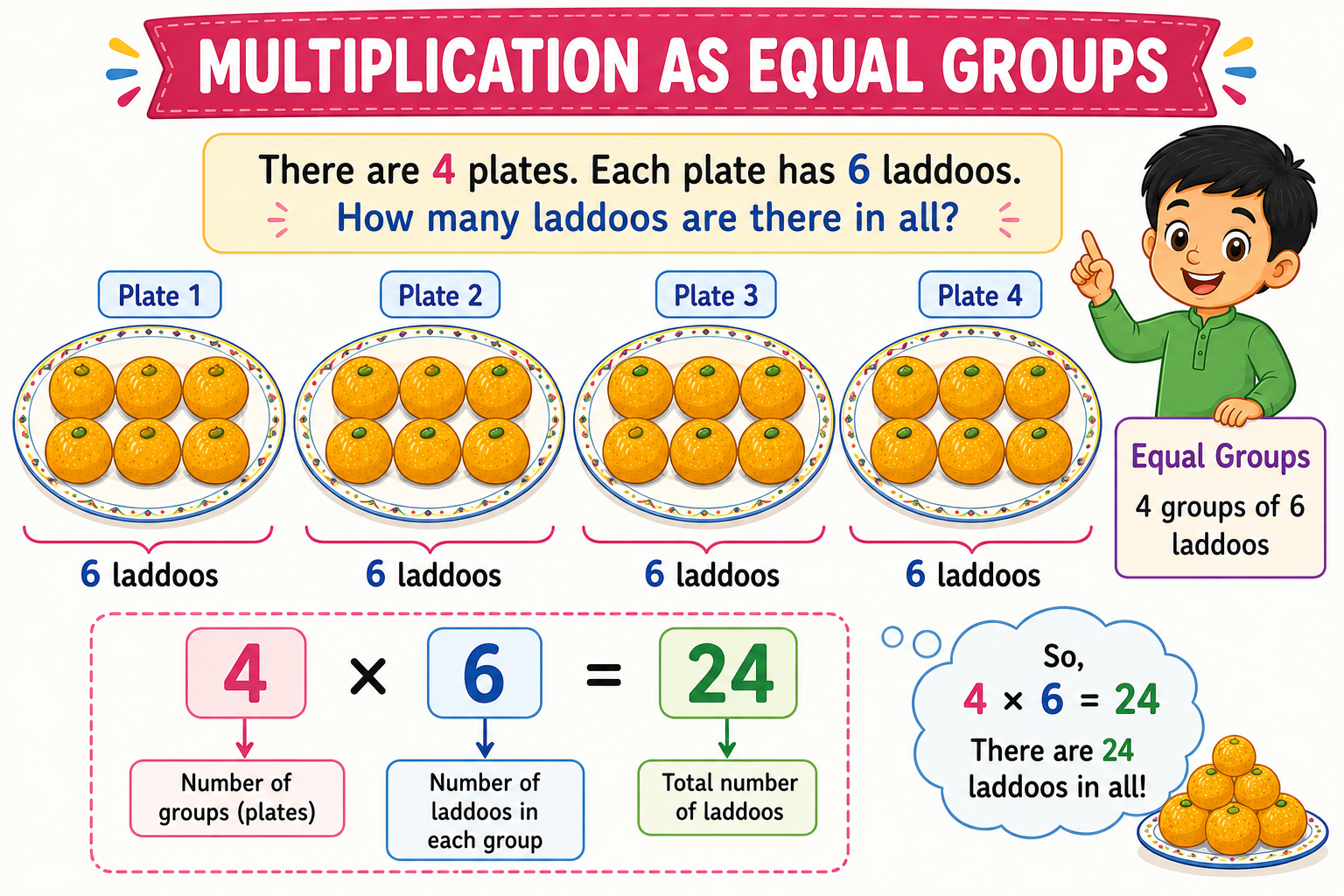
Ravi has 4 packets of biscuits. Each packet has 6 biscuits. How many biscuits does he have in all? We could add: 6 + 6 + 6 + 6 = 24. But there is a faster way — multiplication!
Multiplication is a short way of adding the same number again and again. Instead of writing 6 + 6 + 6 + 6, we write 4 × 6 = 24. We say "4 times 6 equals 24."
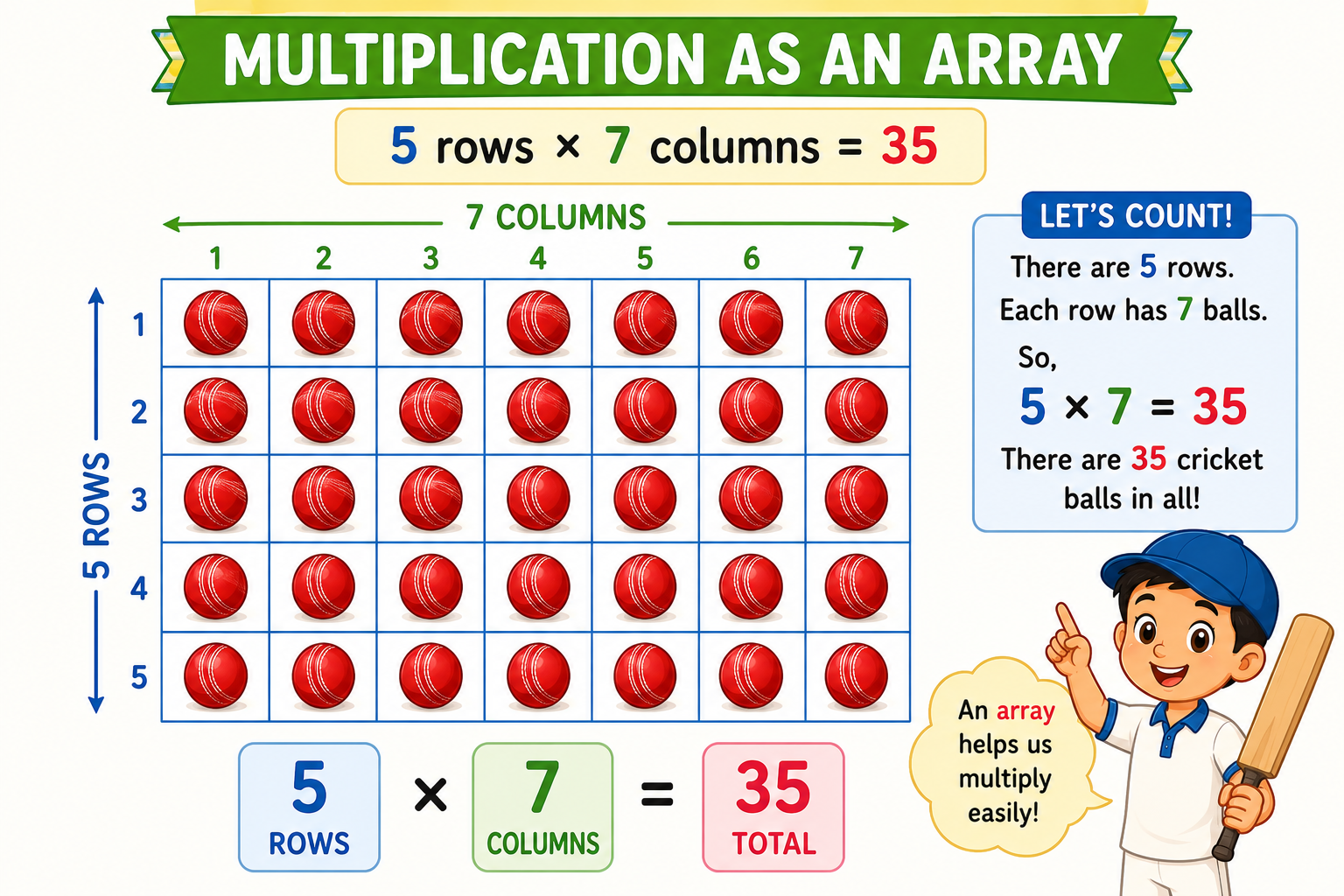
The symbol × means "times" or "multiplied by." Multiplication helps us count things arranged in equal groups, rows, or packets quickly.
Multiplication as Repeated Addition
When we have equal groups, we can use multiplication instead of adding again and again.
3 groups of 4 means: 4 + 4 + 4 = 12
So, 3 × 4 = 12
5 groups of 3 means: 3 + 3 + 3 + 3 + 3 = 15
So, 5 × 3 = 15
6 groups of 7 means: 7 + 7 + 7 + 7 + 7 + 7 = 42
So, 6 × 7 = 42
Multiplying a 2-Digit Number by a 1-Digit Number (with Carrying)
When we multiply larger numbers, we work column by column — starting from the Ones place, just like addition.
Example 1: 23 × 4
| T | O | |
|---|---|---|
| 2 | 3 | |
| × | 4 | |
| = | 9 | 2 |
Step 1 (Ones): 4 × 3 = 12. Write 2 in the Ones column. Carry 1 to the Tens column.
Step 2 (Tens): 4 × 2 = 8, plus the carried 1 = 9. Write 9 in the Tens column.
Answer: 23 × 4 = 92
Example 2: 56 × 7
| H | T | O | |
|---|---|---|---|
| 5 | 6 | ||
| × | 7 | ||
| = | 3 | 9 | 2 |
Step 1 (Ones): 7 × 6 = 42. Write 2 in the Ones column. Carry 4 to the Tens column.
Step 2 (Tens): 7 × 5 = 35, plus the carried 4 = 39. Write 9 in the Tens column. Carry 3 to the Hundreds column.
Step 3 (Hundreds): Write 3 in the Hundreds column.
Answer: 56 × 7 = 392
Ones: 6 × 8 = 48, write 8, carry 4. Tens: 6 × 4 = 24, + 4 = 28. Write 8 in Tens, carry 2 to Hundreds.
Answer: 48 × 6 = 288
Ones: 9 × 5 = 45, write 5, carry 4. Tens: 9 × 7 = 63, + 4 = 67. Write 7 in Tens, carry 6 to Hundreds.
Answer: 75 × 9 = 675
Multiplying a 3-Digit Number by a 1-Digit Number
The method is the same — multiply column by column from right to left, carrying when needed.
Example 1: 234 × 5
| Th | H | T | O | |
|---|---|---|---|---|
| 2 | 3 | 4 | ||
| × | 5 | |||
| = | 1 | 1 | 7 | 0 |
Step 1 (Ones): 5 × 4 = 20. Write 0, carry 2.
Step 2 (Tens): 5 × 3 = 15, + 2 = 17. Write 7, carry 1.
Step 3 (Hundreds): 5 × 2 = 10, + 1 = 11. Write 1 in Hundreds, carry 1 to Thousands.
Step 4 (Thousands): Write 1.
Answer: 234 × 5 = 1,170
Example 2: 167 × 8
| Th | H | T | O | |
|---|---|---|---|---|
| 1 | 6 | 7 | ||
| × | 8 | |||
| = | 1 | 3 | 3 | 6 |
Step 1 (Ones): 8 × 7 = 56. Write 6, carry 5.
Step 2 (Tens): 8 × 6 = 48, + 5 = 53. Write 3, carry 5.
Step 3 (Hundreds): 8 × 1 = 8, + 5 = 13. Write 3, carry 1 to Thousands.
Step 4 (Thousands): Write 1.
Answer: 167 × 8 = 1,336
Ones: 6 × 5 = 30, write 0, carry 3. Tens: 6 × 4 = 24, + 3 = 27, write 7, carry 2. Hundreds: 6 × 3 = 18, + 2 = 20, write 0, carry 2. Thousands: write 2.
Answer: 345 × 6 = 2,070
Properties of Multiplication
Multiplication has some special rules that always work:
| Property | What It Means | Example |
|---|---|---|
| Commutative Property (Order Property) | We can multiply two numbers in any order and the product stays the same. | 3 × 4 = 4 × 3 = 12 |
| Identity Property (Multiplicative Identity) | Any number multiplied by 1 gives the same number. | 7 × 1 = 7 1 × 56 = 56 |
| Zero Property | Any number multiplied by 0 gives 0. | 8 × 0 = 0 0 × 125 = 0 |
Commutative: 6 × 9 = 9 × 6 = 54
Identity: 234 × 1 = 234 (the number stays the same)
Zero: 999 × 0 = 0 (anything times zero is always zero)
Word Problems (Indian Context)
Meena buys 6 notebooks. Each notebook costs ₹45. How much does she pay in all?
Solution: 6 × 45 = ₹270. Meena pays ₹270 in all.
A shopkeeper has 8 packets of pencils. Each packet has 12 pencils. How many pencils are there in all?
Solution: 8 × 12 = 96 pencils in all.
In the school hall, there are 9 rows of chairs. Each row has 25 chairs. How many chairs are there in the hall?
Solution: 9 × 25 = 225 chairs in the hall.
Arjun's cricket team plays 7 matches. In each match, they score exactly 48 runs. What is their total score?
Solution: 7 × 48 = 336 runs in total.
Ravi's school orders 5 boxes of chalk. Each box has 144 pieces of chalk. How many pieces of chalk are ordered?
Solution: 5 × 144 = 720 pieces of chalk.
Key Words
| Word | Meaning |
|---|---|
| Multiplication | A short way of adding the same number many times |
| Product | The answer we get after multiplying |
| Multiplicand | The number being multiplied (e.g., 23 in 23 × 4) |
| Multiplier | The number we multiply by (e.g., 4 in 23 × 4) |
| Repeated Addition | Adding the same number again and again (3 × 4 = 4 + 4 + 4) |
| Carrying (Regrouping) | When a column product is 10 or more, we carry the tens digit to the next column |
| Commutative Property | Order does not matter: a × b = b × a |
| Identity Property | Any number × 1 = the same number |
| Zero Property | Any number × 0 = 0 |
| Times | Another word for "multiplied by" (×) |
- Multiplication is repeated addition: 3 × 4 means 4 + 4 + 4 = 12.
- Always start multiplying from the Ones column (right side).
- If the product in a column is 10 or more, carry the tens digit to the next column.
- Commutative property: 3 × 4 = 4 × 3 (order does not matter).
- Identity property: Any number × 1 = the same number.
- Zero property: Any number × 0 = 0.
- The same column method works for 2-digit and 3-digit multiplication.
- Word problems: look for words like "each," "every," "per," "total" — they hint at multiplication.
Finished learning? Now test what you know!