Singular and Plural (One and Many)
Learning Objectives
- Understand the meaning of singular (one) and plural (more than one).
- Learn the rule of adding -s to make plurals of most nouns.
- Learn the rule of adding -es to nouns ending in s, sh, ch, x, and o.
- Learn to change y to ies for nouns ending in consonant + y.
- Learn to change f/fe to ves for certain nouns.
- Identify and use irregular plurals (child→children, man→men, tooth→teeth).
- Use singular and plural nouns correctly in sentences with Indian context.
Introduction
Look around your classroom. You see one desk, but many desks. You have one pencil, but your friend has five pencils. When we talk about one thing, we use the singular form. When we talk about more than one thing, we use the plural form. In Class 3, we will learn all the important rules for changing singular nouns to plural nouns — including some tricky ones!
What is Singular and Plural?
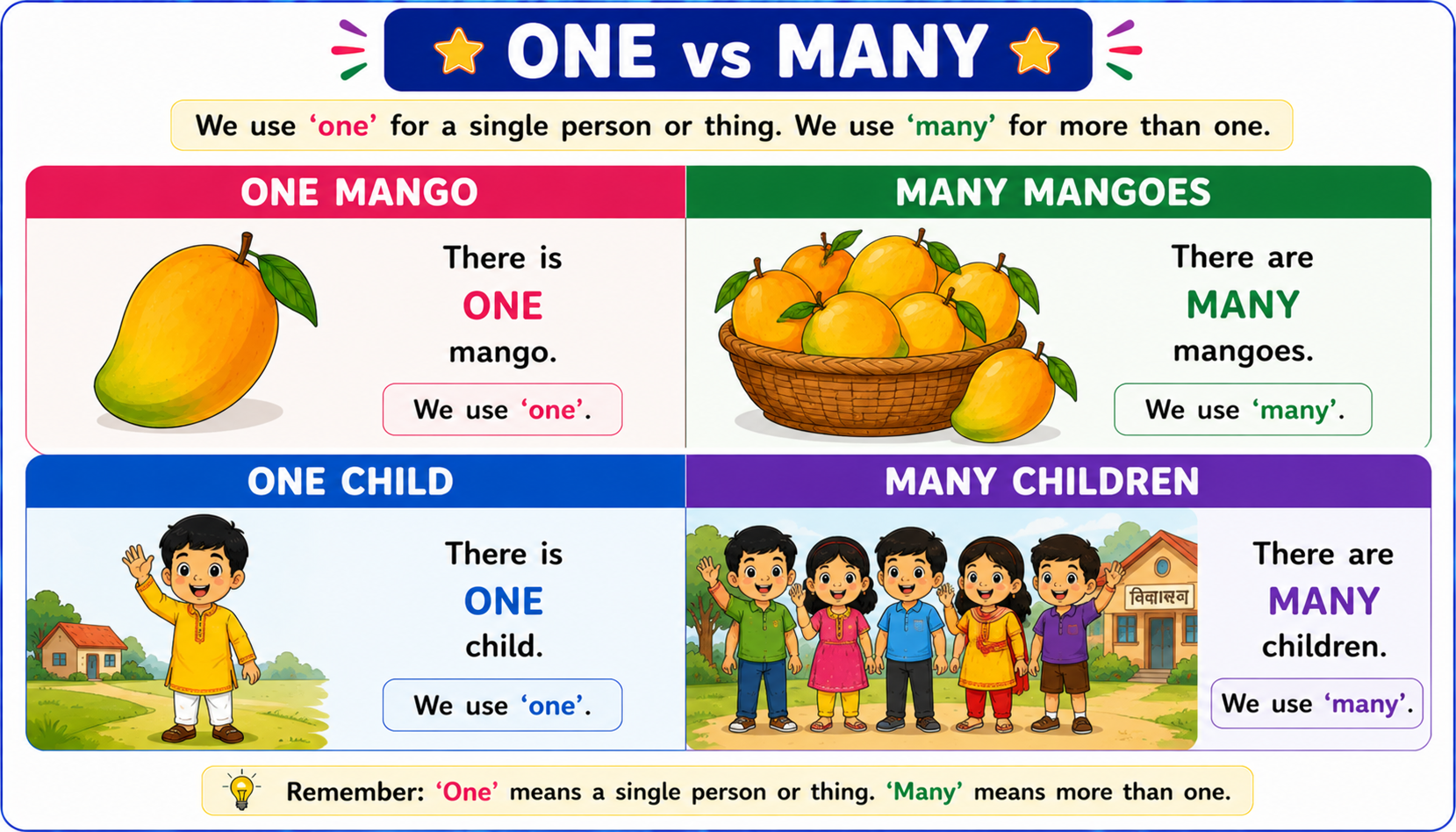
Singular means one — one person, one animal, one place, or one thing.
Plural means more than one — two or more persons, animals, places, or things.
Singular: one mango, one diya, one child, one leaf
Plural: many mangoes, many diyas, many children, many leaves
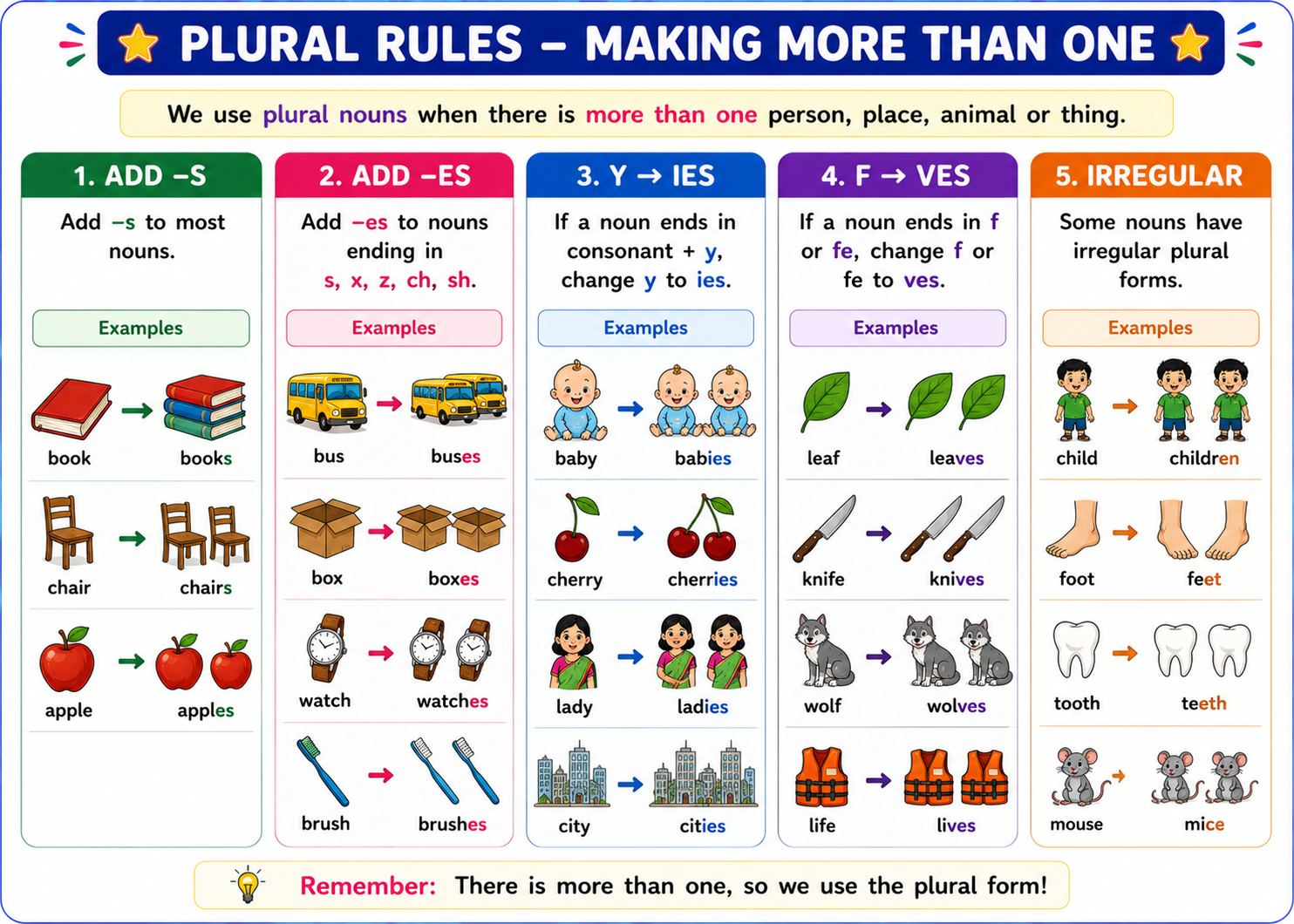
Rule 1: Add -s (Most Nouns)
For most nouns, simply add -s at the end to make the plural form.
| Singular (One) | Plural (Many) | Singular (One) | Plural (Many) |
|---|---|---|---|
| book | books | pen | pens |
| cat | cats | dog | dogs |
| chair | chairs | table | tables |
| diya | diyas | roti | rotis |
| girl | girls | flower | flowers |
Example: Sita has one diya. Meena has ten diyas for Diwali.
Rule 2: Add -es (Nouns ending in s, sh, ch, x, o)
When a noun ends in -s, -ss, -sh, -ch, -x, or -o, add -es to make it plural.
| Singular (One) | Plural (Many) | Rule |
|---|---|---|
| bus | buses | ends in -s |
| glass | glasses | ends in -ss |
| brush | brushes | ends in -sh |
| bench | benches | ends in -ch |
| box | boxes | ends in -x |
| mango | mangoes | ends in -o |
| potato | potatoes | ends in -o |
| tomato | tomatoes | ends in -o |
Example: Arjun bought one mango. His mother bought a dozen mangoes from the market.
Rule 3: Change y to ies (Consonant + y)
If a noun ends in a consonant + y, change the y to i and add -es.
| Singular (One) | Plural (Many) |
|---|---|
| baby | babies |
| story | stories |
| city | cities |
| fly | flies |
| lady | ladies |
| army | armies |
But! If the word ends in a vowel + y, just add -s:
| Singular | Plural | Why? |
|---|---|---|
| boy | boys | vowel (o) + y |
| toy | toys | vowel (o) + y |
| key | keys | vowel (e) + y |
| monkey | monkeys | vowel (e) + y |
Rule 4: Change f or fe to ves
Some nouns ending in -f or -fe change to -ves in the plural form.
| Singular (One) | Plural (Many) |
|---|---|
| leaf | leaves |
| knife | knives |
| wife | wives |
| wolf | wolves |
| half | halves |
| shelf | shelves |
| life | lives |
| thief | thieves |
Rule 5: Irregular Plurals (Special Words)
Some nouns do not follow any rule. They change their spelling completely. We must learn these by heart!
| Singular (One) | Plural (Many) | Singular (One) | Plural (Many) |
|---|---|---|---|
| child | children | foot | feet |
| man | men | woman | women |
| tooth | teeth | goose | geese |
| mouse | mice | ox | oxen |
| person | people | cactus | cacti |
Example: One child is reading. Many children are playing in the park.
Example: The man is walking. The men are working in the field.
Words That Stay the Same (No Change)
Some nouns have the same form for both singular and plural.
| Singular | Plural |
|---|---|
| one sheep | many sheep |
| one deer | many deer |
| one fish | many fish |
| one aircraft | many aircraft |
Using Singular and Plural in Sentences (Indian Context)
Singular: Amma made one roti. → Plural: Amma made ten rotis for dinner.
Singular: There is one mango on the tree. → Plural: There are many mangoes on the tree.
Singular: One child won the race. → Plural: All the children clapped.
Singular: The leaf fell from the neem tree. → Plural: Many leaves fell in autumn.
Singular: Ravi lost one tooth. → Plural: He brushes his teeth twice a day.
Key Words
| Word | Meaning |
|---|---|
| Singular | A noun that refers to only one person, place, animal, or thing |
| Plural | A noun that refers to more than one person, place, animal, or thing |
| Regular plural | A plural formed by following a rule (add -s, -es, -ies, -ves) |
| Irregular plural | A plural that does not follow any rule (child → children) |
| Consonant | All letters except a, e, i, o, u |
| Vowel | The letters a, e, i, o, u |
- Singular means one. Plural means more than one.
- Rule 1: Add -s to most nouns — book → books, cat → cats, diya → diyas.
- Rule 2: Add -es to nouns ending in s, sh, ch, x, o — bus → buses, mango → mangoes.
- Rule 3: Consonant + y → change y to i, add -es — baby → babies, city → cities.
- Rule 3 exception: Vowel + y → just add -s — boy → boys, key → keys.
- Rule 4: Some -f/-fe words → change to -ves — leaf → leaves, knife → knives.
- Rule 5: Irregular plurals must be memorised — child → children, man → men, tooth → teeth.
- Some words stay the same — sheep → sheep, deer → deer, fish → fish.
Finished learning? Now test what you know!