Reading Comprehension
Learning Objectives
- Read passages carefully and understand the main idea.
- Answer different types of questions: who, what, where, when, why, and how.
- Find specific information and details within a passage.
- Learn to underline key words and sentences while reading.
- Build vocabulary by learning new words from passages.
- Write answers in complete sentences using your own words.
- Develop the habit of reading for meaning, not just words.
What is Reading Comprehension?
Reading comprehension means reading a passage (a short piece of writing) and understanding what it says. It is not just about reading the words — it is about understanding the meaning, finding important details, and being able to answer questions about what you read.
When we read a passage, we look for answers to questions like: Who is the passage about? What happened? Where did it happen? When did it happen? Why did it happen? How did it happen?
How to Read a Passage Carefully
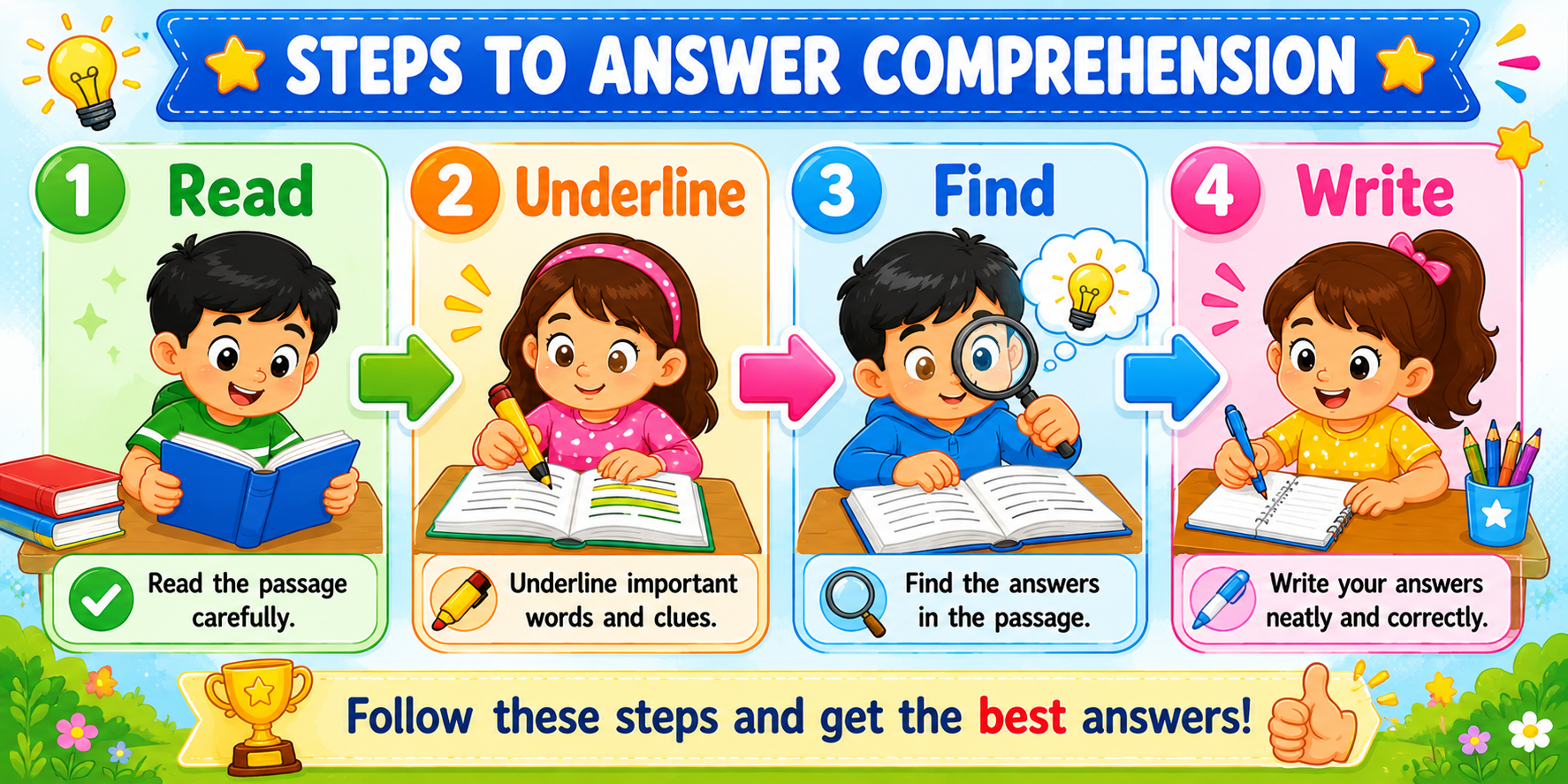
Step 1: Read the title. The title tells you what the passage is about. Think about what you already know about the topic.
Step 2: Read the passage once. Read it slowly from beginning to end. Don't worry about the questions yet. Just try to understand the story or information.
Step 3: Read the questions. Now look at the questions. What do they ask? Are they asking who, what, where, when, why, or how?
Step 4: Read the passage again. This time, underline or circle the words that help you answer the questions.
Step 5: Write your answers. Use complete sentences. Check your spelling and make sure your answer makes sense.
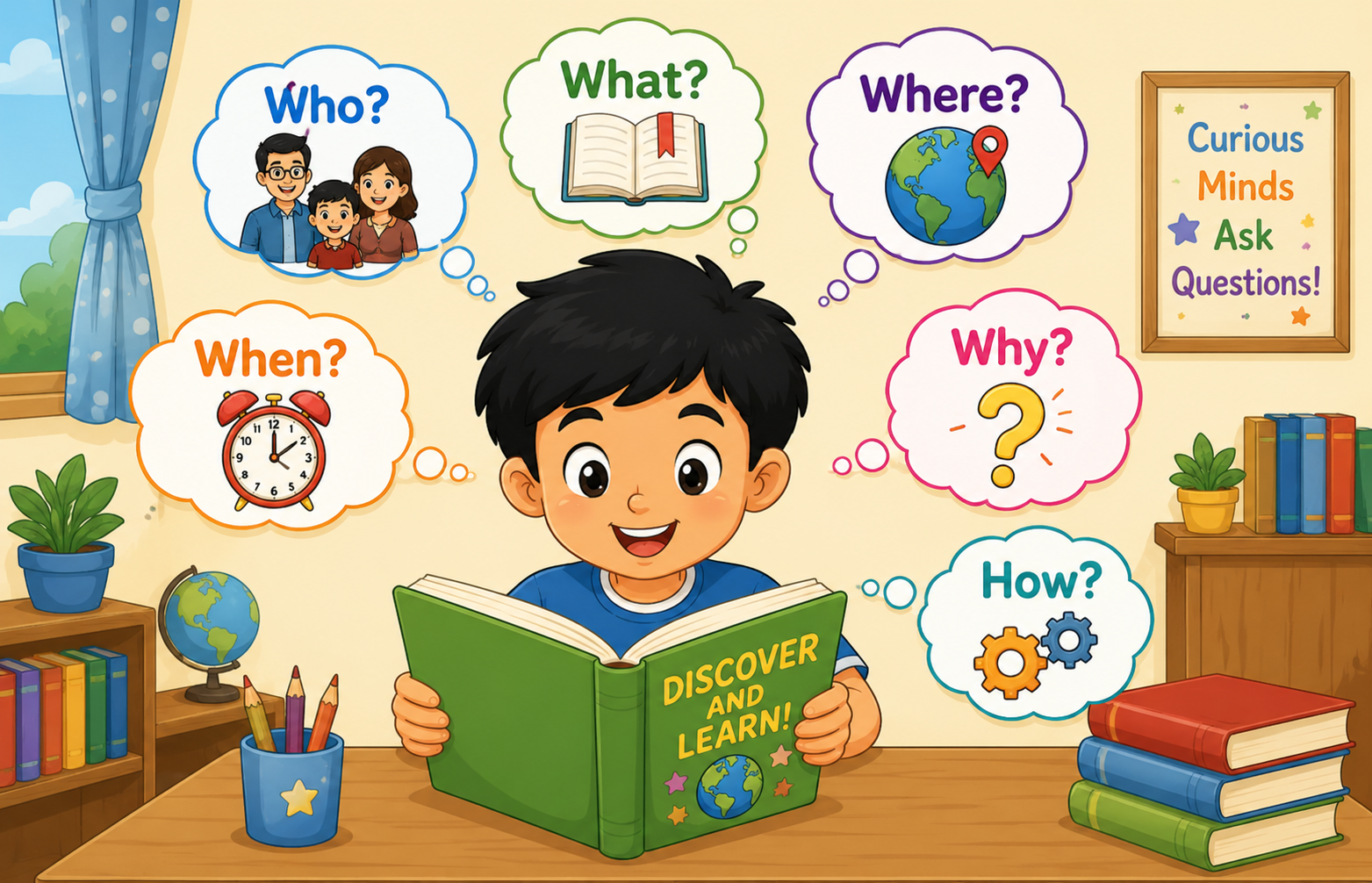
Types of Comprehension Questions
| Question Word | What It Asks | Example |
|---|---|---|
| Who | About a person or character | Who went to the market? |
| What | About a thing, event, or action | What did Ravi buy? |
| Where | About a place or location | Where did the story happen? |
| When | About time | When did the festival begin? |
| Why | About a reason | Why was Meena happy? |
| How | About the way something happened | How did they reach the village? |
Finding Answers in the Text
Most answers to comprehension questions are found inside the passage itself. You do not need to guess or make up answers. Here are some tips:
For fill-in-the-blanks: The exact word is usually in the passage. Look for the sentence that matches the question.
For MCQs (multiple choice): Read all four options. Go back to the passage and find which option matches what is written.
For short answers: Find the relevant sentence in the passage. Write your answer in a complete sentence using some words from the passage.
For "why" questions: Look for words like "because," "so," "therefore," or "that is why" in the passage.
Sample Passage — The Festival of Pongal
Pongal is a harvest festival celebrated in Tamil Nadu. It is celebrated in the month of January every year. The festival lasts for four days. On the main day, people cook a special dish called "Pongal" made from freshly harvested rice, milk, and jaggery. They cook it in a new clay pot until it overflows. The overflowing pot is a sign of good luck and prosperity.
Families decorate their homes with kolam (rangoli) designs made from rice flour. They wear new clothes and visit temples. On the third day, called Mattu Pongal, farmers decorate their cows and bulls with garlands, bells, and paint. They thank the animals for helping them in the fields. Children enjoy eating sweets and playing with friends.
Questions on the Passage
Tips for Answering Comprehension Questions
Tip 1: Always read the passage at least twice before answering.
Tip 2: Underline important names, places, dates, and events.
Tip 3: For "true or false" questions, find the exact sentence in the passage.
Tip 4: Start your answer with words from the question. Example: "Where is Pongal celebrated?" → "Pongal is celebrated in..."
Tip 5: If you don't know a word, read the sentences before and after it for clues.
Tip 6: Check your answer by reading the passage one more time.
Key Words
| Word | Meaning |
|---|---|
| Passage | A short piece of writing (a paragraph or story) |
| Comprehension | Understanding what you read |
| Main idea | The most important point of the passage |
| Detail | A small piece of information in the passage |
| Underline | To draw a line under important words |
| Harvest | The time when crops are collected from fields |
| Prosperity | Being successful and having good fortune |
| Kolam | Decorative patterns drawn on the ground with rice flour |
- Comprehension means understanding what you read.
- Always read the passage at least twice — once for understanding, once for finding answers.
- Use question words (who, what, where, when, why, how) to guide your reading.
- Most answers are found directly in the passage — look carefully!
- Underline key words and important sentences while reading.
- Write answers in complete sentences, not just one word.
- Start your answer using words from the question.
Finished learning? Now test what you know!