Verbs (Action Words, Helping Verbs, Linking Verbs)
Learning Objectives
- Students will understand what a verb is and why it is important in a sentence.
- Students will identify and use action verbs in sentences.
- Students will learn about helping verbs and how they support main verbs.
- Students will understand linking verbs and how they connect the subject to information.
- Students will be introduced to past and present forms of verbs.
- Students will use verbs in Indian context sentences (cricket, festivals, daily life).
What Is a Verb?
A verb is a word that tells us what someone or something does, is, or has. Every sentence needs a verb to be complete. Without a verb, a sentence cannot make sense!
Think of a verb as the engine of a sentence — it makes the sentence move and work. Just like a car cannot run without an engine, a sentence cannot work without a verb.
• Ravi plays cricket every evening. (plays = verb)
• Amma is cooking dinner. (is = verb)
• The children have finished their homework. (have = verb)
Three Types of Verbs
In Class 3, we learn about three important types of verbs:
| Type | What It Does | Examples |
|---|---|---|
| Action Verbs | Shows what someone does (an action) | run, eat, write, play, cook |
| Helping Verbs | Helps the main verb in a sentence | is, am, are, was, were, has, have |
| Linking Verbs | Connects the subject to more information | is, am, are, was, were |
Action Verbs
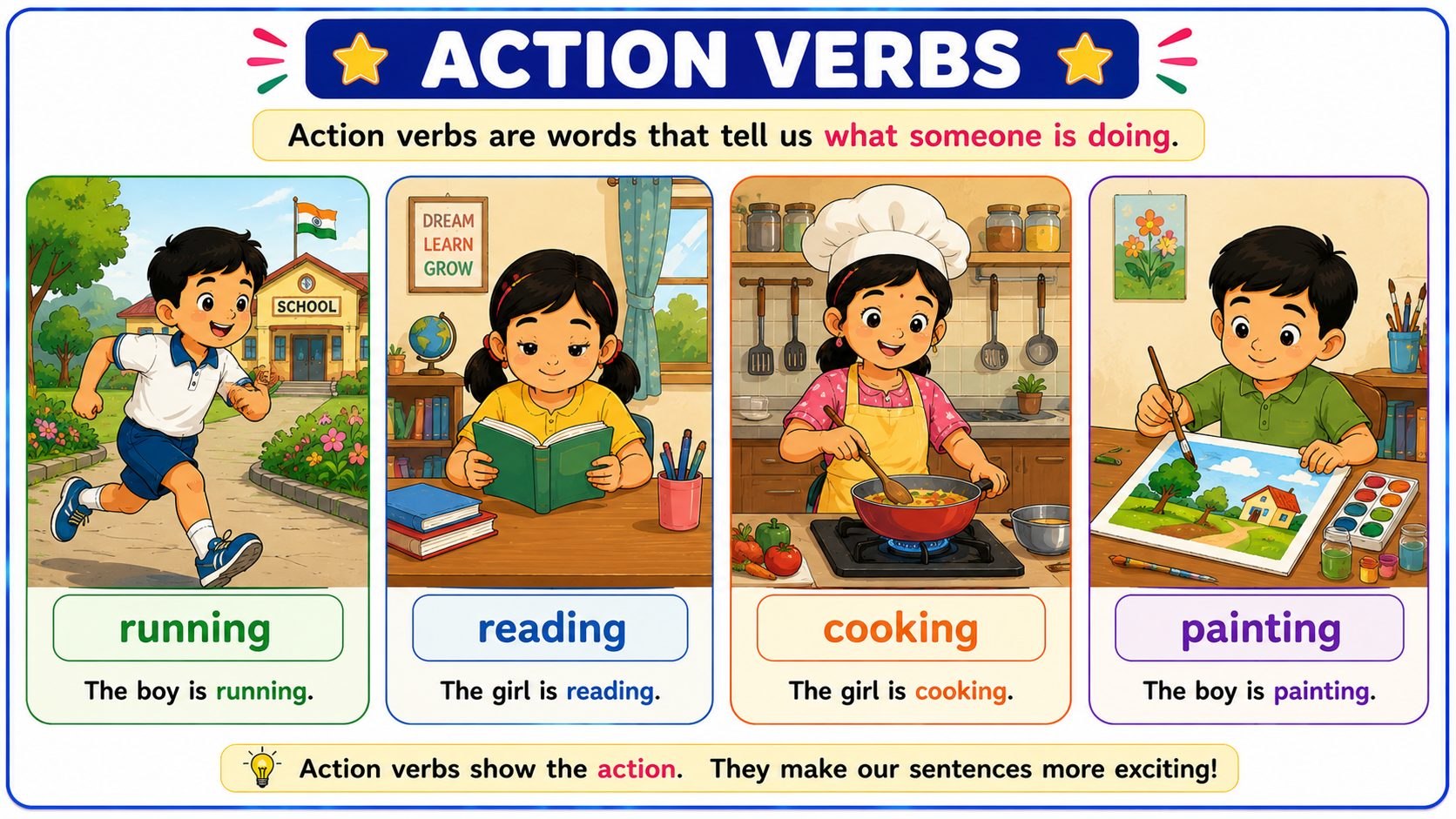
An action verb is a word that shows what a person, animal, or thing does. These are the most common verbs. When you can see or imagine someone doing something, that word is an action verb.
Common Action Verbs
| At Home | At School | At Play | In Nature |
|---|---|---|---|
| cook, eat, sleep | read, write, draw | run, jump, play | grow, bloom, fly |
| wash, sweep, iron | listen, speak, count | kick, throw, catch | swim, crawl, climb |
| chop, stir, serve | study, recite, spell | bat, bowl, score | dig, plant, water |
Action Verbs in Indian Context
| Sentence | Action Verb |
|---|---|
| Arjun bats in the cricket match. | bats |
| Grandmother rolls the roti on the tawa. | rolls |
| Priya studies for her maths exam. | studies |
| The children burst crackers on Diwali. | burst |
| Father drives the auto-rickshaw. | drives |
| Meena draws a rangoli at the door. | draws |
| The farmer ploughs the field. | ploughs |
| Ravi flies a kite on Makar Sankranti. | flies |
| Amma lights the diya in the evening. | lights |
| The students sing the national anthem. | sing |
🖼️ Image 1
Helping Verbs
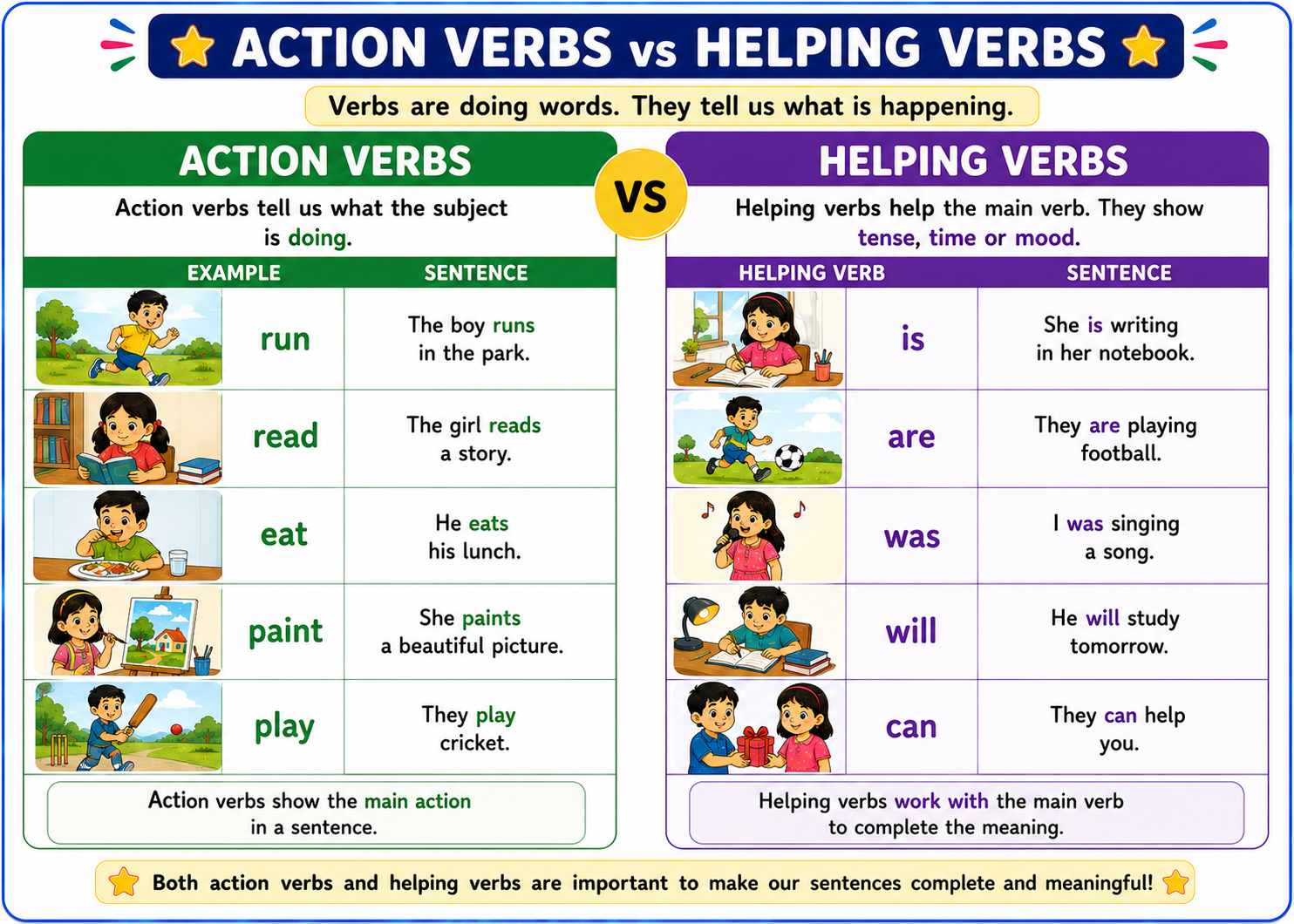
A helping verb is a verb that comes before the main verb and helps it. It does not show the action itself — it helps the action verb by telling us about time (when) or state.
Helping verbs are also called auxiliary verbs.
is, am, are (present) | was, were (past) | has, have (possession/completion)
How Helping Verbs Work
| Sentence | Helping Verb | Main Verb |
|---|---|---|
| Ravi is playing cricket. | is | playing |
| I am reading a storybook. | am | reading |
| The girls are dancing on stage. | are | dancing |
| Meena was cooking dal. | was | cooking |
| They were celebrating Diwali. | were | celebrating |
| She has finished her homework. | has | finished |
| We have eaten lunch. | have | eaten |
Which Helping Verb to Use?
| Subject | Present | Past |
|---|---|---|
| I | am | was |
| He / She / It | is | was |
| We / You / They | are | were |
Linking Verbs
A linking verb does not show action. Instead, it connects (links) the subject to a word that describes or renames it. Think of it as an equals sign (=) in a sentence.
• Ravi is happy. (Ravi = happy)
• I am a student. (I = student)
• The mangoes are sweet. (mangoes = sweet)
• She was tired after the race. (She = tired)
• They were excited about the trip. (They = excited)
Linking Verb vs Helping Verb — What's the Difference?
| Sentence | Type | Why? |
|---|---|---|
| Ravi is tall. | Linking verb | "is" connects Ravi to the description "tall" |
| Ravi is playing cricket. | Helping verb | "is" helps the main verb "playing" |
| She was happy. | Linking verb | "was" connects she to "happy" |
| She was singing a song. | Helping verb | "was" helps the main verb "singing" |
🖼️ Image 2
Past and Present Forms of Verbs
Verbs change their form to show when an action happens. If it is happening now, we use the present form. If it happened before (yesterday, last week), we use the past form.
Regular Verbs (add -ed for past)
| Present (Now) | Past (Before) | Example Sentence (Past) |
|---|---|---|
| play | played | Arjun played cricket yesterday. |
| cook | cooked | Amma cooked biryani last night. |
| study | studied | Priya studied for the test. |
| jump | jumped | The frog jumped into the pond. |
| walk | walked | We walked to the temple. |
| clean | cleaned | Ravi cleaned his room. |
Irregular Verbs (change spelling for past)
| Present (Now) | Past (Before) | Example Sentence (Past) |
|---|---|---|
| run | ran | She ran in the school race. |
| eat | ate | We ate samosas at the fair. |
| write | wrote | He wrote a letter to his friend. |
| sing | sang | The choir sang beautifully. |
| go | went | They went to the zoo. |
| come | came | Grandmother came to visit us. |
| give | gave | Father gave me a new book. |
| see | saw | I saw a peacock in the garden. |
Verbs in Daily Life — Indian Context
Here are sentences using verbs from everyday Indian life:
| Activity | Sentence | Verb |
|---|---|---|
| Playing cricket | Virat hits the ball for a six! | hits |
| Cooking roti | Amma kneads the dough and rolls the roti. | kneads, rolls |
| Studying for exams | Priya is revising her science chapter. | is revising |
| Celebrating Diwali | The family decorates the house with diyas. | decorates |
| Morning routine | Ravi wakes up early and brushes his teeth. | wakes up, brushes |
| School assembly | Students stand in line and sing the prayer. | stand, sing |
| Festival of Holi | Children throw colours and dance with joy. | throw, dance |
| Visiting grandparents | We travel by train to our village. | travel |
Key Words
| Word | Meaning |
|---|---|
| Verb | A word that shows action, state, or helps another verb |
| Action verb | A verb that shows what someone does (run, eat, write) |
| Helping verb | A verb that helps the main verb (is, am, are, was, were, has, have) |
| Linking verb | A verb that connects the subject to a description (is, am, are) |
| Main verb | The most important verb in a sentence that shows the action |
| Present tense | The form of a verb that shows action happening now |
| Past tense | The form of a verb that shows action already done |
| Subject | The person or thing doing the action in a sentence |
- A verb is a word that shows action, being, or having. Every sentence needs a verb.
- Action verbs show what someone does: run, eat, write, play, cook, sing.
- Helping verbs come before the main verb and help it: is, am, are, was, were, has, have.
- Linking verbs connect the subject to a description: "She is happy." (is = linking verb)
- The same word (is, am, are) can be a helping verb OR a linking verb depending on the sentence.
- If followed by another verb → helping verb. If followed by a noun/adjective → linking verb.
- Verbs have present (now) and past (before) forms.
- Regular verbs add -ed for past (play → played). Irregular verbs change spelling (run → ran).
Finished learning? Now test what you know!