Number Sequences
Learning Objectives
- Understand what a number sequence (pattern) is.
- Identify increasing sequences that add a fixed number.
- Identify decreasing sequences that subtract a fixed number.
- Perform skip counting by 2s, 3s, 5s, 10s, and 100s.
- Find the rule in a given number sequence.
- Find missing numbers in a sequence.
- Recognise growing patterns where the amount added increases.
Introduction
Look at the house numbers on your street: 1, 3, 5, 7, 9... Do you notice something? Each number is 2 more than the one before it! This is called a number sequence — a list of numbers that follow a rule or pattern. Number sequences are everywhere — in cricket scores, festival countdowns, and even the pages of your textbook. Once you learn to spot the rule, you can predict what comes next!
What is a Number Sequence?
A number sequence is a list of numbers arranged in a special order. Each number in the sequence is called a term. The numbers follow a rule — a pattern that tells you how to get from one number to the next.
Rule: Add 2 each time.
Terms: 2 is the 1st term, 4 is the 2nd term, 6 is the 3rd term, and so on.
Every sequence has:
- A starting number — where the sequence begins
- A rule — what you do to get the next number
- Terms — the numbers in the sequence
Increasing Sequences (Adding a Fixed Number)
In an increasing sequence, each number is bigger than the one before it. You get the next number by adding the same number every time.
| Rule | Sequence | What Happens |
|---|---|---|
| Add 2 | 3, 5, 7, 9, 11, 13 | Each number is 2 more |
| Add 3 | 4, 7, 10, 13, 16, 19 | Each number is 3 more |
| Add 5 | 5, 10, 15, 20, 25, 30 | Each number is 5 more |
| Add 10 | 10, 20, 30, 40, 50, 60 | Each number is 10 more |
| Add 4 | 1, 5, 9, 13, 17, 21 | Each number is 4 more |
Day 1: ₹5, Day 2: ₹10, Day 3: ₹15, Day 4: ₹20, Day 5: ₹25...
Rule: Add 5. This is an increasing sequence!
Decreasing Sequences (Subtracting a Fixed Number)
In a decreasing sequence, each number is smaller than the one before it. You get the next number by subtracting the same number every time.
| Rule | Sequence | What Happens |
|---|---|---|
| Subtract 2 | 20, 18, 16, 14, 12, 10 | Each number is 2 less |
| Subtract 3 | 30, 27, 24, 21, 18, 15 | Each number is 3 less |
| Subtract 5 | 50, 45, 40, 35, 30, 25 | Each number is 5 less |
| Subtract 10 | 100, 90, 80, 70, 60, 50 | Each number is 10 less |
| Subtract 4 | 40, 36, 32, 28, 24, 20 | Each number is 4 less |
Day 1: 10 days left, Day 2: 9 days left, Day 3: 8 days left...
Rule: Subtract 1. This is a decreasing sequence!
Skip Counting Patterns
Skip counting means counting forward by jumping over numbers. Instead of counting 1, 2, 3, 4... you skip some numbers and count by a fixed amount.
Skip Counting by 2s
2, 4, 6, 8, 10, 12, 14, 16, 18, 20, 22, 24...
These are all even numbers! You jump over one number each time.
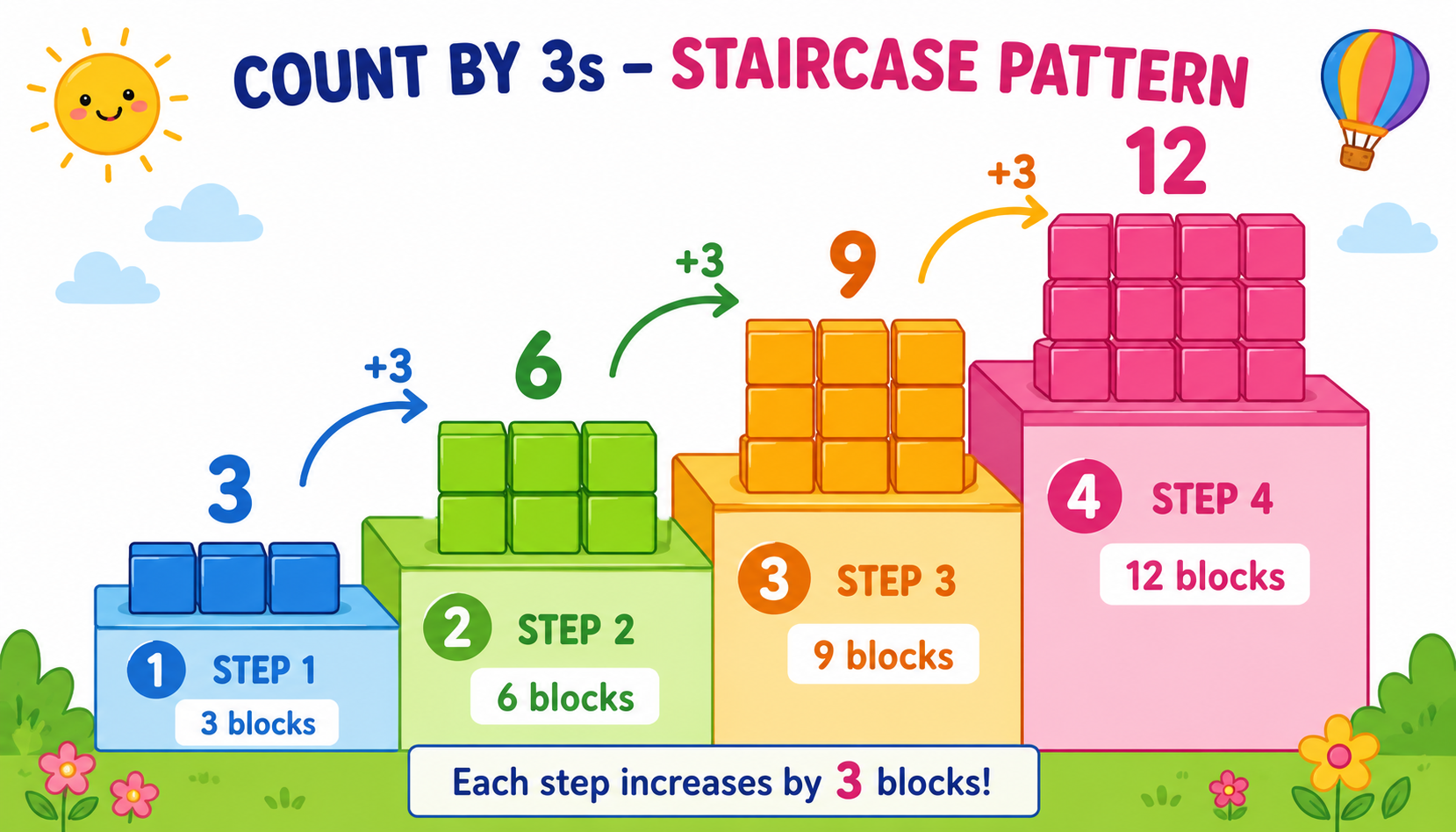
Skip Counting by 3s
3, 6, 9, 12, 15, 18, 21, 24, 27, 30...
This is the same as the 3 times table!
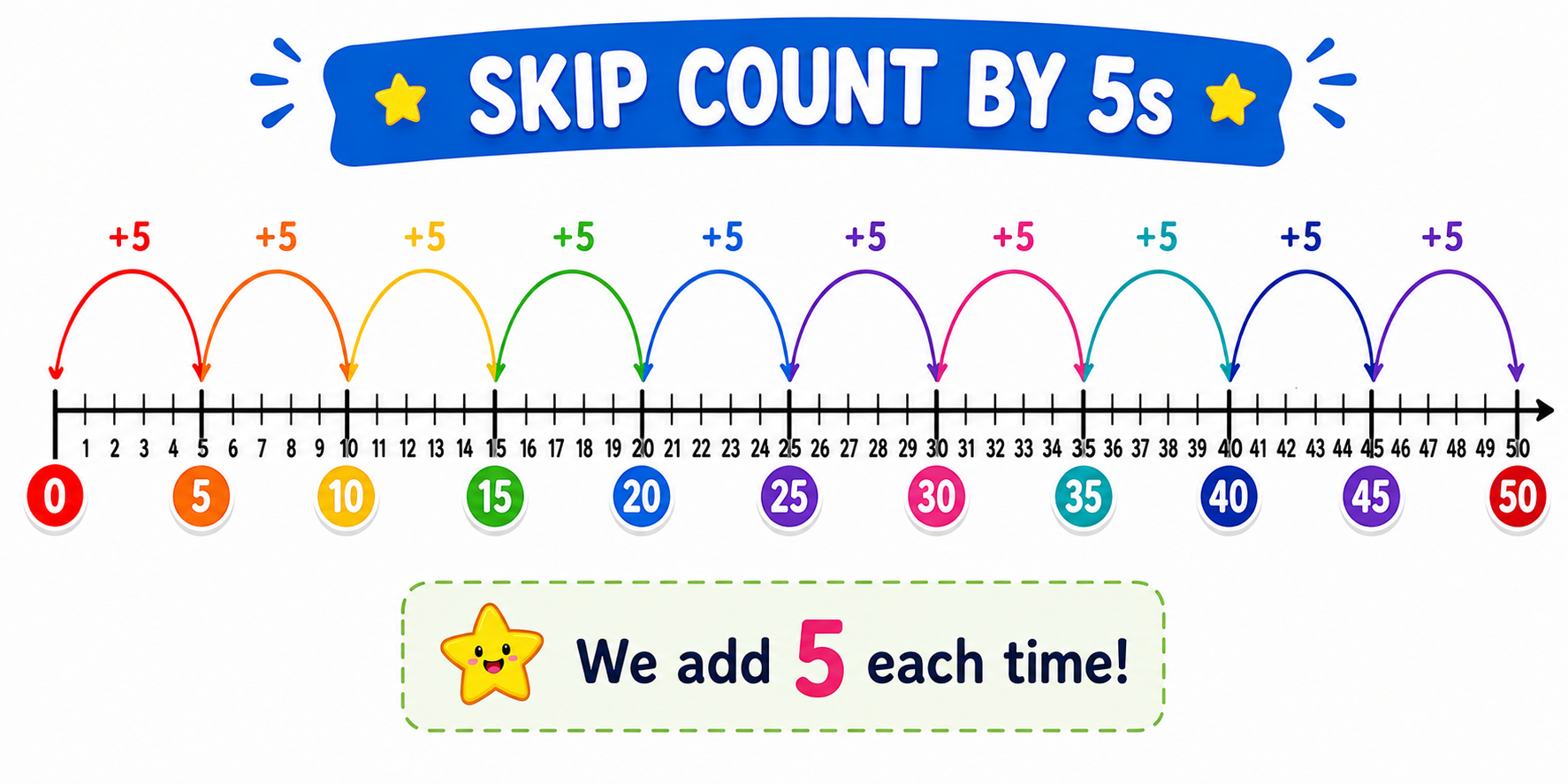
Skip Counting by 5s
5, 10, 15, 20, 25, 30, 35, 40, 45, 50...
Notice: the numbers always end in 0 or 5.
Skip Counting by 10s
10, 20, 30, 40, 50, 60, 70, 80, 90, 100...
The numbers always end in 0. Easy to remember!
Skip Counting by 100s
100, 200, 300, 400, 500, 600, 700, 800, 900, 1000
Just the hundreds! Like counting ₹100 notes.
Ball 1: 4 runs, Ball 2: 8 runs, Ball 3: 12 runs, Ball 4: 16 runs...
That's skip counting by 4s!
Finding the Rule in a Sequence
To find the rule, look at the difference between each pair of numbers next to each other.
11 − 7 = 4, 15 − 11 = 4, 19 − 15 = 4, 23 − 19 = 4
Rule: Add 4
45 − 40 = 5, 40 − 35 = 5, 35 − 30 = 5, 30 − 25 = 5
Numbers are getting smaller, so Rule: Subtract 5
100 − 90 = 10, 90 − 80 = 10
Rule: Subtract 10
Steps to find the rule:
- Look at the first two numbers. Find the difference.
- Check if the same difference works for the next pair.
- If numbers go up → the rule is "Add ___"
- If numbers go down → the rule is "Subtract ___"
Finding Missing Numbers
Once you know the rule, you can find any missing number in a sequence!
Rule: Add 5. So the missing number is 10 + 5 = 15
Rule: Subtract 3. So the missing number is 30 − 3 = 27
Rule: Add 4. So the missing number is 8 + 4 = 12
Rule: Add 100. Missing numbers: 300 and 500
Growing Patterns (Increasing Amounts)
In a growing pattern, the amount you add increases each time. The difference between numbers is not the same — it grows!
Differences: +1, +2, +3, +4, +5
The amount added grows by 1 each time!
Differences: +2, +4, +6, +8
The amount added grows by 2 each time!
Differences: +1, +2, +3, +4, +5
Next difference would be +6, so next term = 20 + 6 = 26
Growing patterns are trickier because the rule changes! You need to look at how the differences themselves are changing.
Number Sequences in Daily Life (Indian Context)
Number sequences are all around us! Here are some examples from everyday life in India:
| Situation | Sequence | Rule |
|---|---|---|
| House numbers (odd side) | 1, 3, 5, 7, 9, 11... | Add 2 |
| House numbers (even side) | 2, 4, 6, 8, 10, 12... | Add 2 |
| Cricket overs (runs at 6 per over) | 6, 12, 18, 24, 30... | Add 6 |
| Saving ₹10 daily | ₹10, ₹20, ₹30, ₹40... | Add 10 |
| Diwali countdown (days left) | 10, 9, 8, 7, 6, 5... | Subtract 1 |
| Counting ₹5 coins | 5, 10, 15, 20, 25... | Add 5 |
| Floor numbers in a building | G, 1, 2, 3, 4, 5... | Add 1 |
| Auto-rickshaw fare (₹25 start + ₹10/km) | ₹25, ₹35, ₹45, ₹55... | Add 10 |
Key Words
| Word | Meaning |
|---|---|
| Sequence | A list of numbers arranged in a special order following a rule |
| Term | Each number in a sequence |
| Rule | The pattern or operation that connects one term to the next |
| Increasing sequence | A sequence where numbers get bigger (add) |
| Decreasing sequence | A sequence where numbers get smaller (subtract) |
| Skip counting | Counting forward by jumping a fixed number each time |
| Growing pattern | A pattern where the amount added increases each time |
| Difference | The gap between two numbers next to each other |
⭐ Key Points to Remember
- A number sequence is a list of numbers that follow a rule.
- In an increasing sequence, you ADD the same number each time.
- In a decreasing sequence, you SUBTRACT the same number each time.
- To find the rule, subtract each number from the next one.
- Skip counting by 5s always gives numbers ending in 0 or 5.
- Skip counting by 10s always gives numbers ending in 0.
- In a growing pattern, the difference itself increases.
- Always check your answer by applying the rule to all terms.
Finished learning? Now test what you know!