Learn what dinosaurs were, when they lived, and how big they were.
Know about different types of dinosaurs — herbivores, carnivores, and flying reptiles.
Understand what fossils are and how scientists learn about dinosaurs.
Learn about dinosaur fossils found in India.
Understand why dinosaurs became extinct 66 million years ago.
📖 Introduction
Millions of years ago, long before humans existed, giant creatures called dinosaurs roamed the Earth. Some were as tall as a five-storey building! Some ate plants, some ate meat, and some could even fly. The word "dinosaur" comes from Greek and means "terrible lizard". Dinosaurs ruled the Earth for about 165 million years — much, much longer than humans have been around (only about 300,000 years). Even though they are gone, we can still learn about them from their bones and footprints buried in rocks!
⏰ When Did Dinosaurs Live?
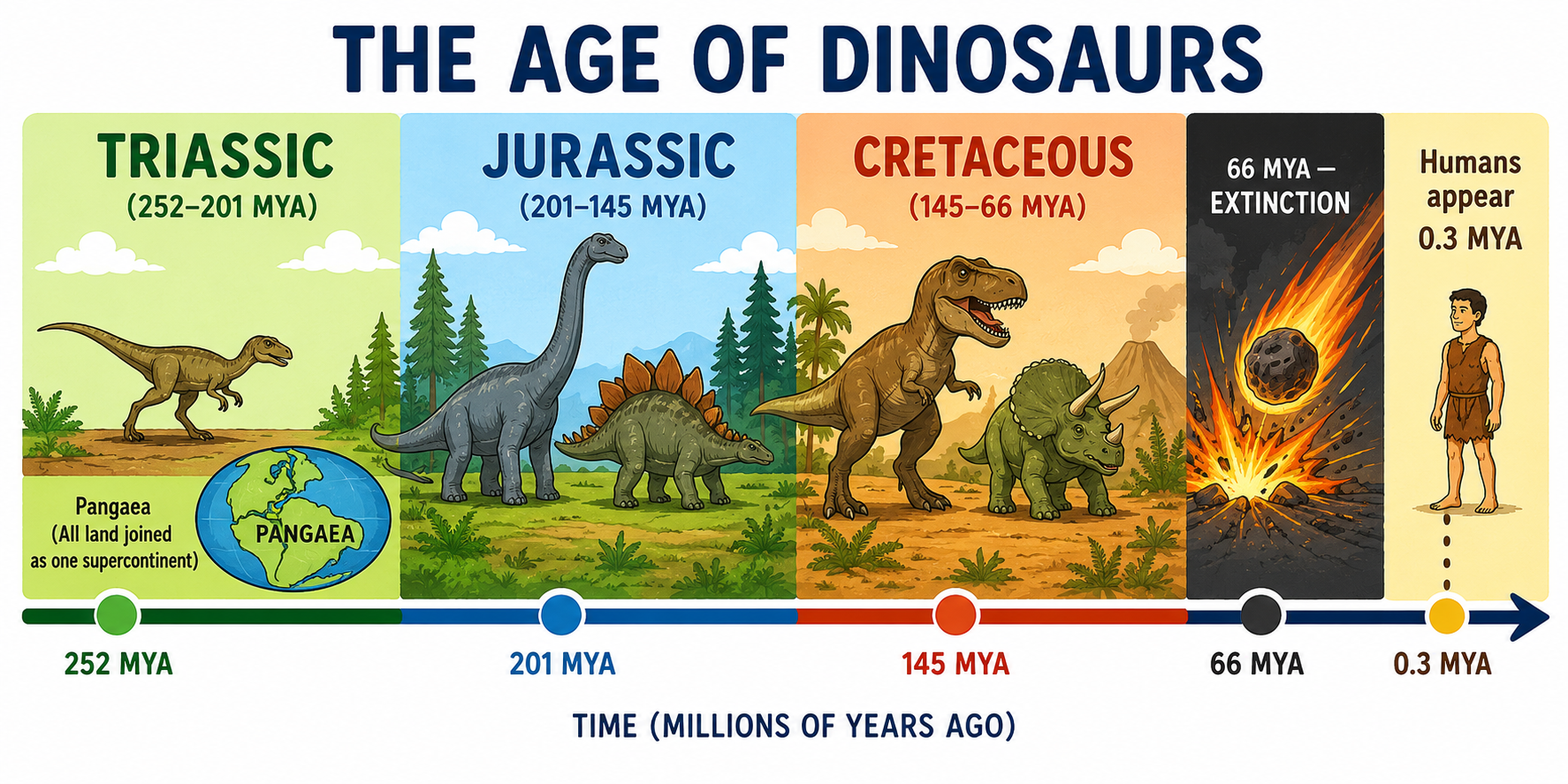
Dinosaurs lived during a time called the Mesozoic Era (the "Age of Reptiles"), which lasted from about 252 million years ago to 66 million years ago. This era is divided into three periods:
Period
When
What Happened
Triassic
252–201 million years ago
First dinosaurs appeared. They were small (dog-sized). All land was one supercontinent called Pangaea.
Jurassic
201–145 million years ago
Dinosaurs grew very large. Forests and swamps appeared. Famous dinosaurs: Brachiosaurus, Stegosaurus.
Cretaceous
145–66 million years ago
Dinosaurs were everywhere! T-Rex and Triceratops lived now. Ended with mass extinction.
Think about it — dinosaurs lived for 165 million years. Humans have only been around for about 300,000 years. If the history of dinosaurs was a 24-hour clock, human history would be less than 3 seconds!
🦕 Types of Dinosaurs
Dinosaurs came in all shapes and sizes. Some were gentle plant-eaters, some were fierce hunters, and some could fly!
Herbivores (Plant-Eaters) 🌿
These dinosaurs ate leaves, ferns, and plants. They usually had flat teeth for grinding plants and long necks to reach tall trees.
Dinosaur
Size
Interesting Fact
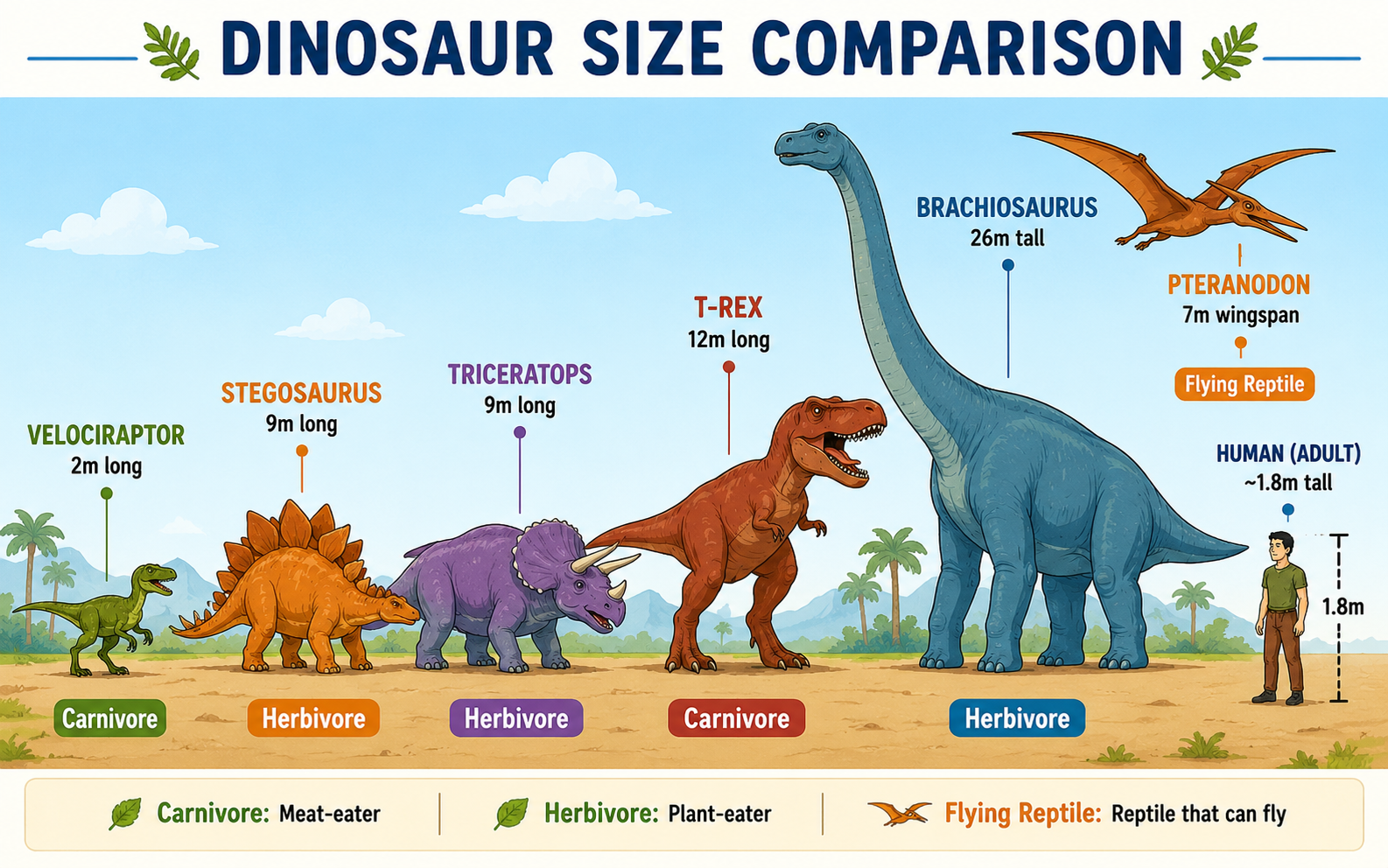
Brachiosaurus
26 metres long, 13 metres tall
One of the tallest dinosaurs ever! Its neck alone was 9 metres long — as tall as a 3-storey building.
Triceratops
9 metres long
Had 3 horns on its head and a large bony frill. Used horns to fight predators.
Stegosaurus
9 metres long
Had large bony plates on its back and 4 sharp spikes on its tail for defence.
Diplodocus
27 metres long
One of the longest dinosaurs. Its tail was like a whip!
Ankylosaurus
7 metres long
Covered in armour (bony plates) like a tank. Had a club-shaped tail.
Carnivores (Meat-Eaters) 🥩
These dinosaurs hunted other animals. They had sharp teeth, strong jaws, and usually walked on two legs to run fast.
Dinosaur
Size
Interesting Fact
Tyrannosaurus Rex (T-Rex)
12 metres long
The "King of Dinosaurs"! Had tiny arms but massive jaws with 60 sharp teeth, each as big as a banana.
Velociraptor
2 metres long
Small but very fast and smart. Hunted in packs (groups). Had a large curved claw on each foot.
Spinosaurus
15 metres long
Even bigger than T-Rex! Had a sail on its back and ate fish. Could swim!
Allosaurus
10 metres long
A fierce hunter from the Jurassic period. Had strong arms with sharp claws.
Flying Reptiles (Pterosaurs) 🦅
These were not actually dinosaurs, but flying reptiles that lived alongside them:
Pteranodon — 7-metre wingspan, ate fish, had a large crest on its head.
Quetzalcoatlus — the largest flying animal ever! 11-metre wingspan (as wide as a small airplane!).
🦴 Fossils — How We Know About Dinosaurs
No human ever saw a living dinosaur — they died out millions of years before humans appeared! So how do we know so much about them?
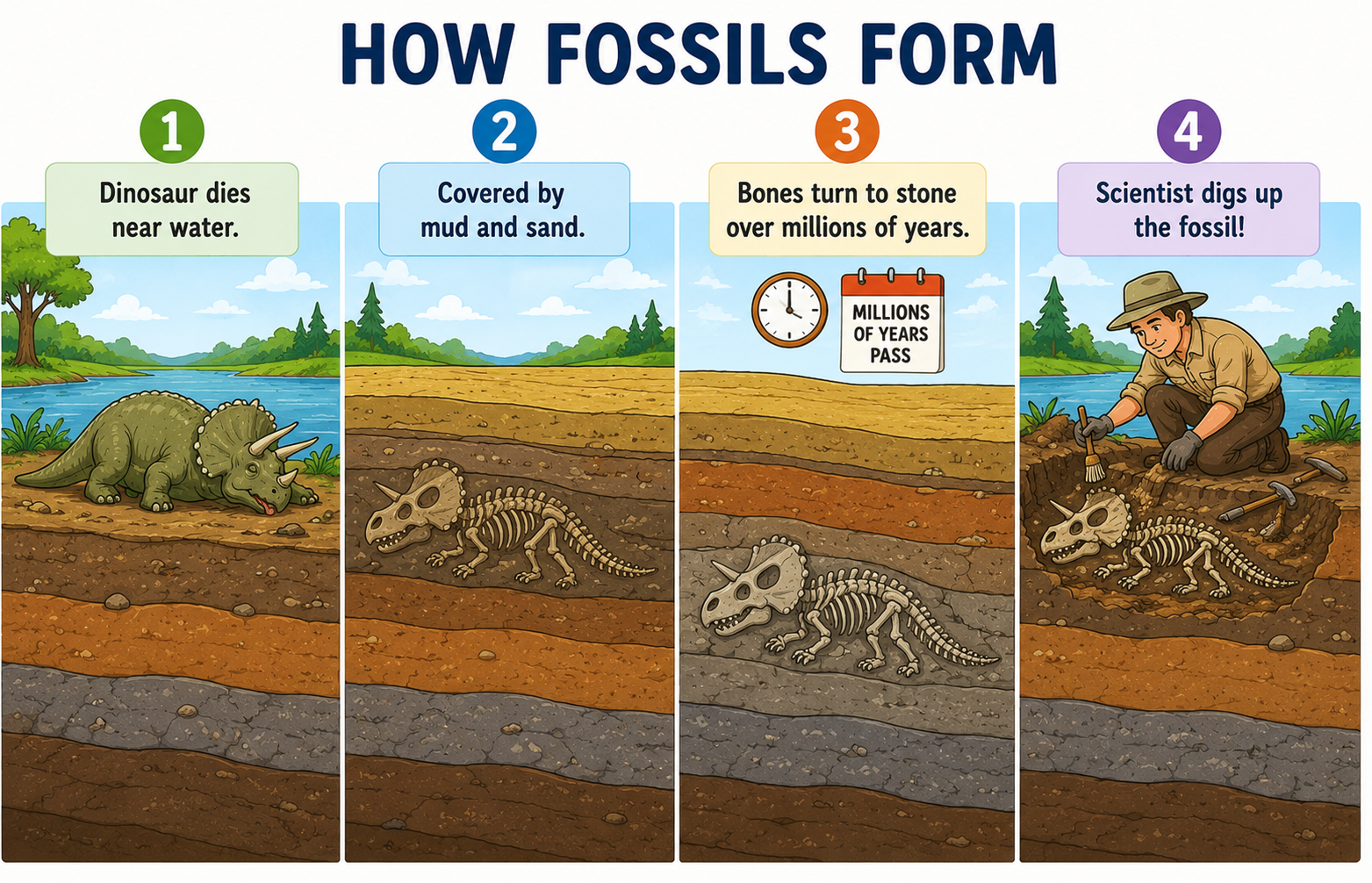
The answer is fossils. A fossil is the remains or impression of a plant or animal that has been preserved in rock over millions of years.
Types of Fossils:
Bone fossils — actual dinosaur bones that turned to stone over time.
Footprint fossils — impressions of dinosaur feet in mud that hardened into rock.
Coprolites — fossilised dinosaur poop! (Scientists study it to learn what they ate.)
Tooth fossils — tell us if a dinosaur ate plants or meat.
How Fossils Form:
A dinosaur dies and is quickly covered by mud, sand, or water.
Over millions of years, layers of sediment pile up on top.
Minerals slowly replace the bones, turning them to stone.
Earth movements bring the fossils close to the surface.
A palaeontologist (fossil scientist) digs them up carefully!
The word "palaeontologist" is long, but it simply means "a scientist who studies ancient life." They use brushes, hammers, and even dental tools to carefully dig out fossils!
🇮🇳 Dinosaurs in India!
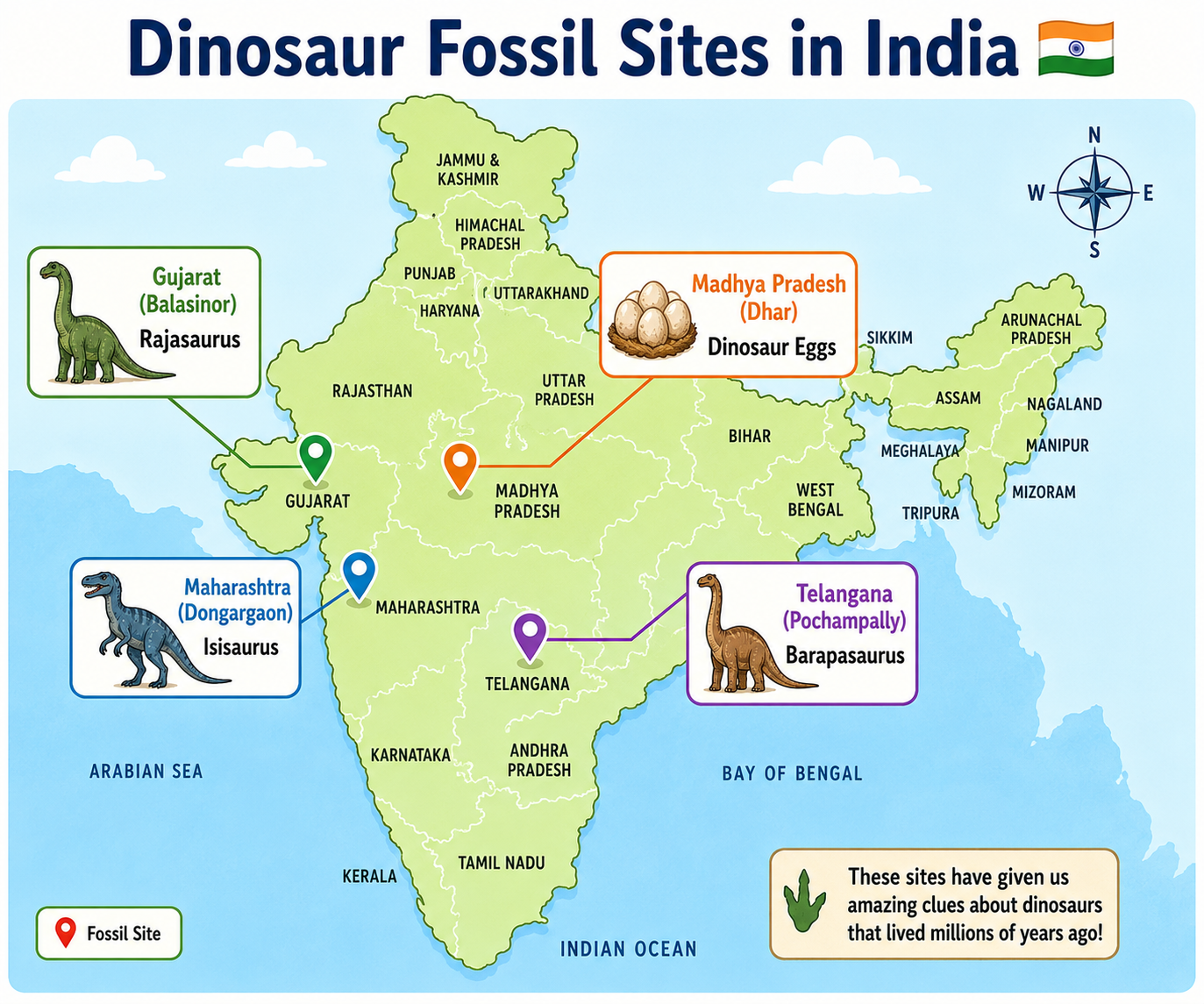
Did you know that dinosaur fossils have been found in India too? India was once home to many dinosaurs! Here are some amazing discoveries:
Dinosaur
Where Found
Interesting Fact
Rajasaurus ("King Lizard")
Gujarat (Balasinor)
A fierce meat-eater, about 7 metres long. Lived 67 million years ago.
Isisaurus
Maharashtra (Dongargaon)
A large plant-eater. Named after the Indian Statistical Institute (ISI).
Barapasaurus ("Big Leg Lizard")
Telangana (Pochampally)
One of the earliest large dinosaurs found in India. About 18 metres long.
Dinosaur eggs
Madhya Pradesh (Dhar)
Hundreds of fossilised eggs found! One of the largest dinosaur nesting sites in the world.
Jainosaurus
Madhya Pradesh
Named after Indian palaeontologist Sohan Lal Jain.
Balasinor in Gujarat is called "India's Jurassic Park" — you can actually visit and see dinosaur fossils and eggs there!
☄️ Why Did Dinosaurs Become Extinct?
About 66 million years ago, all dinosaurs (except birds) suddenly disappeared from Earth. Scientists believe a giant asteroid (a huge rock from space, about 10 km wide) crashed into Earth near what is now Mexico. This caused a chain of terrible events:
Massive explosion — the impact was billions of times more powerful than a nuclear bomb.
Dust and ash blocked sunlight for months — the sky became dark.
Plants died without sunlight. Then herbivores (plant-eaters) starved.
Carnivores had no prey left and also died.
The Earth became extremely cold ("impact winter").
About 75% of all life on Earth died. But not everything! Small animals, insects, birds, and sea creatures survived. Scientists now believe that today's birds are direct descendants of dinosaurs — so in a way, dinosaurs are still alive!
Next time you see a chicken, a sparrow, or a crow — remember, you are looking at a living relative of the dinosaurs!
📝 Key Words
Word
Meaning
Dinosaur
A group of reptiles that lived millions of years ago (means "terrible lizard")
Fossil
Remains or impression of an ancient plant or animal preserved in rock
Extinct
When all members of a species have died and none are left alive
Herbivore
An animal that eats only plants
Carnivore
An animal that eats only meat (hunts other animals)
Palaeontologist
A scientist who studies fossils and ancient life
Mesozoic Era
The time period when dinosaurs lived (252–66 million years ago)
Asteroid
A large rock from space that orbits the Sun
Pangaea
The ancient supercontinent when all land was joined together
Pterosaur
A flying reptile that lived alongside dinosaurs (not actually a dinosaur)
⭐ Key Points to Remember
Dinosaurs lived 252–66 million years ago during the Mesozoic Era.
"Dinosaur" means "terrible lizard" in Greek.
Some were herbivores (Brachiosaurus, Triceratops) and some were carnivores (T-Rex, Velociraptor).
We know about dinosaurs from fossils — bones, footprints, eggs, and even poop!
Dinosaur fossils have been found in India — Gujarat, Maharashtra, MP, and Telangana.
Rajasaurus ("King Lizard") was found in Balasinor, Gujarat.
Dinosaurs became extinct 66 million years ago due to an asteroid impact in Mexico.
Today's birds are descendants of dinosaurs — they are living dinosaurs!
Finished learning? Now test what you know!
🎯 Quick Quiz — Test Yourself!
Answer these questions right here. You get instant feedback — no paper needed!
Score: 0 / 8
1. The word "dinosaur" means:
"Dinosaur" is a Greek word meaning "terrible lizard".
2. Dinosaurs that ate only plants are called:
Plant-eaters are called herbivores. Meat-eaters are carnivores.
3. Which fierce meat-eating dinosaur is very famous?
T-Rex was a famous meat-eating (carnivore) dinosaur with sharp teeth.
4. How do scientists learn about dinosaurs today?
Scientists study fossils — bones and footprints buried in rocks — to learn about dinosaurs.
5. The bones and footprints of dinosaurs found buried in rocks are called ______.
Fossils are the remains (bones, footprints) preserved in rocks.
6. Dinosaurs became extinct about how many million years ago? (a number)
Dinosaurs became extinct about 66 million years ago.
7. Dinosaurs that ate meat are called ______.
Meat-eating dinosaurs are called carnivores.
8. "Extinct" means a kind of animal:
Extinct means the animal has died out completely and no longer exists.
✏️ Practice Questions
A. Fill in the Blanks:
1. The word "dinosaur" means "" in Greek.
2. T-Rex was a -eater (meat/plant).
3. We learn about dinosaurs from found in rocks.
4. Dinosaurs became extinct about million years ago.
5. fossils were found in Gujarat (India).
6. A scientist who studies fossils is called a .
7. Brachiosaurus was a -eater (meat/plant).
8. Today's are believed to be descendants of dinosaurs.
5. Dinosaur eggs have been found in Madhya Pradesh, India.
E. Short Answer Questions:
1. What is a fossil? How does it form?
2. Name two herbivore dinosaurs and two carnivore dinosaurs.
3. Why did dinosaurs become extinct? Explain in 3–4 sentences.
4. Name one dinosaur found in India and where it was discovered.
🎨 Fun Activities
Activity 1 — My Favourite Dinosaur: Draw your favourite dinosaur. Write its name, whether it ate plants or meat, how big it was, and one interesting fact about it.
Activity 2 — Dinosaur Size Chart: Using a measuring tape, mark 12 metres on the ground (the length of a T-Rex). Then mark 2 metres (Velociraptor). Stand next to both marks. How do you compare?
Activity 3 — Fossil Hunt: Go to your garden or a park. Look for interesting stones, shell impressions, or leaf prints in rocks. Draw what you find and imagine it could be millions of years old!
Want to review the lesson again?
GK / World History
Dinosaurs: The Giant Reptiles
Class 3 | CBSE / NCERT / ICSE
Name: Class: Date:
Introduction
Dinosaurs were giant reptiles that lived 252–66 million years ago. "Dinosaur" means "terrible lizard." They ruled Earth for 165 million years. We know about them from fossils found in rocks.
When Did Dinosaurs Live?
Period
When
What Happened
Triassic
252–201 MYA
First small dinosaurs appeared. Land = one piece (Pangaea).
Jurassic
201–145 MYA
Dinosaurs grew huge. Brachiosaurus, Stegosaurus.
Cretaceous
145–66 MYA
T-Rex, Triceratops. Ended with asteroid.
Famous Dinosaurs
Herbivores (Plant-Eaters):
Dinosaur
Size
Fact
Brachiosaurus
26m long
Tallest dinosaur, 9m neck
Triceratops
9m long
3 horns + bony frill
Stegosaurus
9m long
Bony plates + tail spikes
Ankylosaurus
7m long
Armoured body, club tail
Carnivores (Meat-Eaters):
Dinosaur
Size
Fact
T-Rex
12m long
Tiny arms, 60 banana-sized teeth
Velociraptor
2m long
Fast, smart, hunted in packs
Spinosaurus
15m long
Bigger than T-Rex, ate fish
Fossils — How We Know About Dinosaurs
Fossil = remains of ancient life preserved in rock. Types: bone fossils, footprints, eggs, coprolites (poop!).
How fossils form: Dinosaur dies → covered by mud → minerals replace bones → scientist digs it up.
Dinosaurs in India 🇮🇳
Dinosaur
Where Found
Fact
Rajasaurus
Gujarat (Balasinor)
Meat-eater, 7m long
Isisaurus
Maharashtra
Large plant-eater
Barapasaurus
Telangana
18m long, early dinosaur
Dinosaur eggs
Madhya Pradesh (Dhar)
Hundreds found!
Balasinor (Gujarat) is called "India's Jurassic Park"!
Why Did Dinosaurs Become Extinct?
66 million years ago, a giant asteroid (10 km wide) hit Earth near Mexico. This caused fires, dust clouds blocking sunlight, plants dying, food chains collapsing, and extreme cold. 75% of all life died. But birds survived — they are living descendants of dinosaurs!
Key Words
Word
Meaning
Dinosaur
Ancient reptile ("terrible lizard")
Fossil
Ancient remains preserved in rock
Extinct
All members of a species died out
Herbivore
Plant-eater
Carnivore
Meat-eater
Palaeontologist
Scientist who studies fossils
Asteroid
Large rock from space
Mesozoic Era
Age of Reptiles (252–66 MYA)
Pangaea
Ancient supercontinent
⭐ Key Points:
Dinosaurs lived 252–66 million years ago (Mesozoic Era).