Ancient Egypt: Pyramids and Mummies
Learning Objectives
- Learn about ancient Egypt and where it is located on the world map.
- Understand what pyramids are, why they were built, and how they were constructed.
- Learn what mummies are and the step-by-step process of mummification.
- Discover the Sphinx, hieroglyphics, and daily life in ancient Egypt.
- Compare ancient Egypt with ancient India (Indus Valley Civilization).
Introduction
Thousands of years ago, in a land far away called Egypt, people built some of the most amazing structures the world has ever seen — the Pyramids! Egypt is a country in Africa, and a long, mighty river called the Nile flows through it. The ancient Egyptians were incredibly clever. They built massive pyramids, wrote using pictures called hieroglyphics, invented paper from papyrus plants, and even preserved dead bodies as mummies! Their civilization lasted for over 3,000 years.
🌍 Where is Egypt?
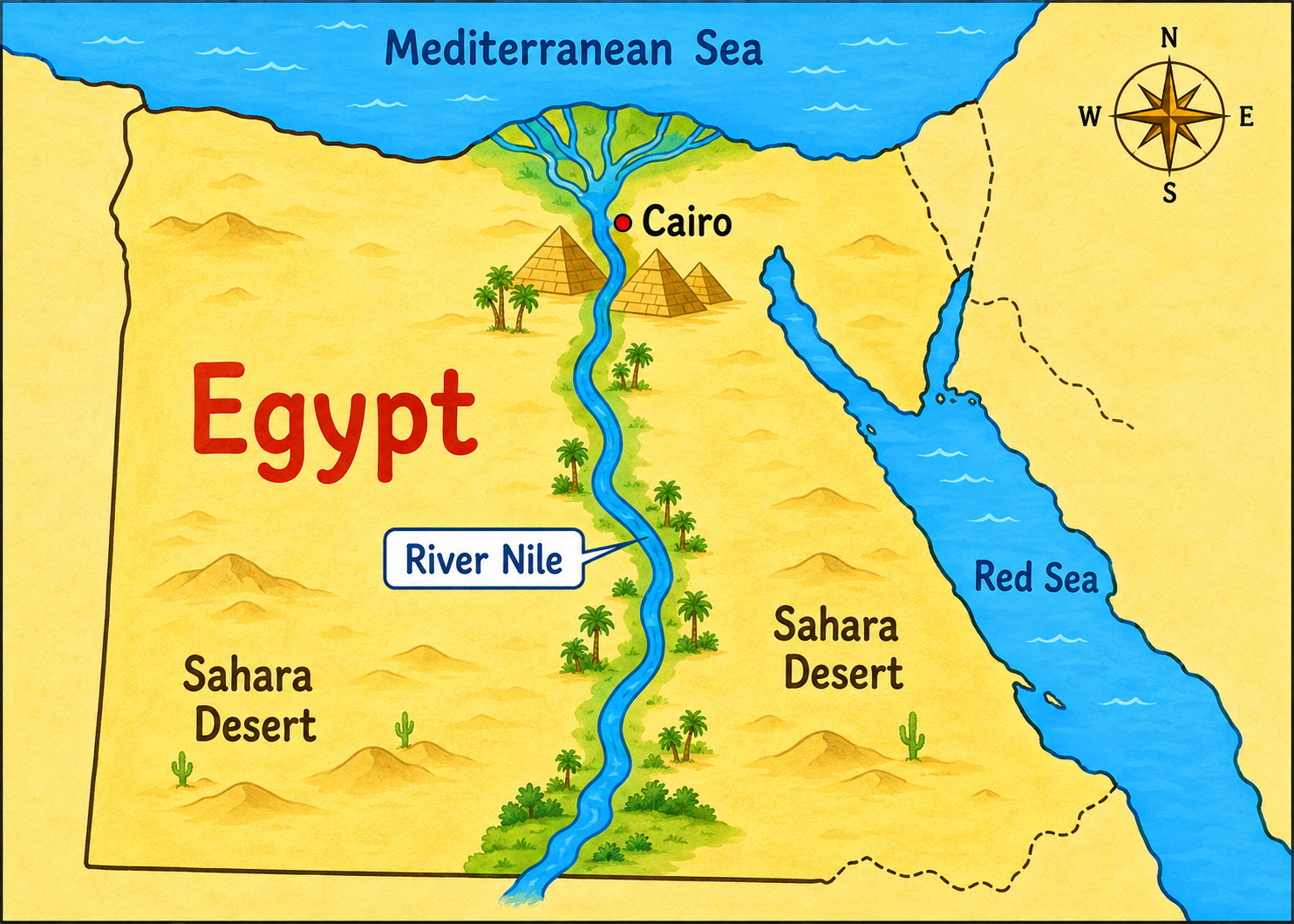
Egypt is in the north-east corner of Africa. It is surrounded by the Mediterranean Sea to the north and the Red Sea to the east. Most of Egypt is covered by the hot, sandy Sahara Desert.
The River Nile — one of the longest rivers in the world (about 6,650 km) — flows from south to north through Egypt and empties into the Mediterranean Sea. Ancient Egyptians built their cities, farms, and temples along the Nile because the river gave them:
- Water for drinking and bathing
- Fertile soil for growing wheat, barley, and vegetables (the Nile flooded every year, leaving rich black soil)
- Transport — boats carried people and goods up and down the river
- Papyrus reeds that grew along its banks (used to make paper, baskets, and boats)
🏛️ The Pyramids
The pyramids are huge stone structures with a square base and four triangular sides that meet at a point on top. They were built as tombs (burial places) for the Egyptian kings called Pharaohs. Egyptians believed their kings were gods on Earth, so they built grand tombs to protect the Pharaoh's body and treasures for the afterlife.
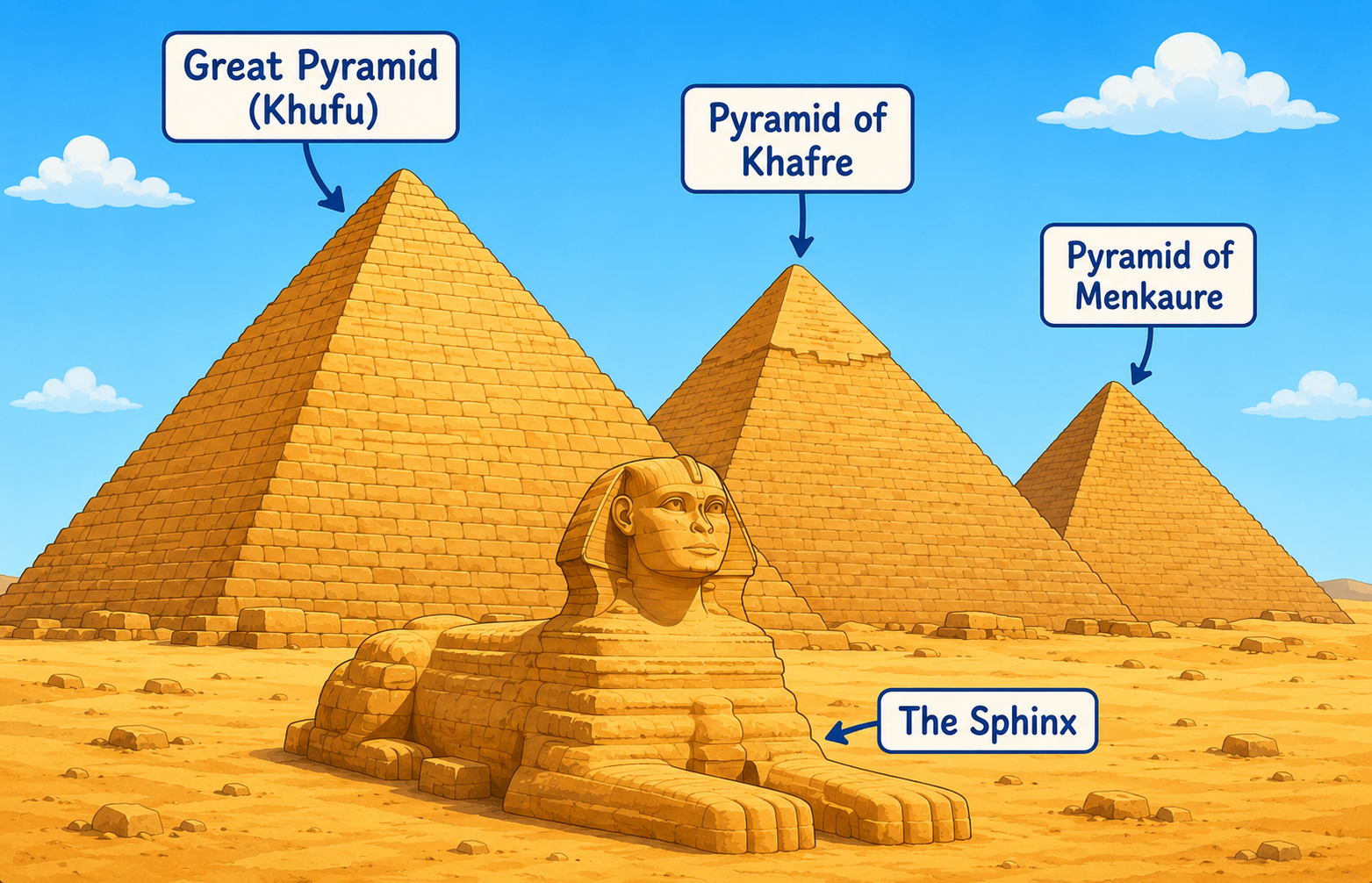
The most famous pyramids are the Pyramids of Giza, near the city of Cairo. There are three main pyramids at Giza:
- The Great Pyramid (Pyramid of Khufu) — the largest and oldest. Built around 2560 BCE.
- Pyramid of Khafre — slightly smaller, with the Sphinx guarding it.
- Pyramid of Menkaure — the smallest of the three.
| Amazing Pyramid Facts | Details |
|---|---|
| Number of stone blocks | About 2.3 million blocks in the Great Pyramid |
| Weight of each block | About 2,500 kg (as heavy as an elephant!) |
| Time to build | About 20 years with thousands of workers |
| Original height | 146 metres (taller than a 40-storey building!) |
| Age | Over 4,500 years old |
| Record | Tallest building in the world for over 3,800 years |
| Wonder status | Only surviving Wonder of the Ancient World |
How Were Pyramids Built?
Scientists still debate exactly how, but here is what we know:
- Workers cut huge limestone blocks from quarries using copper tools.
- Blocks were placed on wooden sledges and pulled by teams of workers.
- Water was poured on sand in front of the sledge to make it slide more easily.
- Ramps (sloping paths) were built to push blocks higher as the pyramid grew.
- The outer surface was covered with smooth white limestone that gleamed in the sun.
🦁 The Great Sphinx
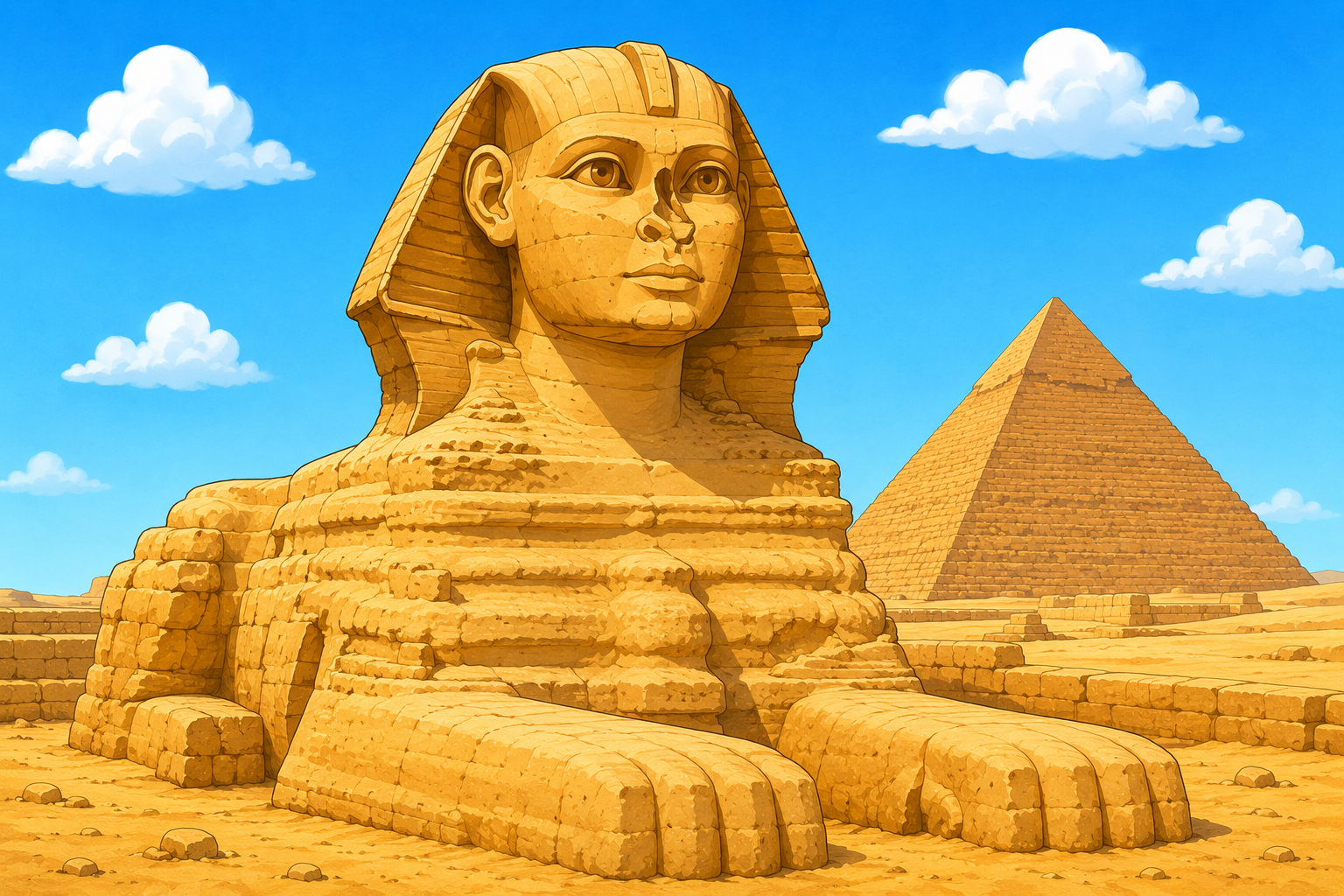
Near the pyramids of Giza stands a giant statue called the Sphinx. It has the body of a lion and the head of a human (believed to be Pharaoh Khafre).
- It is about 73 metres long (as long as a football field!) and 20 metres tall.
- It was carved from a single piece of limestone rock.
- The Sphinx guards the pyramids — ancient Egyptians believed it scared away evil spirits.
- Its nose is missing! No one knows exactly how it was lost.
🧷 Mummies — Preserved Bodies
Ancient Egyptians believed in life after death. They thought that when a person died, their spirit (called "Ba") would need their body in the afterlife. So they preserved dead bodies very carefully. These preserved bodies are called mummies.
How Were Mummies Made? (Step by Step)
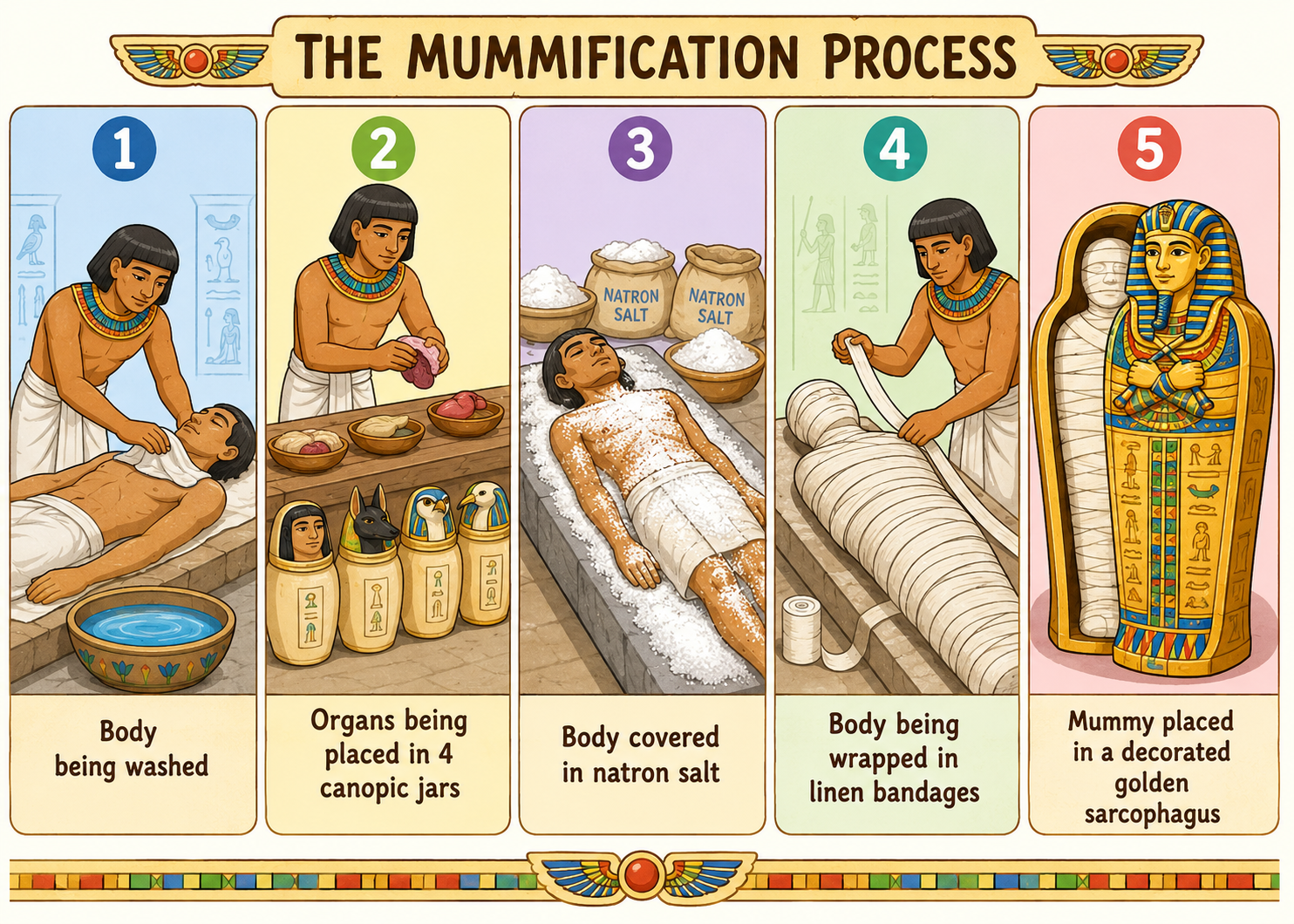
- Washing: The body was washed and cleaned with water from the Nile.
- Removing organs: Internal organs (liver, lungs, stomach, intestines) were removed and stored in special jars called canopic jars. The heart was left inside (Egyptians believed it was needed for judgement in the afterlife).
- Drying: The body was covered in a special salt called natron for 40 days to dry it out completely.
- Stuffing: The body was stuffed with linen, sawdust, or leaves to give it shape.
- Wrapping: The body was wrapped tightly in hundreds of metres of linen cloth (like bandages). Priests said prayers during wrapping.
- Placing in coffin: The mummy was placed in a decorated coffin called a sarcophagus, often painted with the person's face.
- Burial: The sarcophagus was placed in a tomb with food, jewellery, furniture, and even toys — things the dead person might need in the afterlife!
✍️ Hieroglyphics — Picture Writing
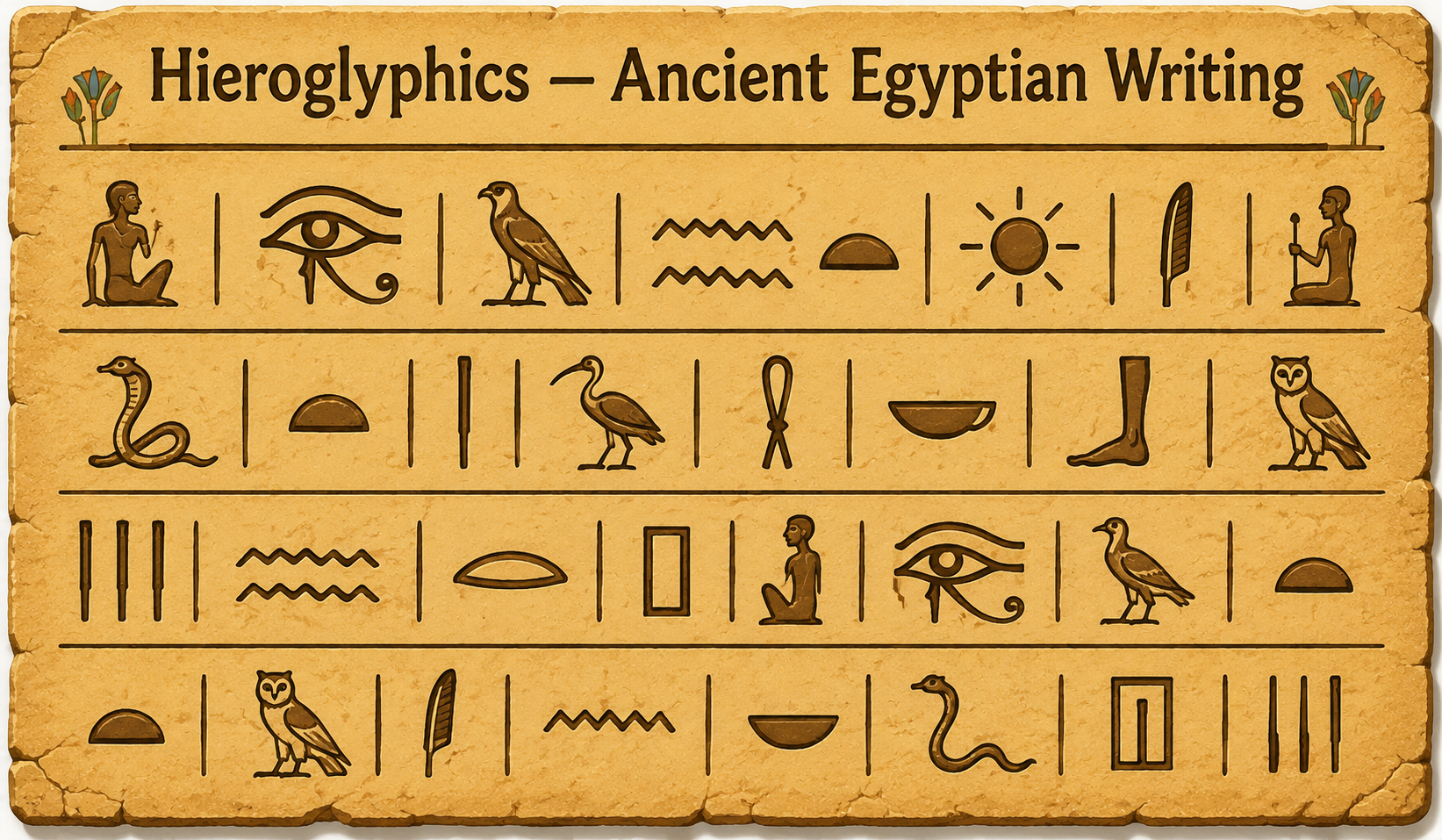
Ancient Egyptians did not write with letters like we do. They used pictures and symbols called hieroglyphics. There were over 700 different symbols!
- Each symbol could stand for a sound, a word, or an idea.
- They wrote on papyrus (a paper-like material made from reeds) and on temple walls.
- Only special people called scribes knew how to read and write hieroglyphics. They trained for many years.
- For a long time, no one could read hieroglyphics. Then in 1799, the Rosetta Stone was found, which helped scientists decode the language.
👑 Daily Life in Ancient Egypt
Life along the Nile was busy and interesting:
| Aspect | Details |
|---|---|
| Food | Bread, beer, fish, onions, garlic, dates, figs. They farmed wheat and barley. |
| Clothing | White linen clothes (Egypt was very hot). Children often wore nothing! |
| Homes | Made of mud bricks dried in the sun. Rich people had big houses with gardens. |
| Jobs | Farmers, builders, scribes, priests, soldiers, potters, weavers. |
| Children | Played with dolls, balls, spinning tops, and board games. Only rich children went to school. |
| Pets | Cats (considered sacred!), dogs, monkeys, and birds. |
| Religion | Worshipped many gods — Ra (sun god), Anubis (god of mummies), Isis (goddess of magic). |
🇮🇳 India and Egypt — Ancient Connection
Both India and Egypt are ancient civilizations that grew along great rivers!
| Feature | Ancient Egypt | Ancient India (Indus Valley) |
|---|---|---|
| River | River Nile | River Indus (Sindhu) |
| Age | About 5,000 years | About 5,000 years |
| Famous cities | Memphis, Thebes | Harappa, Mohenjo-daro |
| Writing | Hieroglyphics | Indus script (still not decoded!) |
| Great buildings | Pyramids, temples | Great Bath, granaries, planned cities |
| Country today | Egypt (Africa) | India/Pakistan (Asia) |
Both civilizations were incredibly advanced — with planned cities, trade routes, art, and writing systems. India and Egypt even traded with each other thousands of years ago!
Key Words
| Word | Meaning |
|---|---|
| Pyramid | A huge stone structure with a square base and triangular sides, used as a tomb for pharaohs |
| Pharaoh | The title given to ancient Egyptian kings (considered living gods) |
| Mummy | A dead body that has been preserved so it does not decay |
| Hieroglyphics | Ancient Egyptian writing using over 700 pictures and symbols |
| Tomb | A place where a dead person is buried |
| Sarcophagus | A decorated stone coffin used for mummies |
| River Nile | The longest river in Africa (6,650 km), flowing through Egypt |
| Sphinx | A giant statue with a lion's body and a human head |
| Canopic jars | Special jars used to store a mummy's organs |
| Papyrus | Paper-like material made from reeds, used for writing |
| Scribe | A person trained to read and write hieroglyphics |
| Natron | A special salt used to dry bodies during mummification |
- Egypt is in north-east Africa. The River Nile (6,650 km) flows through it.
- Pyramids were built as tombs for Pharaohs. The Great Pyramid has 2.3 million stone blocks.
- The Great Sphinx has a lion's body and a human head. It is 73 metres long.
- Mummies are preserved bodies wrapped in linen. The process took about 70 days.
- Egyptians used hieroglyphics (picture writing) with over 700 symbols.
- The Rosetta Stone helped scientists read hieroglyphics again.
- Ancient Egypt and ancient India (Indus Valley) were both about 5,000 years old.
- Cats were sacred in ancient Egypt — hurting one was a serious crime!
Finished learning? Now test what you know!