Clothing
Learning Objectives
- I can say why we wear clothes.
- I can name clothes we wear in different seasons.
- I can name clothes for different occasions.
- I can name some Indian traditional clothes.
Let Us Begin!
What are you wearing today? Clothes are one of our most important needs. We wear clothes every day.
Different people wear different types of clothes. We wear different clothes for different seasons and different occasions.
Let us learn about clothing!
Why Do We Wear Clothes?
We wear clothes for many reasons:
Clothes protect us from heat, cold, rain, and dust. Clothes keep our body clean. Clothes make us look neat and presentable. Clothes show our culture and traditions. Special clothes protect workers — like a doctor's white coat or a firefighter's uniform.
Clothes for Different Seasons
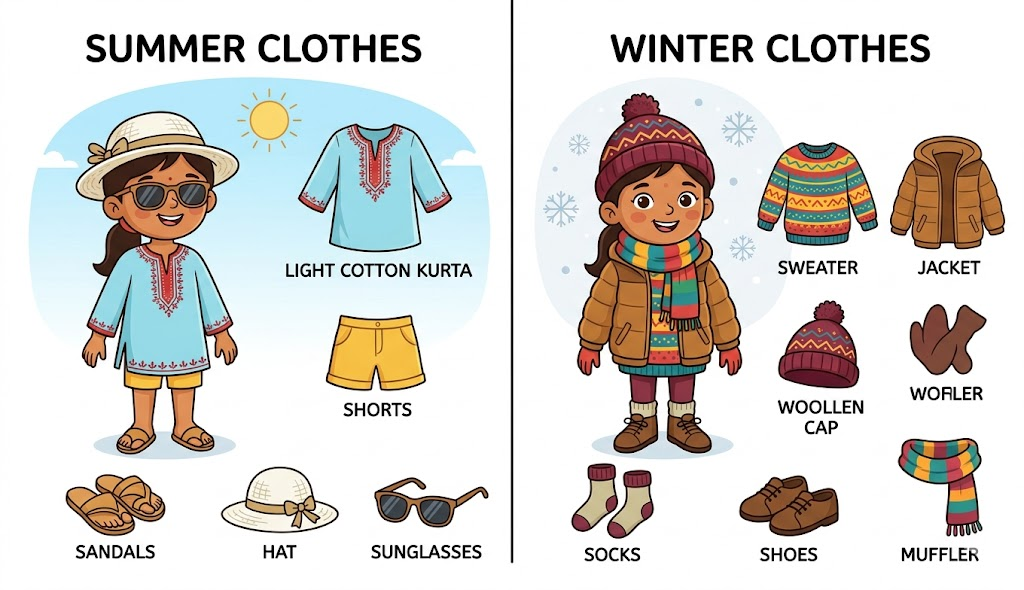
| Season | Clothes We Wear | Why |
|---|---|---|
| Summer | Light cotton clothes, shorts, T-shirts, frocks | Cotton is cool and lets air pass through |
| Rainy season | Raincoat, gumboots, umbrella | To stay dry in the rain |
| Winter | Sweater, jacket, woollen cap, socks, muffler | Wool keeps us warm in cold weather |
Clothes for Different Occasions
School uniform — worn at school. It makes all students look the same.
Festive clothes — worn during festivals like Diwali and Eid. Bright and colourful.
Sports clothes — worn during games and exercise. Comfortable and easy to move in.
Night clothes — worn while sleeping. Soft and comfortable.
Indian Traditional Clothes
| Clothing | Worn By | State / Region |
|---|---|---|
| Saree | Women | All over India |
| Kurta-Pyjama / Dhoti | Men | All over India |
| Salwar Kameez | Women and girls | North India, Punjab |
| Lungi | Men | South India, Bengal |
| Lehenga-Choli | Women and girls | Rajasthan, Gujarat |
Key Words
| Word | Meaning |
|---|---|
| Clothing | Things we wear on our body |
| Cotton | A soft material from plants, good for summer |
| Wool | A warm material from sheep, good for winter |
| Uniform | Special clothes worn for school or work |
| Traditional | Something that has been done for a long time in a culture |
- We wear clothes to protect our body and to look neat.
- In summer, we wear light cotton clothes. In winter, we wear warm woollen clothes.
- In the rainy season, we wear raincoats and use umbrellas.
- We wear different clothes for school, festivals, and sports.
- India has many beautiful traditional clothes like saree, kurta, and salwar kameez.
Finished learning? Now test what you know!